

Just Cook It! Talkin’ turkey
Amanda Steen | Ăĺ±±˝űµŘ
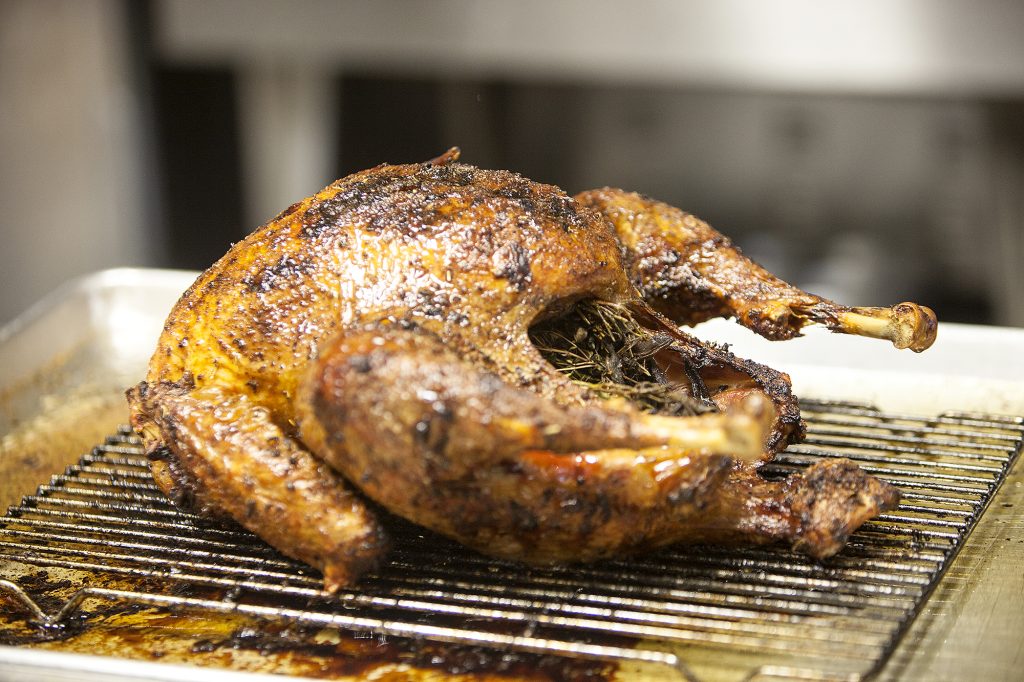
Mario’s Roasted Turkey uses several herbs and a brown butter, but a turkey can be prepared to individual tastes.
Amanda Steen | Ăĺ±±˝űµŘ
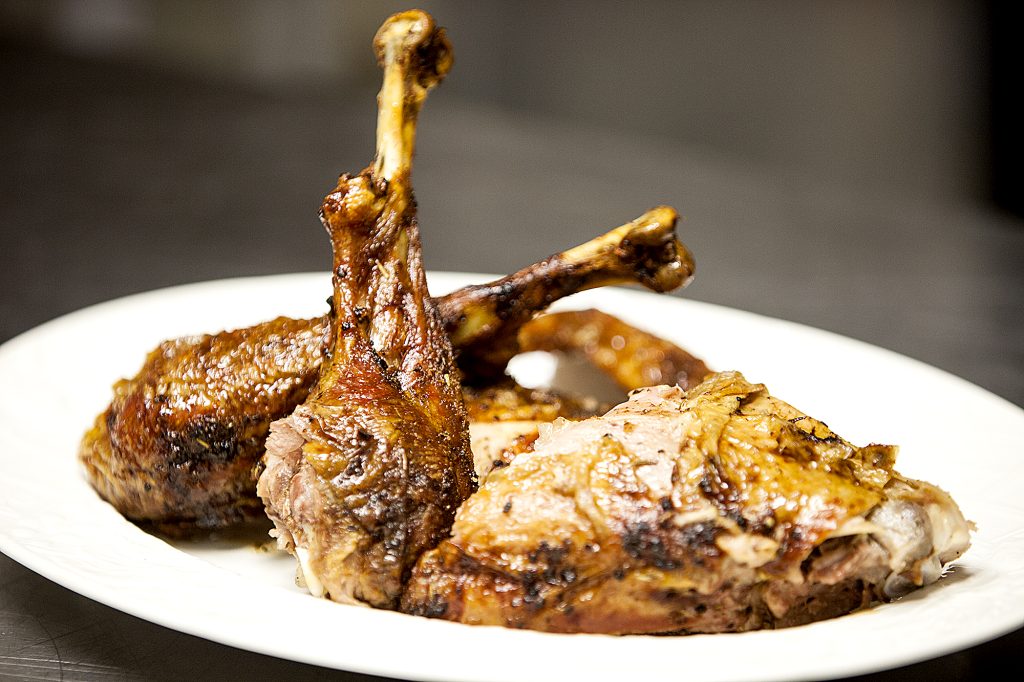
To keep your turkey moist, pull it out of the oven when the thermometer reads 160, instead of 165.
November, to me, is all about Thanksgiving. In November, nothing else matters, and I have been focused on this highly anticipated yearly meal for the entire month. I love everything about Thanksgiving and I love the fact that it’s finally time to talk about the centerpiece of your meal — the turkey.
Turkey is one of those birds that people tend to save for the holidays. It can be purchased from the local supermarket all year long, but people tend to, more often than not, pass it by until Thanksgiving and Christmas.
Since the turkey isn’t something commonly made throughout the year, there can be some questions and confusion when it is time to prepare your bird. Should you buy fresh or frozen? Should you be ultra cool and modern and brine your turkey or not? What should you stuff your turkey with? What do you do with the neck and bag of goodies that come in the cavity? How long does it have to cook so that you’re sure it’s done but not dry and overcooked?
I will answer all of your questions and even give you a hands on tutorial via the video posted at HeraldStandard.com and on my radio show “Just Cook It” this Saturday morning on WMBS 590 AM.
After absorbing all of this information about turkey cookery, you should be able to roast a turkey like a true turkey roasting professional — if there is such a thing.
Let’s start by addressing this question — is there a difference between a fresh turkey and a frozen turkey? The obvious answer is yes, The frozen turkey is frozen solid and the fresh one isn’t. Many people believe that frozen turkeys aren’t as flavorful as fresh turkeys and can also be drier. This may be true if you are using an organic or heritage turkey from a local farm. However, if you buy your turkey at the supermarket, the difference is really negligible.
The USDA allows turkeys that carry the “Fresh” label to be chilled to 26 degrees (water freezes at 32 degrees). Since the temperature is allowed to drop below freezing, ice crystals form on the turkey and cause the meat to act as it would on a fully frozen turkey. At the end of the day, if you are buying your bird at the supermarket, the major difference between a fresh turkey and a frozen turkey is the price.
To brine or not to brine, that is the question. Brining has become more and more popular over the past few years and seems like the “in” thing to do with your turkey. While brining does yield moist and tender meat, there are still some reasons not to brine your turkey. Just in case you’re wondering, I don’t brine mine.
When you brine a turkey, you soak it in a solution of water, salt and other flavoring agents such as fresh herbs. Through the process of osmosis, the water and flavors from the solution make their way into the meat of the turkey. Brined meats gain 10 percent or more of their original weight from soaking in this water and salt solution.
So what’s the problem? The bird is juicy and tender and isn’t that what we want?
Yes and no.
Brining takes a lot of the actual turkey flavor away from the meat. Since the meat absorbs a water and salt solution, it ends up tasting more like water and salt and less like turkey. I don’t know about you, but I eat turkey to actually taste turkey.
Also, I love gravy, and brining makes the pan juices from the roasted turkey too salty to use for gravy making. Gravy is a staple of every Thanksgiving dinner, and if there is a turkey at that dinner, then the gravy should come forth from said turkey. The powdered or jarred stuff just doesn’t cut it on Thanksgiving.
I actually believe in simplicity when it comes to roasting large birds or pieces of meat on the bone. You will get a lot of flavor from the meat itself and from the bones if you are starting with a quality product.
I generally stuff the cavity of my bird with a variety of fresh herbs such as rosemary, sage and thyme.
Next, I rub the skin with extra virgin olive oil and then season it liberally with whatever seasoning I am feeling that day. You can be traditional and simply use sea salt and fresh cracked black pepper or you can use a seasoning blend that you prefer. In the video at HeraldStandard.com, I used my own blend, but you can season your bird with whatever you like.
By the way, the neck and bag of goodies that you remove from the turkey’s cavity can be used to fortify your gravy with extra turkey flavor. Simply roast them in a hot oven (400-450 degrees) until they are golden brown and then add them to your gravy as it cooks. Be sure to strain them out before serving your gravy.
After my turkey is stuffed with herbs and seasoned, I usually place it on a sheet pan fitted with a roasting rack. You can most certainly roast your bird in a roasting pan; however, I prefer the extra exposure the turkey gets by roasting on a flat pan. Since the sides aren’t covered, it allows for more crispy skin — my favorite part.
I roast my turkey at 350 degrees. I rotate the pan and baste my bird with brown butter every 30 minutes.
Please, don’t let a small piece of white plastic ruin your turkey euphoria! I’m talking, of course, about that pesky pop up timer that is commonly jammed into turkeys.
The most important tool in your turkey cooking arsenal is a real probe thermometer. I usually start checking the temperature after about two hours of roasting, depending on the size of the bird. For birds 20 pounds or more, you can start testing after three hours of roasting.
Your turkey is finished cooking when your thermometer is placed into the meatiest part of the thigh and reads 160 degrees. I understand that 165 degrees is the safe temperature, but when you pull your turkey out of the oven and allow it to rest at room temperature before carving, it will continue to cook and the temperature will continue to rise. This is called carry-over cooking, and it happens with every piece of meat you roast. If you pull your turkey out of the oven when your thermometer reads 165 or higher, it will overcook and inevitably become dry.
For carving techniques and other tips, see the video at HeraldStandard.com.
On Thanksgiving, more than ever, Just Cook It!
Mario J. Porreca of Belle Vernon is a food personality, author, and the host of Just Cook It on WMBS Radio 590 AM. He can be reached via his website at: www.JustCookIt.net.