

Local farmers prep for freeze
On Sunday, Leigh Shields wheeled out about 20 green wagons, filling each with tropical plants, hanging baskets and flats of flowers.
Those, along with delicate herbs and other annuals, took up residence in an already-crowded greenhouse to wait out the frost at Shields Herb & Flower Farm in Spraggs.
“We had to carry everything out this morning and tonight, we’ll carry everything back in again,” he said on Monday.
The unpredictability of springtime brought temperatures as low as 28 degrees over the past few days, prompting Shields and other area farmers to take precautions to keep their plants and animals from harm.
At Simmons Farm in Canonsburg, their sweet corn will be covered with clear plastic. They’re also protecting their strawberries by continually covering them in water with an overnight irrigation system, which can protect it against temperatures as low as 20 degrees, said Scott Simmons.
“When ice is created on a surface, it must generate some amount of heat that it’s creating the ice on, and that protects it enough from freezing through to the middle of the bloom,” he said.
A mid-April cold spell isn’t unusual, but having fruits at this stage already is, Simmons said. The farm’s apples and strawberries normally don’t start blooming for another seven to 10 days.
Simmons said he is helped by planting early crops at the top of a hill.
“On a calm, clear night, there’s about an eight-to-10 degree difference between the valley, when the cold air sinks to the valley first, and the top of the hill,” he said.
Monday afternoon, Fred McConn of Harden’s Family Farm in Fredericktown was planning to fill more propane tanks to fuel the small heaters he places in his tunnels to keep plants warm when it dips below 35. He’ll also light ground bales for smoke to keep plants warm.
So far this year, he’s planted 700 tomato plants, and has zucchinis, cucumbers and green beans growing in the tunnels.
“About 10 days ago, that last cold snap, I had heaters in there, and I still lost 400 plants,” he said. “It wasn’t enough.”
For an extra precaution, he plans to cover 12 feet from the end of each tunnel, where the cold typically encroaches about six to eight feet.
The impending freeze is one more marker of a “terrible year,” McConn said, which included losing 1,500 plants when a furnace went out in his greenhouse in February.
The wild temperature swings don’t help plant growth, McConn said. Neither do the arid conditions — which he predicted will get offset by too much rain.
“When we do get it, it comes so hard it just runs off,” he said, “So it’s just fighting everything.”
Animals handle the cold better than basil or strawberries, but still require some care.
Larry Daughtery of Heritage Farms, a livestock farm in McClellandtown, said they will make a deep bed of pine shavings for the piglets, then add straw on top so they can burrow into it.
On cold nights like the one forecast for Monday, the calves get full access to the barns, where round bales of hay are strategically placed inside to entice them to come.
“The more you have, the more body heat’s in there, so we try to keep all the babies inside for the most part whenever the cold weather comes,” he said.
Karis Tressel of The Old Road Farm in Washington was less concerned about Monday night than the 40-degree swing and rains of Saturday night.
The animals do a decent job tolerating cold weather, she said, unless it’s particularly wet, or if the temperature recently plunged. Babies born on warm days have lower tolerance for cold snaps than one born on a single-digit day, she said.
“And we’ve been really lucky this season,” she said. “Weather’s been all over the place, and we haven’t seen any pneumonia, except in one pig.”
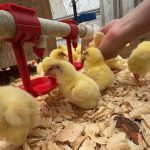
Tressel’s to-do list Monday included things like disconnecting the hoses from the hydrants, making sure the animals’ water is topped off in case of frozen hoses in the morning, and making sure the chicks in the brooder are tucked in tight.
Farmers expected to deal with more curveballs ahead — though what that might look like, they weren’t sure.
Asked how many more days of frost he anticipated, Shields immediately said, “You can’t do that.”
“We could have a killing frost on June 8, and it’s happened before,” he said. “You just face every time that something’s going to happen.”