

New Mars exhibit at Carnegie Science Center looks at the Red Planet

Allegheny County Executive Rich Fitzgerald at the opening of “Mars: The Next Giant Leap” at the Carnegie Science Center. (Photos by Brad Hundt)
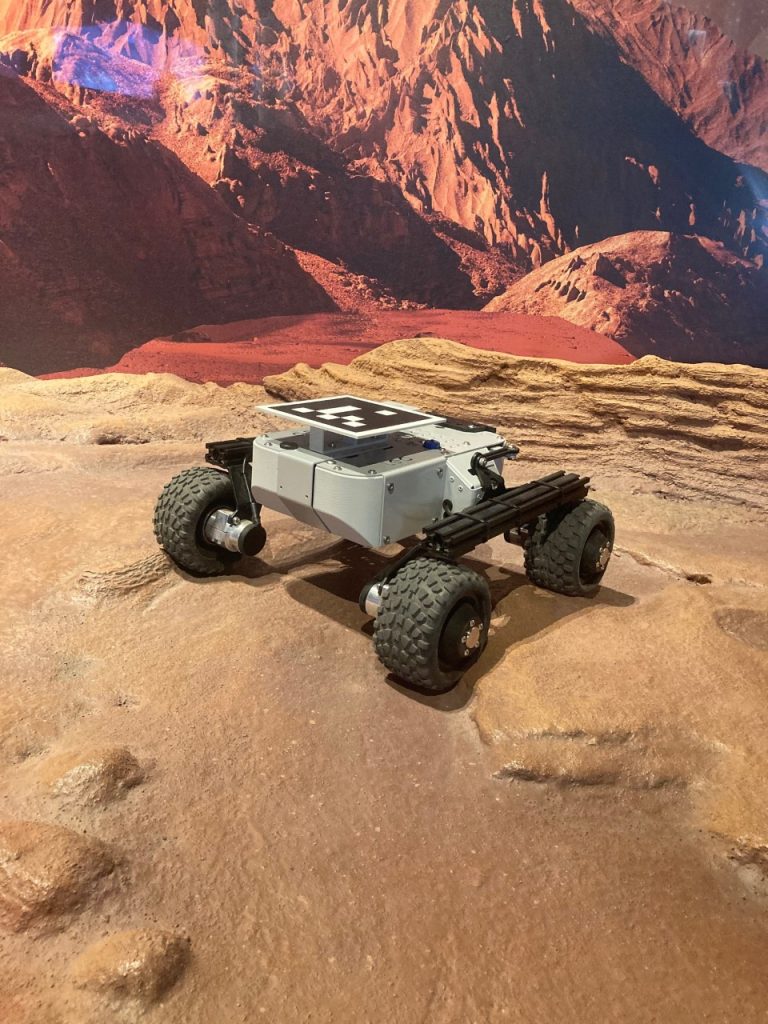
Visitors to “Mars: The Next Giant Leap” will be able to control a rover that travels over a Mars-like landscape.
Brad Hundt
Brad Hundt
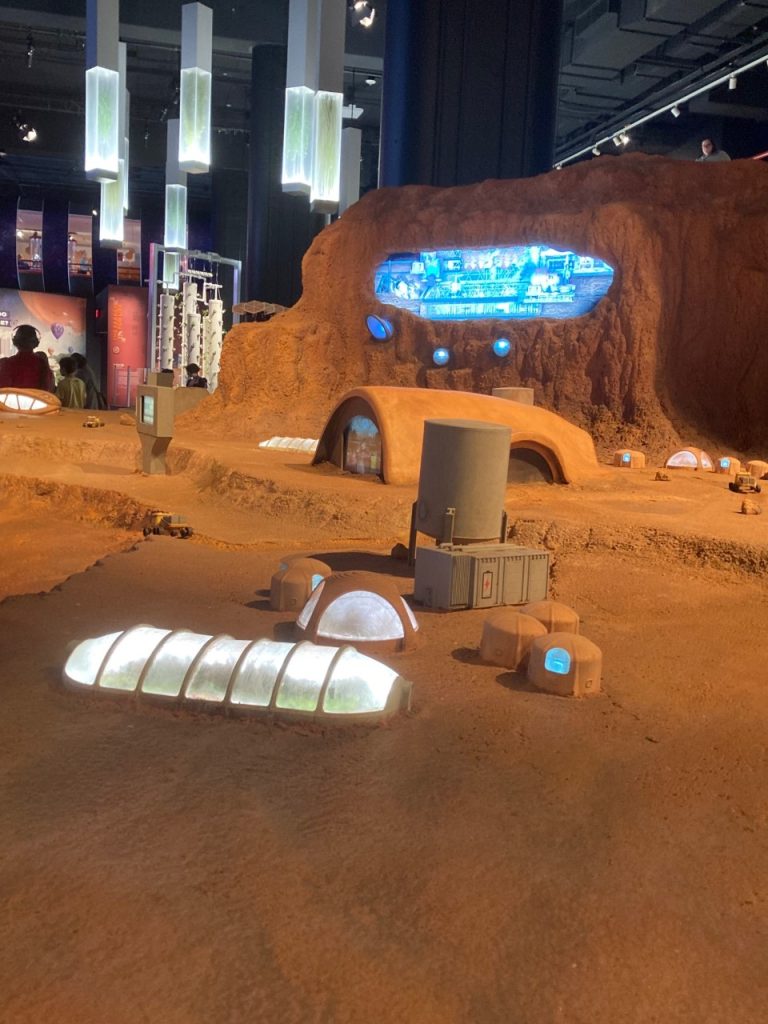
“Mars: The Next Giant Leap” has models of what a colony on the planet might look like.
Brad Hundt
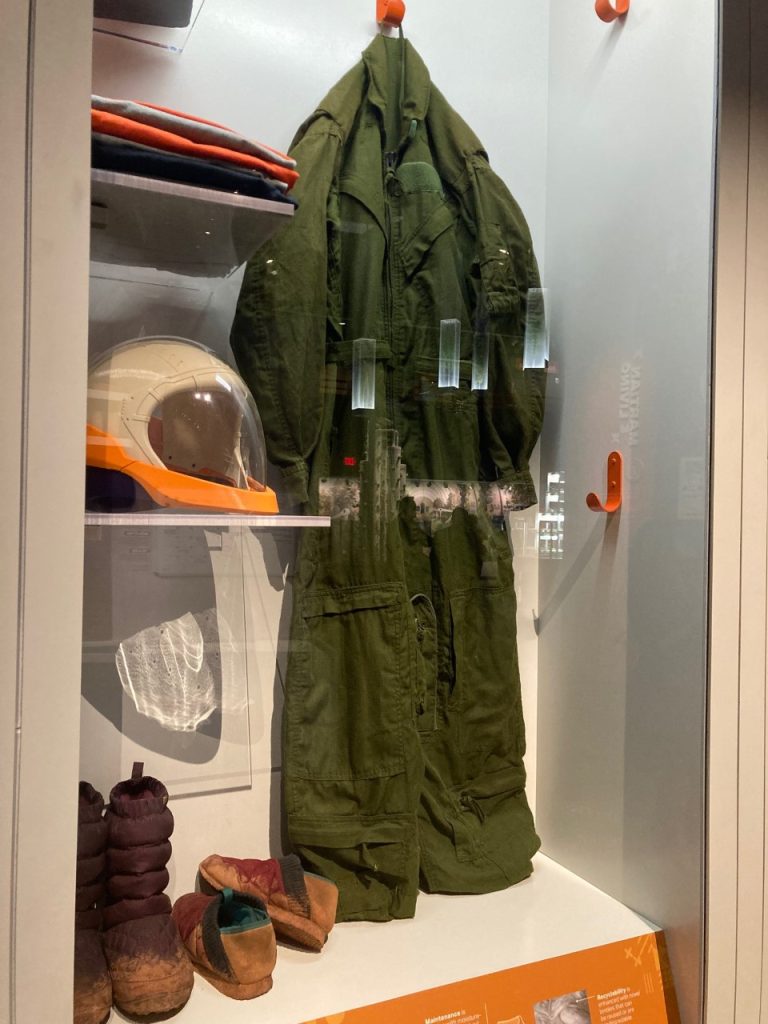
Traveling to and living on Mars would entail wearing special gear, as can be seen in “Mars: The Next Giant Leap” at the Carnegie Science Center.
Brad Hundt
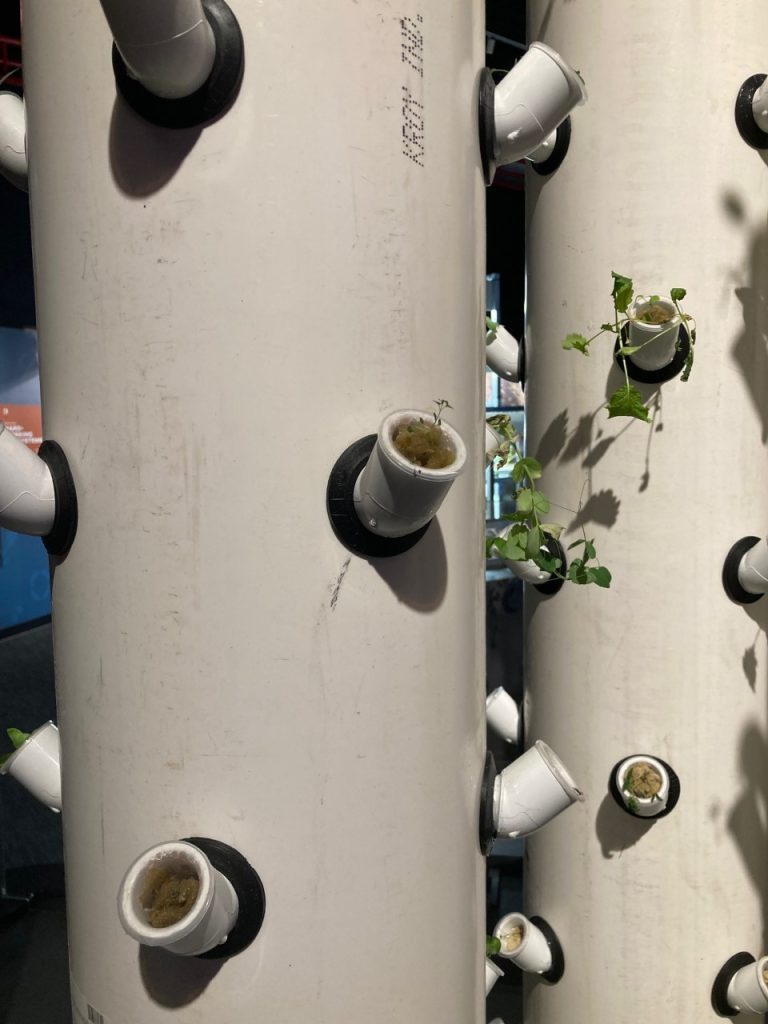
“Mars: The Next Giant Leap” looks at how food and plants might be grown in the inhospitable world of Mars.
PITTSBURGH–The late astronomer Carl Sagan once observed that “through 99% of our time on Earth, we have been wanderers, and the next place to visit is Mars.”
It’s probably inevitable that one day man will attempt to reach the Red Planet that looms in the heavens more than 50 million miles away. It will be an enormous undertaking, and that’s almost certainly an understatement — it will take nine months to get there, and nine months to get back. For that investment of time, a crew would probably want to stay more than a day or two. Setting up a permanent colony would be a colossal endeavor.
Right now, journeying to Mars and settling there is still the stuff of science fiction. But “Mars: The Next Giant Leap,” a new permanent exhibit at the Carnegie Science Center, asks visitors to consider what living on Mars would be like and how it allows us to think in fresh ways about how we live on Earth.
Jason Brown, the Science Center’s director, said visitors “will be challenged to ask questions about what makes a community thrive, how our lives are shaped by our environments, and how exploring Mars will impact life on Earth.” “Mars: The Next Giant Leap” has been installed in the Science Center in a space that had been filled by “roboworld,” a robot exhibit that opened in 2009 and closed over the summer. At a cost of $4.4 million and taking up 7,400 square feet, “Mars: The Next Giant Leap” is one of the most ambitious ventures the Science Center has undertaken.
Rich Fitzgerald, Allegheny County’s executive, said at the exhibit’s opening last week, “Pittsburgh has always been a scientific community. We’ve always been at the forefront.”
At the heart of “Mars: The Next Giant Leap” is the question of how you build a civilization from scratch. And that’s what it would take if man successfully reaches Mars and settles there. The planet may have been able to sustain life millions of years ago, but humans would not last long on Mars if they just tumbled out of spaceships and started strolling around. Mars’ atmosphere has only a minuscule amount of oxygen, there is no water on its surface, the average daytime temperature is a brutally cold 81 degrees below zero, and red dust swirls through the air, frequently in violent storms.
The amount of gravity is one-third that of Earth, sunsets are blue and sunrises are pink, sound moves more slowly and the smell of sulfur fills the air. And, no, Amazon does not deliver there.
So, being a member of a pioneering Mars colony would not be for the faint of heart. The number of people in it would be tiny, so it would be necessary for everyone to get along, flaws and all. You would never be able to venture outside, so you would need virtual reality to switch the scenery with virtual reality technology to keep from going batty. But, of paramount concern would be the need to generate water, grow food, educate children, take care of health and medical needs and establish basic governance and rules to live by.
The exhibit has a “Martian Garden” that explores ways that food could be grown on Mars. It also looks at how climates produce the conditions that cause life to arise or die. Visitors will also be able to control a Martian rover and learn about how companies in Pittsburgh are contributing to space research. Settlers on Mars would not be able to access fossil fuels, so they would need to come up with ways to generate energy. The exhibit foregrounds the idea that thinking about how to inhabit a world as hostile as Mars can make us think about sustainable ways of living on Earth — and extending the life of this planet.
“The next generation won’t even think about going to Mars,” predicted Pittsburgh Mayor Ed Gainey at the exhibit’s opening. “Pittsburgh will be the next city to help us get to Mars.”
More information on “Mars: The Next Giant Leap” is available at carnegiesciencecenter.org/exhibits/mars.