

Talking to kids about climate change
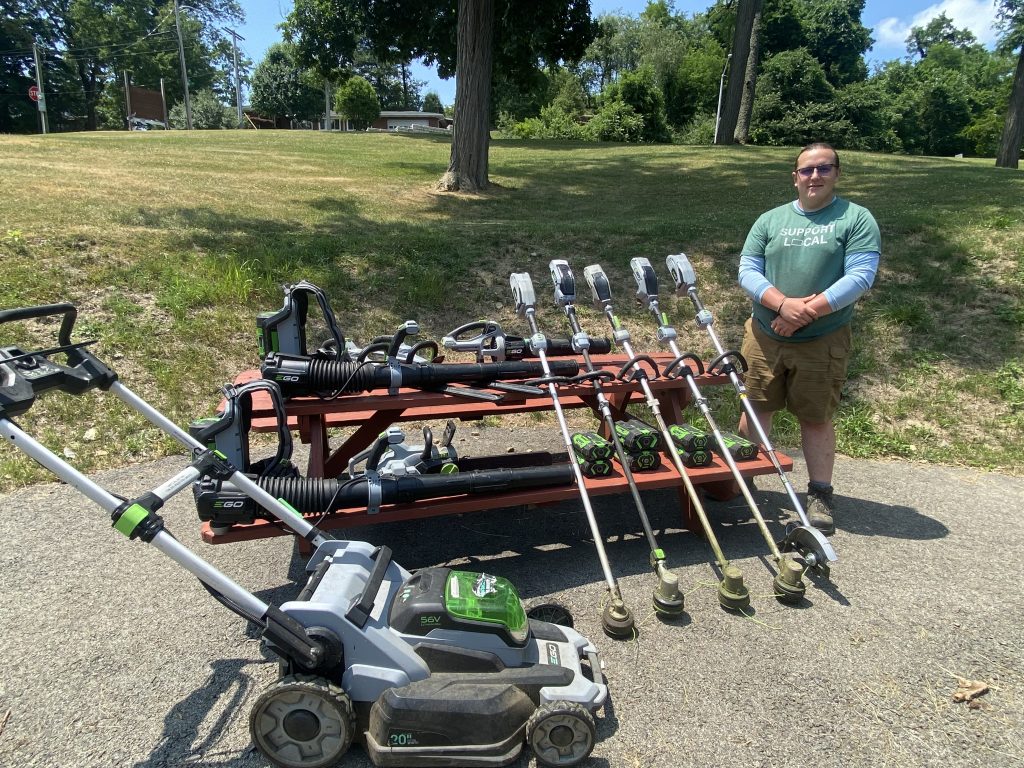
Oliver Kilgore, who runs a landscaping business, uses environmentally friendly electric lawn equipment. (Photo courtesy of Pam Kilgore)
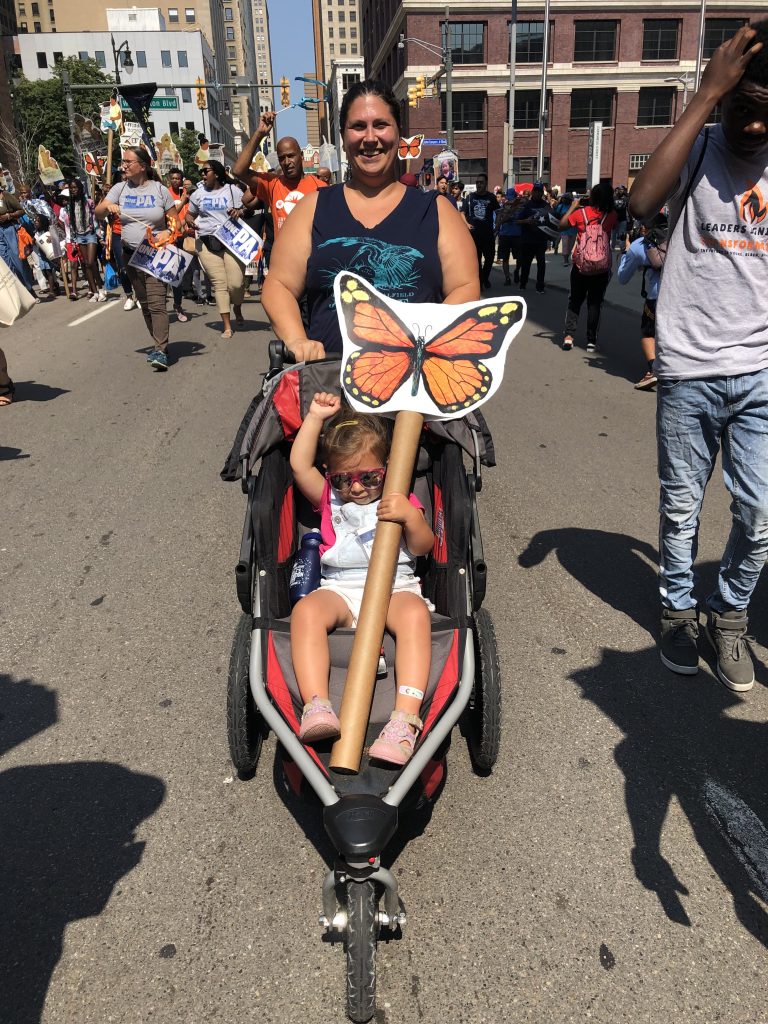
Veronica Coptis, director for Center for Coalfield Justice, was accompanied by her daughter Rory, at a rally in Detroit, Mich., in 2019. (Photo courtesy of Veronica Coptis)
Courtesy of WashPa Outdoors
Courtesy of WashPa Outdoors
Courtesy of WashPa Outdoors
Courtesy of WashPa Outdoors
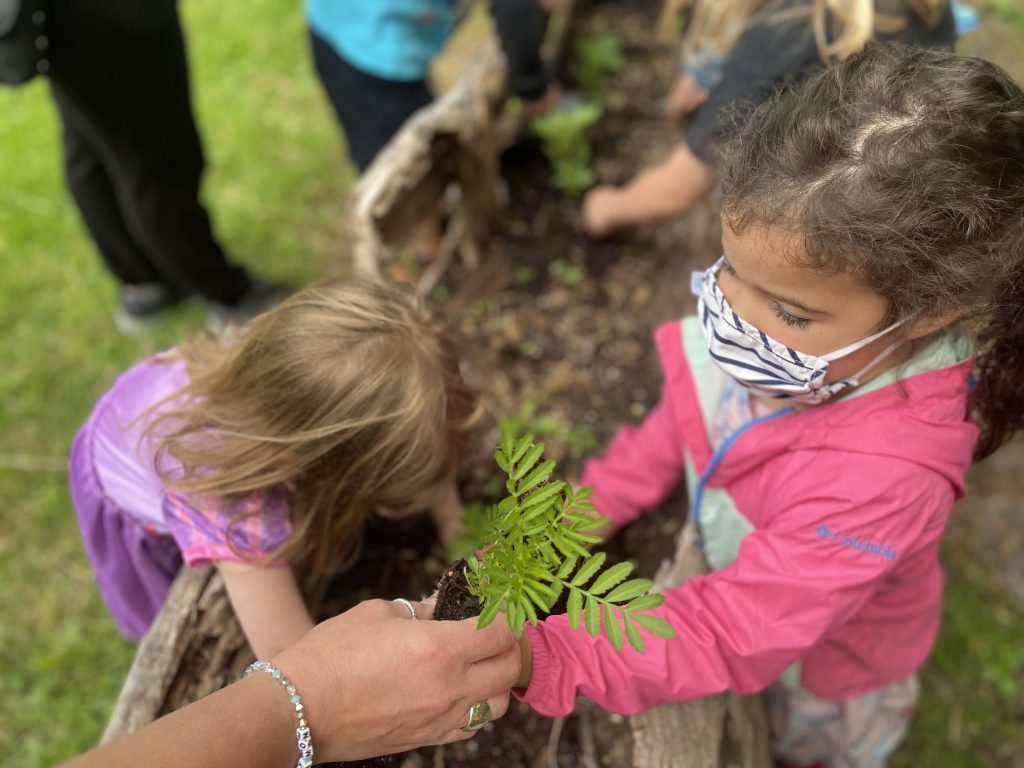
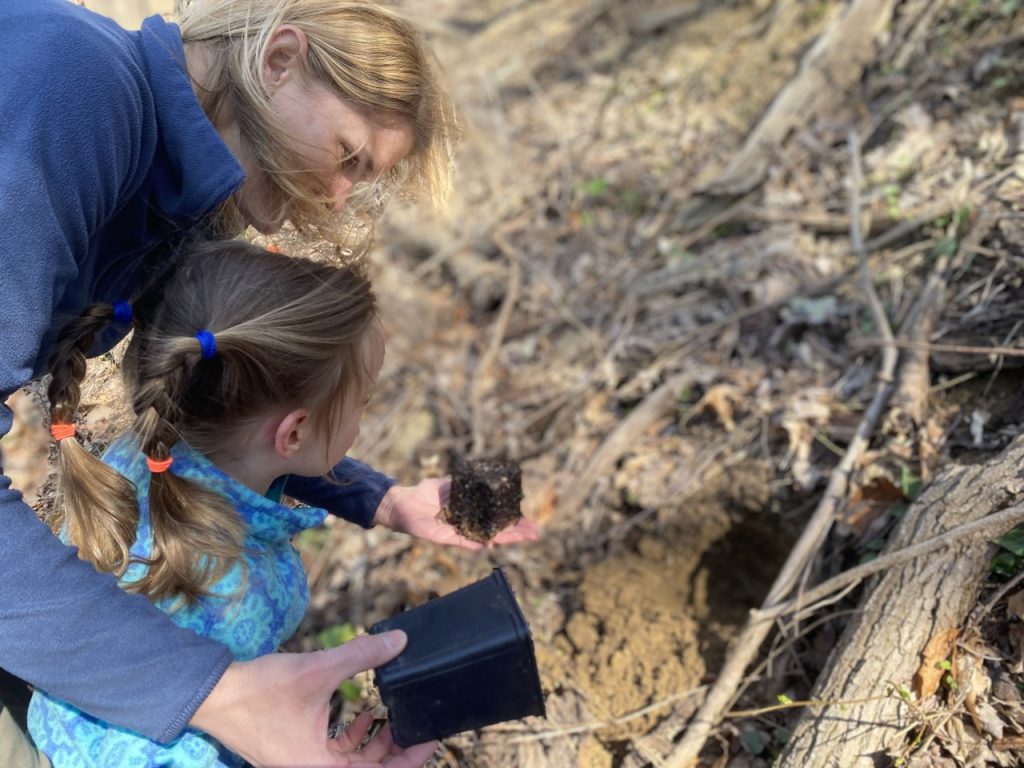
A parent helps a preschooler plant a native dogwood in Washington Park. (Photo courtesy of WashPa Outdoors)
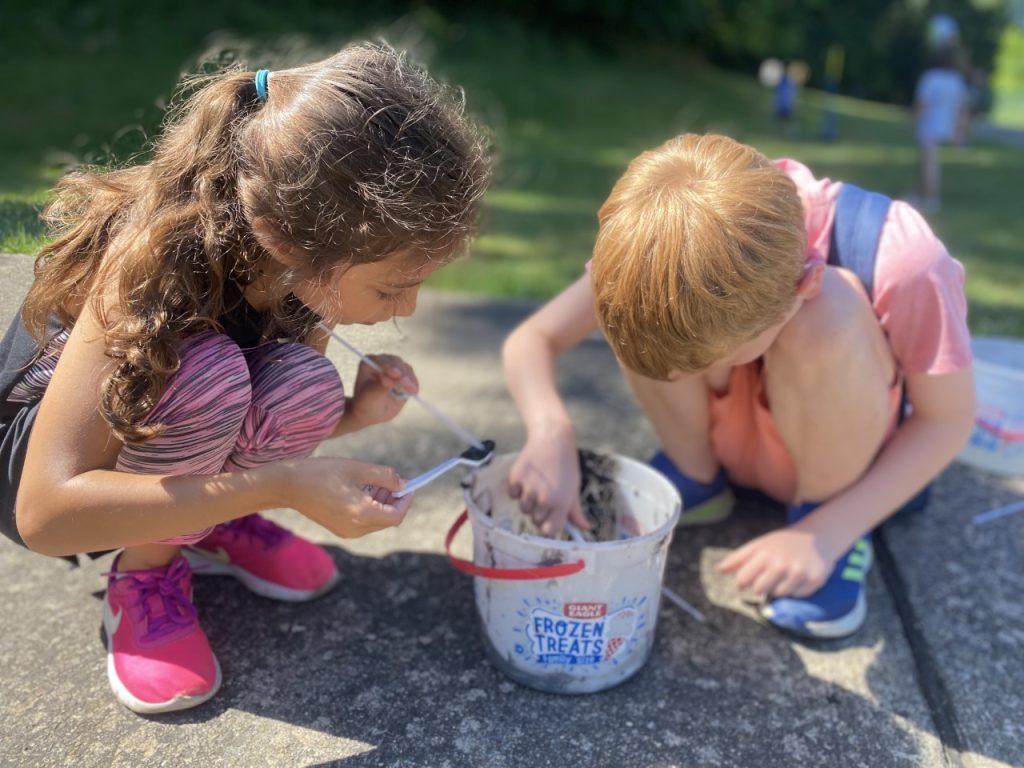
Two Nature Day campers sift through a pond sample looking for macroinvertebrates, indicators of water quality, at a recent camp. (Photo courtesy of WashPa Outdoors)
news@greenecountymessenger.com
As a science teacher, Dave Wray understands the climate crisis.
But when he thinks about the impact of climate change, Wray thinks about his 7- and 4-year-old sons.
“I’m greatly concerned about the world they will inherit,” said Wray a fourth-grade science teacher at Washington Park Elementary School. “On a scale of 1 to 10, (my level of concern) is probably at 7 right now.”
In February, the United Nations’ Intergovernmental Panel on Climate Change released its detailed report on how human activity has caused climate change, and issued a warning that countries aren’t doing enough to avoid 1.5 degrees Celsius of warming. The IPCC cautioned that extreme weather, which is already happening, will have more devastating impacts in the years ahead.
Wray said climate news can feel overwhelming.
But Wray combines his perspective as an educator and a parent to inspire children to make a positive difference however they can.
“I try to focus on what I can do, and what they can do,” said Wray. “I try to always look at the positive possibilities, instead of the negative ones that will keep me up at night.”
In the classroom, for example, Wray started a “bring your own straw to school club,” where students brought in reusable straws. He carries reusable bags and discusses with students how they won’t end up in landfills, like plastic bags do.
Wray said leading by example is important. At their Scenery Hill home, Wray and his family are converting to solar energy for electricity.
“I’ve talked with my 7-year-old and said, ‘Yeah, we’re gonna go ahead bite the bullet and install solar panels,'” and he said, ‘It’s going to be good for the planet, let’s do it,'” said Wray.
Wray tries to make taking care of the planet fun. For example, instead of throwing away crayons, his family recycles them by melting them down and pouring them into molds.
“There are so many opportunities to talk about taking care of the planet, to talk about how we shouldn’t be wasteful, and how we don’t want plastic to end up in the landfill,” he said. “I want to make the culture of our family one where caring about the environment is always in our heads.”
Pam Kilgore of Washington, mother of two teenagers and a naturalist at WashPa Outdoors, offers a variety of environmental workshops and classes for children.
She is alarmed that the number and severity of natural disasters in the U.S. and worldwide – floods, droughts, wildfires, heat waves, tornadoes, hurricanes – is increasing.
“It’s so easy to become overwhelmed and feel helpless, but that’s not going to do anything to solve the problem,” she said.
Instead, she encourages her own children – Oliver, 19, and Maya, 15 – and children who attend her programs to focus on things they can control.
There are individual actions everyone can take, she said.
“You control how many times you drive your car each week versus how many times you ride your bike or walk. Empowering kids to have that kind of autonomy is going to give them more of a sense of hope and control,” said Kilgore.
Kilgore’s son, Oliver, has a lawn cutting business and is converting to electric mowers and equipment.
Her daughter rides her bike to pet-sitting jobs and other odd jobs.
“We made a decision to live in town so we can walk to destinations. We’ve always focused on living local, buying local, composting, whatever we can do to reduce our footprint,” said Kilgore.
Kids are smart and perceptive, and they know something’s happening to the planet, Kilgore said.
It’s important to reassure children and educate them about what’s happening.
“I think being honest and letting your kids drive the conversation is important. Don’t overshare doom and gloom facts. Give them a sense there are things they and their family can do to address those issues at home; when they’re ready to deal with it on a larger scale, look into resources for larger changes,” said Kilgore,
She noted there are opportunities for older children to get involved in advocacy, through groups such as Fridays for Future, a youth-led and organized movement started by Greta Thunberg.
Kilgore has scheduled Land Art Generator Initiative to talk with campers at WashPA Outdoors’ Nature Day Camp in Washington Park about renewable sources. LAGI is an international effort by two Pittsburgh residents to crowdsource creative solutions and designs to address climate change with renewable energy solutions.
“People are doing things to address climate change in their communities, and it helps me to feel a little more optimistic,” said Kilgore. “But, the clock is running, and we have to start adapting and making more conscious choices with how we buy things, how we consume things.”
Veronica Coptis, director of Center For Coalfield Justice, is the mother of two girls, Rory, 5, and Regan, 2.
Coptis grew up near the Bailey Mine Complex in Greene County, and earned a biology degree at West Virginia University.
Rory attended her first environmental rally with her mother when she was 6 months old.
Coptis notes the worsening climate crisis is being driven by planet-warming greenhouse gas emissions. But instead of winding down fossil fuel production to help limit warming to 1.5 degrees Celsius as required by the 2015 Paris Agreement, governments continue to produce coal, oil, and gas greatly in excess of the levels called for in the Paris Agreement’s temperature limits.
Additionally, the Supreme Court recently limited the Environmental Protection Agency’s ability to regulate carbon emissions from power plants, making it much tougher to cut U.S. greenhouse gas emissions in half by the end of the decade and to meet the goals of the Paris Agreement for a livable planet.
“Our government is protecting the profits of fossil fuel companies over the safety of people,” said Coptis. “I am deeply concerned about what type of livable climate we’ll be leaving my kids and their kids,” said Coptis. “But I know I’m going to fight like hell to make it as livable as possible.”
Despite the enormous consequences the world faces due to climate change – among them, water shortages and food insecurity, reduced air quality, species extinction – Wray remains hopeful.
“I think that, in the end, science will save the day,” said Wray. “In my heart, I believe that.”