

Bridging the gap: Forum connects schools with businesses to fill jobs
Karen Mansfield
Karen Mansfield
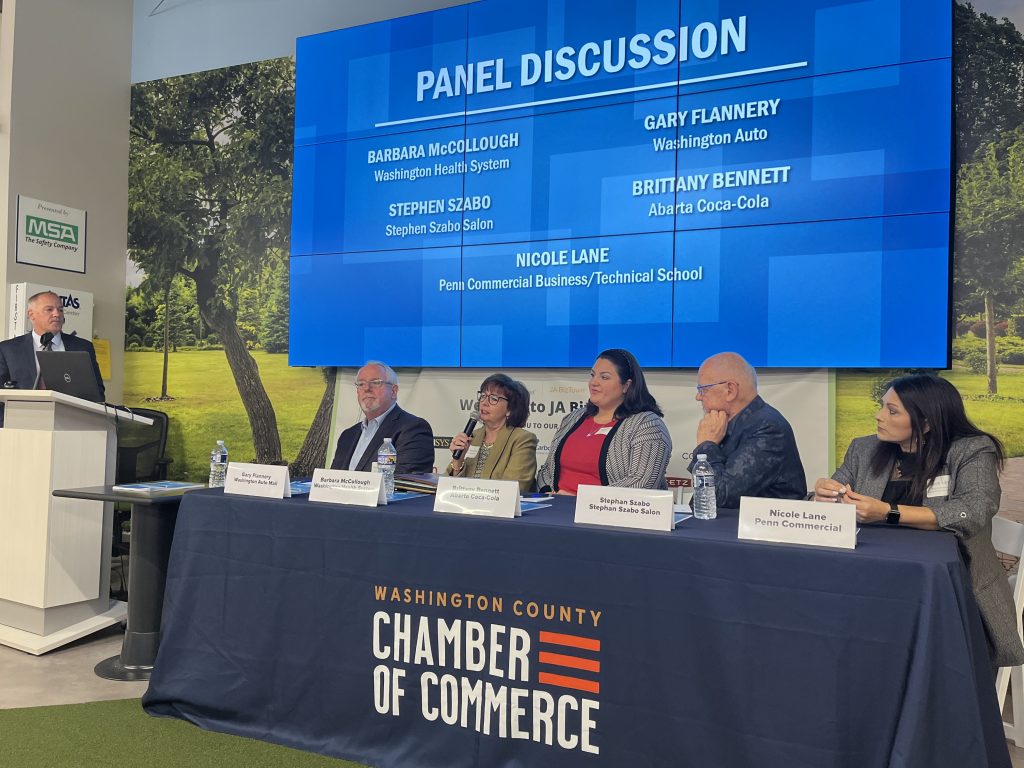
Aaron Shenck, executive director of Mid-Atlantic Association of Career Schools, left, participated in the SWPA Skills Gap Forum on Tuesday, which included local business leaders, from left, Gary Flannery of Washington Auto Mall; Barbara McCullough of Washington Health System; Brittany Bennett of ABARTA Coca-Cola; Stephan Szabo of Stephan Szabo Salon; and Nicole Lane of Penn Commercial.
Karen Mansfield
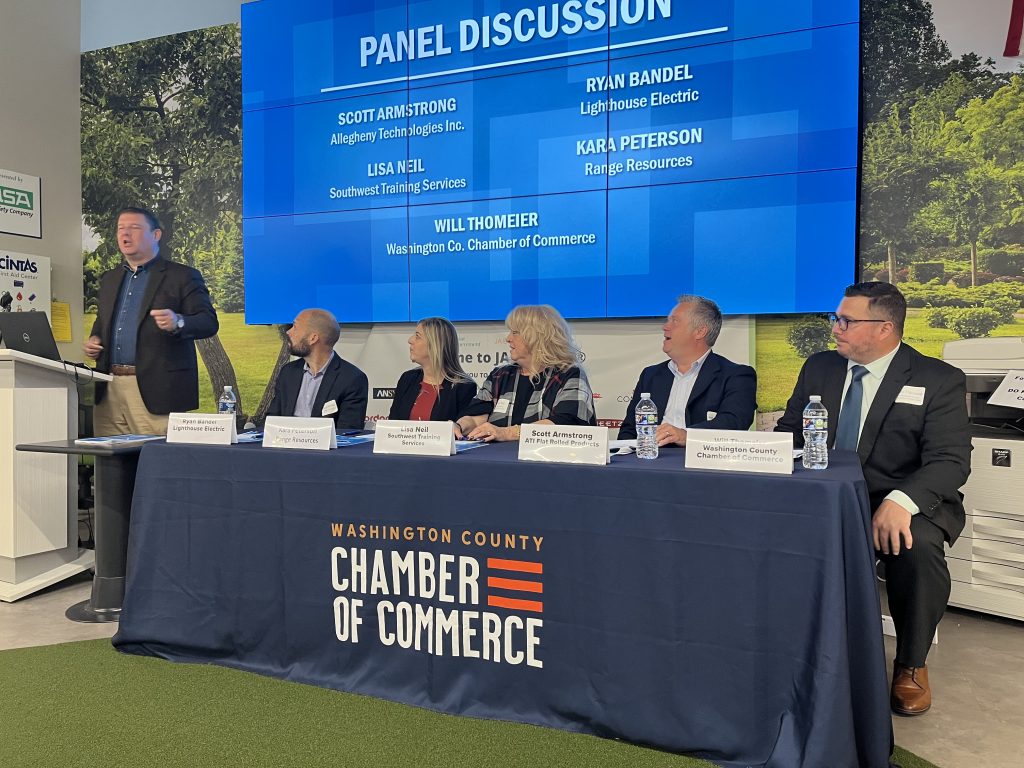
Jeff Kotula, president of the Washington County Chamber of Commerce, left, moderated the SWPA Skills Gap Forum Tuesday in Bridgeville. Seated from left are panelists Ryan Bandel of Lighthouse Electric, Kara Peterson of Range Resources, Lisa Neil of Southwest Training Services, Scott Armstrong of Allegheny Technologies Inc., and Will Thomeier of the Chamber of Commerce.
news@greenecountymessenger.com
Much like companies across all sectors in the United States, local businesses are struggling to find skilled, non-college workers to fill jobs.
“We have 170 employees, and we are at this time 22 people short. We could add 22 positions right now,” said Gary Flannery, general manager of Washington Auto Mall.
Flannery was one of about a dozen local business leaders who served as panelists at the Southwestern Pennsylvania Skills Gap Forum, held at BizTown at the Junior Achievement of Southwestern Pennsylvania headquarters in Bridgeville.
The forum’s objective was to connect superintendents from regional school districts with local business leaders to explore the widening gap between Southwestern Pennsylvania employers and skilled workers, and how schools, businesses and public organizations can partner to attract and train high school students – the next generation of workers.
During the event, business leaders shared the challenges their companies are facing as the work shortage become more acute for blue-collar workers.
The forum was a collaboration between the Washington County Chamber of Commerce, Junior Achievement, Penn Commercial Business and Technical School, Southwest Training Services Inc., and Washington Greene County Job Training Agency Inc.
Amy Gatts, director of Southwest Corner Workforce Development Board, told attendees that many of the region’s most in-demand occupations are skilled positions, but the pool of workers is not filling those needs because of, among other things, skilled workers aging out of the workforce.
“We have a ‘silver tsunami,’ as we speak. People are leaving the workforce and there’s not enough people coming in,” said Gatts, who stressed the importance of connecting high schools with local employers.
Allegheny Technologies Inc. (ATI) in Washington, which has more than 70 job openings, has felt the impact.
“It’s a real challenge right now,” said Scott Armstrong. “The number of people retiring over the last five to 10 years is big.”
Nicole Lane, campus director at Penn Commercial in Washington County, which offers 13 programs in trades and technical careers, said the school is regularly contacted by employers seeking candidates for positions in fields ranging from HVAC and welding to phlebotomy and cosmetology, but there aren’t enough workers to fill the demand.
“We have companies contacting us all the time to recruit, but we don’t have enough students to place because they’re all placed. We have a 100% placement rate for HVAC program for the next two years. HVAC companies are calling us for graduates; we don’t have anybody to send them,” said Lane. “For electricians right now, it’s booming.”
Students in the 12-week phlebotomy program are being hired as soon as they take their certification exam, Lane said. Graduates of the six-week CDL training program, too, are immediately stepping into jobs and employers are paying bonuses that cover the cost of the program.
Two factors contributing to the dearth of skilled workers, superintendents and employers say, are the perception that jobs in the trades are inferior to those that require a college degree – what Mike Rowe, host of the show, “Somebody’s Gotta Do It,” calls “some kind of vocational consolation prize” – and high school students aren’t aware of the skilled trades careers available.
Said Jeff Kotula, president of the Washington County Chamber of Commerce, “There is a perception that if you’re smart you go to college and if you’re not you go to some vocational school, and that’s incorrect. That’s the perception that we have to start changing, both as educators and as business leaders.”
Part of the message employers wanted to convey is that these aren’t the low-paying, “get-your-hands-dirty” blue collar jobs blue-collar jobs as in years past.
“One thing about technicians that’s changed tremendously is the old image of a grease monkey. That’s gone,” said Flannery, noting that auto technicians need to stay on top of their skills as technology advances.
He noted several of the company’s technicians earn six-figure salaries.
“(Technicians) make plenty of money to be able to raise a family; they can live comfortably and enjoy a good life,” Flannery said.
Erikka Storch, executive director of Project BEST, a construction industry labor-management organization, said it’s important “to change the narrative” and to encourage high school students to explore trades.
While the “American dream” long has been viewed as graduating from a four-year college, the trades are increasingly becoming an option as the cost of a college education continues to far outpace incomes for workers with bachelor’s degrees.
Over the past 25 years, for example, the cost of tuition at Penn State University has increased 250%, while the median income of a college graduate has increased 47%, as college student loan debt has surpassed $1.75 billion, according to Forbes.
Fred Morecraft, superintendent of Carmichaels Area School District in Greene County, said school districts are working to create more career pathways for students.
“I thinks schools are getting better at that. One of the things we’re pushing is that not every kid goes to college, and that’s OK,” said Morecraft.
Increasingly, companies facing skilled worker shortages are training their own new labor pools.
ABARTA Coca-Cola Beverages, which employs 350 workers at its Houston location, has had difficulty filling CDLA driver positions, so it pays for CDLA training for employees – part of the “earn-and-learn” apprenticeship model adopted by a growing number companies.
“Over the past few years, we’ve seen skills gaps coming into play in a lot of positions,” said Brittany Bennett, Human Resources director at ABARTA, noting how computerized beverage machines have become.
As part of the earn-and-learn philosophy, high school graduates who are hired at ABARTA can earn $18 an hour and train for higher-paying positions.
“We love the (Coca-Cola) brand, and we’d love to grow Coca-Cola for generations to come. We definitely know the high school students who are currently waiting for jobs are the perfect pipeline for us to be able to do that,” Bennett told superintendents. “We have a lot of opportunities … and we absolutely want to be able to work with you to find spots for individuals.”
It has been a challenge, too, for Washington Health System, to hire and retain staff because of a shortage of qualified candidates in the area.
The health system, which employs about 2,000 workers, has about 260 open positions.
That’s “unheard of” for Washington Health System, said Barbara McCullough, vice president of human resources at WHS, where at one time employees accepted part-time positions while waiting for a full-time position to open.
“Our difficulty in filling positions runs the gamut,” said McCullough. “There is no doubt in health care I can find a job for every student you have, and make them feel successful and productive.”
She said most entry-level positions pay more than $16 an hour, and offer overtime, shift differentials and an excellent benefit package.
The hospital has developed “earn-to-learn” phlebotomy-in-training and medical assistant-in-training programs, and offers 100% tuition coverage for employees to attend WHS School of Nursing.
“I will pay 100% for people to go to nursing school and they will come out earning $30 an hour, plus shift differential, plus overtime, and not have a single student loan. Which one of you wouldn’t take that deal?” asked McCullough, earning appreciative laughs from the audience. “I have lots of deals like that. I’m ready to make a deal.”