

Your license plate frame is enough for police in Pa. to pull you over, court rules
Spotlight PA is an independent, nonpartisan newsroom powered by The Philadelphia Inquirer in partnership with PennLive/The Patriot-News, TribLIVE/Pittsburgh Tribune-Review, and WITF Public Media. Sign up for our free newsletters.
Spotlight PA
HARRISBURG – Thousands of drivers in Pennsylvania could now be at greater risk of getting pulled over by police – all because of the frame around their license plate.
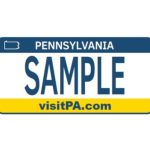
A state appellate court ruling this week affirmed the right of police officers to stop drivers if any part of their license plate is obscured. That doesn’t just include the unique combination of letters and numbers that make up a person’s license plate – but any lettering — including the visitpa.com URL – or, for that matter, the paint around it.
Critics argue the decision, by a three-judge Superior Court panel, raises concerns about racial bias and other potential abuses of power by law enforcement, and could give police another pretext to pull over a driver for a seemingly trivial reason, among other wide-reaching and unintended consequences.
“At a point in time when we want to do away with pretextual stops, this decision specifically opens the door to every person being stopped at the will of police for investigation,” said Philadelphia lawyer S. Philip Steinberg, who argued against the court’s decision in the case.
A spokesperson for Philadelphia District Attorney Larry Krasner’s office, which appealed the case to the state Superior Court, called that assessment “unfair.”
The ruling, said Krasner spokesperson Dustin Slaughter, “simply confirms current case law,” and does not enable officers to employ new or different tactics when conducting traffic stops. But the ruling itself states that the decision answers a novel question before the court.
At the heart of the decision is how to interpret the language in a section of Pennsylvania’s vehicle code that prohibits license plates from being obscured.
The code states that it’s unlawful to display a license plate that is so dirty that its numbers and letters are illegible from a reasonable distance; or is obscured in such a way that a red light camera or toll collection system can’t read it; or “is otherwise illegible at a reasonable distance or is obscured in any manner.”
In their ruling, the three judges seized on the phrase “or is obscured in any manner,” which they said was a catchall phrase meant to prohibit all obstructions of any part of the plate. If the legislature only wanted to prohibit just obstructions to the license plate number and issuing authority, it would have specifically done so, the panel said.
“While we appreciate Appellee’s position that § 1332 [of the vehicle code] should be limited to the elements of a registration plate that are actually pertinent to the identification of a vehicle’s registration, that interpretation does not comport with a plain reading of the statute,” Judge Mary Jane Bowes wrote.
The ruling stems from a case involving an April 2021 traffic stop in Philadelphia during which a police officer pulled over a car because of a partially obstructed plate. What was obstructed: the strip at the bottom of the plate that lists the website of the state’s official tourism office, visitpa.com, which standard-issue license plates in Pennsylvania include.
During the stop, according to court documents, the officer noticed that the front seat passenger, Derrick Ruffin, was making “furtive movements,” as if to hide something, and conducted a “protective sweep” of the passenger seat. There he found a loaded revolver (which Ruffin was not licensed to carry), ammunition, and marijuana. The officer also found that the car was not registered, and that the driver did not have a license.
Ruffin was charged with several crimes, including carrying an unlicensed firearm.
But at a pretrial hearing last summer, a lower court suppressed the evidence the officer recovered. In its opinion, the court found that the Philadelphia police officer lacked probable cause to make the stop because the state’s vehicle code only prohibits the obstruction of a license plate number and the plate’s issuing authority. The state’s tourism website, it found, did not count toward such a violation.
The Superior Court’s three-judge panel disagreed.
Steinberg, the Philadelphia lawyer who represented Ruffin, said a quick check of any Pennsylvania parking lot will show that most vehicles have frames around the plate – some of them are placed there by dealerships when a car is bought. His own car, he said, has a frame that obscures the outer edges of his license plate.
The court’s decision, he said, affirms that many Pennsylvanians are technically breaking the law and could be pulled over at any time.
“How is that enforced — and against who is it enforced?” said Steinberg, a partner at Schatz, Steinberg & Klayman. “I don’t think the Superior Court had ill intent in this decision but … this really opens up the Pandora’s box.”
Younger drivers, drivers of color, and drivers with older cars could find themselves in the crosshairs of more targeted stops, he said.
Andy Hoover, director of communications for ACLU Pennsylvania, said the decision was “another flimsy excuse for police to pull people over, and we’ve seen repeatedly how routine traffic stops can escalate into tragic outcomes, especially for Black and brown people.”
If you learned something from this story, pay it forward and become a member of Spotlight PA so someone else can in the future at spotlightpa.org/donate.