

Pennsylvania ranks third in states with most banned books
news@greenecountymessenger.com
Pennsylvania ranks third in the nation behind Texas and Florida in number of book titles banned in state school districts, according to a report recently published by the free speech organization PEN America.
“Book bans are an old thing. The momentum that is driving this is new,” said Jonathan Friedman, director of free expression and education at PEN America and lead author of the report “Banned in the USA: The Growing Movement to Censor Books in Schools.”
Book bans are defined by PEN America as action taken against a title by parents, community groups or administration based on the book’s content. PEN America also considers a district’s decision to pull a book based on direct or threatened action from lawmakers a “ban.”
“In Pennridge (School District in Bucks County), they moved … ‘Heather Has Two Mommies’ … to the guidance offices and counseling offices. We count that also as a book ban, because rather than the book being accessible to students in the library, it is being banished to the guidance centers,” Friedman said.
Between July 2021 and June 2022, 2,532 books were banned by 138 districts in 32 states, including 11 Pennsylvania school districts, according to the report. A total of 1,648 individual titles were pulled from districts, impacting the work of 1,553 authors, illustrators and translators.
A majority of the books banned in Pennsylvania were in Central York School District in York County.
“In Pennsylvania, we have seen a few districts get really deep into this issue. One of the places that started a lot of this energy was Central York,” said Friedman. “The list of books that needed to be banned (was) essentially a list to encourage inclusivity and diversity. … They included a Sesame Street special on racism, and whole book series. (One book) about a black protagonist.”
Last week, Jefferson-Morgan High School students spent time educating their peers on titles that have throughout history been labeled problematic.
“Our student council has put a couple bulletin boards up around the school just to bring awareness to Banned Books Week,” said Michael Hildreth, district assistant principal. “If history tells us anything, if we go back to Mark Twain, Huckleberry Finn, sometimes when we start censoring what our students see, we’re really hindering their education. Our teachers do a really good job of explaining those concepts in those books in a way our community feels really empowers our kids.”
The majority of banned books listed in PEN America’s report center on the Black and LGBTQ+ experience, including the popular “Who Was?” series by Pam Pollack and Caldecott Honor book “A Big Mooncake for Little Star.”
“Gender Queer: A Memoir” by Maia Kobabe leads the charge, with 41 districts nationwide banning the title. Books adapted to the screen, including the novel series-turned-Netflix hit “Thirteen Reasons Why,” have found themselves ousted from schools across the country. Trinity High School graduate Anastasia Higginbotham’s White Raven Book Award-winning “Not My Idea: A Book About Whiteness” stands alongside other acclaimed banned books, including Nobel Prize-winner Toni Morrison’s “The Bluest Eye” and George M. Johnson’s “All Boys Aren’t Blue.”
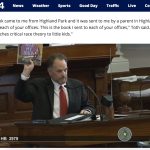
Last year, “Not My Idea” was used as an example on the Texas Senate floor as legislatures discussed House Bill 3979, regarding social studies curriculum.
“They were using my book to shut other people out. That’s exactly the opposite of what I was trying to do,” said Higginbotham, whose book is an invitation to white children and adults to join in the legacy of fighting for social justice.
The publicity, while national, was not the boost in book sales many outsiders think, said the author.
“There is such a thing as bad publicity. Sales are down. People do steer clear of it. People are afraid of losing their funding, losing their jobs. Librarians, teachers, they do shy away from it. They’re afraid of drawing the attention of Proud Boys, of Moms For Liberty,” Higginbotham said. “People will say specifically that my book ‘Not My Idea’ makes white kids feel bad about being white. My response to that is, are you also concerned about Black and Brown kids feeling bad about being black and brown? It’s not irony, it’s tragedy. It’s overt racism … and hatred of LGBTQ people and Muslims and Jews and it’s so overt.”
Higginbotham, who writes for kids on death, sex and other serious topics, said removing books – particularly those that explore Black, Brown and minority experiences – sends a devastating message to the nation’s youth.
“It’s detrimental because they’re not just looking to read a book; they’re looking to see themselves in the pages of the books. They want to see themselves, they want to see their families, they want to see their struggles, they want to see their joys. When we ban them from the books, we ban them from themselves,” said Higginbotham. “It’s also letting them know that we don’t trust them. If we just snatch things out of their hands before they even have a chance to reach for it, or be curious about it, we are letting them know, I don’t trust you. You don’t have good judgement. You have to be protected from what the world is.”
As a mother, Higginbotham understands the desire to shield children from the dangers of this world. She said she has compassion for those parents and organizations advocating to ban books.
“There are things out there that I don’t want my kids to internalize. There are things that I want to protect them from – mortal danger – but not ideas, not identities, not people’s experiences,” she said. “I don’t ban those things from my kids’ lives. I let them know … what bothers me about the thing, and then I trust them to sort through it.”