

Setting snakes straight
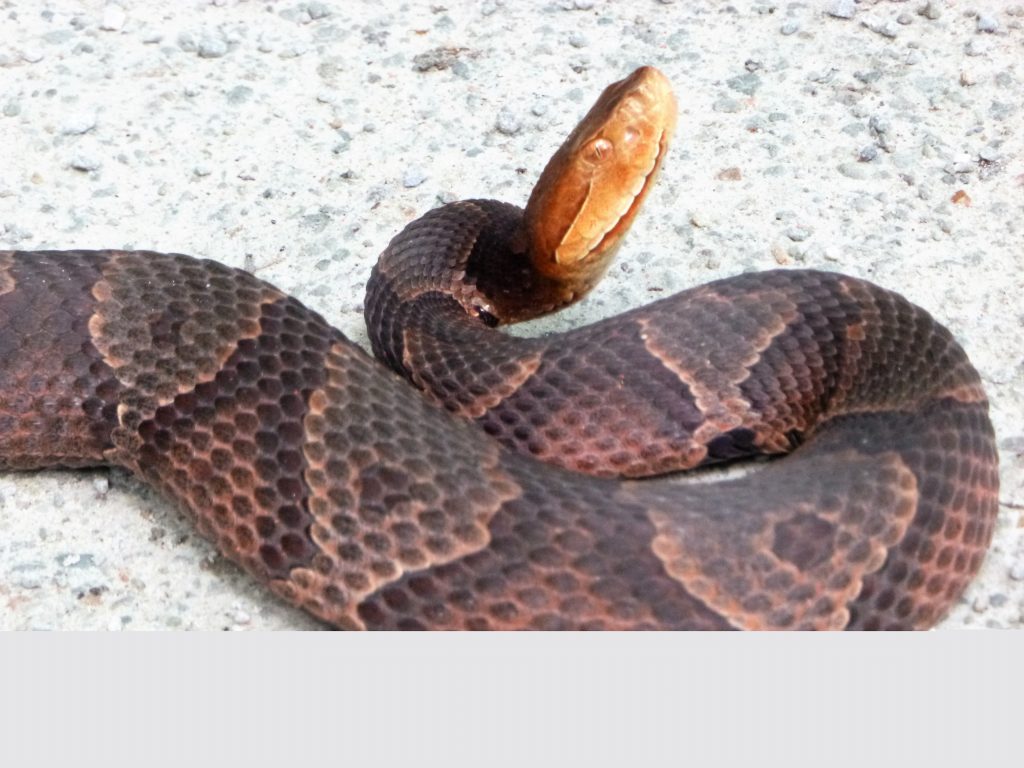
“Hourglass” shaped dark bands across the body, most narrow at the top of the back, are the most reliable identifying characteristic of the northern copperhead. Also note the copper-colored head and vertical pupil. (Photo by Ben Moyer)
Ben Moyer
Ben Moyer
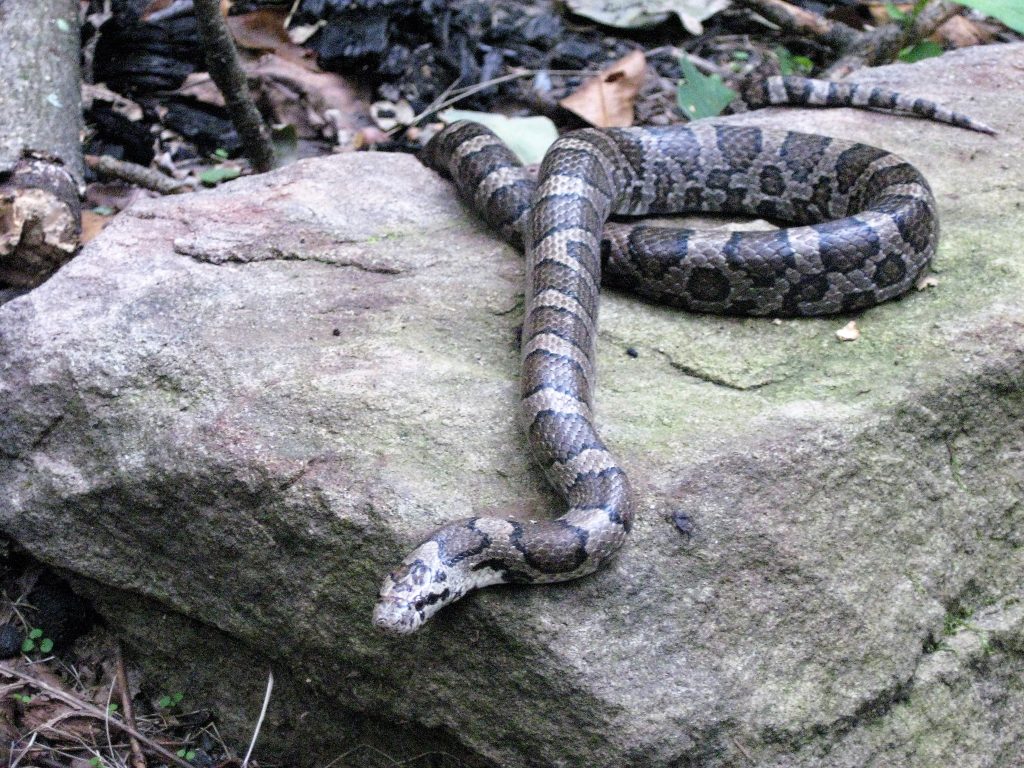
The harmless eastern milk snake is often confused with the copperhead, which it superficially resembles. Dark bands across the milk snake’s body are of even width or tapering slightly toward the belly. The milk snake, like all non-venomous snakes in our region, has round eye pupils.
A recent outdoor encounter recalled an old saying that goes something like: “We see what we want to see.”
A moderate-size snake was crossing a local trail. Often, snakes are obscured in dense vegetation, but this one was exposed and in the open. As I approached, it coiled and tracked my movements but was in no way aggressive. Its instinct was to defend itself, if necessary, against a much larger animal.
The snake was a northern copperhead, one of two species of venomous snakes that inhabit our region — the other being the generally larger timber rattlesnake. Encountering the snake in this open setting offered an excellent chance to observe it closely, noting its behavior and identifying characteristics.
The ability to recognize a northern copperhead when you see one is important for two reasons. First, the copperhead can deliver a potentially dangerous bite. In “Reptiles of Pennsylvania and the Northeast,” herpetologist-authors Arthur C. Hulse, C.J. McCoy, and Ellen J. Censky, state: “…although the northern copperhead is responsible for a significant percentage of all snake bites reported, fatalities resulting from its envenomation are almost nonexistent. This is not to suggest that a bite should not be treated as a serious medical emergency.”
What the authors went a long way around to say is that this snake’s presence in our woodlands is no reason to stay indoors, but that it should always be treated with respect.
Of course, with snakes, one could adopt the first rule of firearms safety, which is to treat every gun with the respect due a loaded one. You could assume every snake you meet is venomous and keep your distance. That would protect you from venomous snakebite, but some people carry the assumption too far, insisting they see a copperhead when they’ve encountered a harmless milk snake or water snake. Thousands of harmless snakes — milk snakes especially — have been needlessly killed because they superficially resemble the copperhead. But knowing what to look for, then honestly assessing the clues will erase any confusion.
Some often-touted distinctions between venomous and non-venomous snakes can be misconstrued. The “triangular head” rule is a good example. If a person wants to see a snake’s head as triangular, they’ll see it that way, perhaps because of the drama and allure that attend encounters with copperheads and rattlesnakes. It’s better to rely on details that are observable and rigid, requiring no judgement to discern.
A copperhead in our region will be a generally brown to coppery color. Dark bands run across the body, interspersed with regions of lighter shade. The one most reliable mark that identifies a copperhead are those darker bands. On a copperhead, the bands will be most narrow where they cross the top of the snake’s back, becoming wider toward its belly. Another way to consider this is that the dark identifying bands form an “hourglass” pattern, with the narrow “waist” at the top of the back, directly over the spine.
The harmless milk snake, often mistaken for a copperhead, also has dark bands across the body. But the bands are not “hourglass” shaped. On the milk snake the bands are of even-width, or slightly tapered in the opposite direction from the copperhead’s bands. If they taper at all, a milk snake’s bands are widest at the top of the back, tapering slightly toward the belly.
The same description holds for the dark bands across the body of a northern water snake, although these can vary more than the milk snake’s. But neither the milk snake nor the northern water snake show the distinct and unmistakable “hourglass” bands that reliably identify a copperhead.
There are other distinctions. The copperhead’s head is, well, it’s copper in color. But that’s another feature that can be misinterpreted if you insist on seeing a copperhead when looking at a milk snake. Regarding the head, it’s better to look for markings. A copperhead’s head is free of markings, except for two tiny and faint dark spots atop the head, between and a little behind the eyes. A milk snake displays dark blotches on the head that resemble the bands on the body.
The pupils of the eyes are distinctly different, although that’s a feature that can be hard to see unless you’re closer than you should be to the snake’s “business end.” The copperhead’s pupils are vertical slits — “elliptical” is the term herpetologists use. The eye pupils of both the milk snake and the water snake are round. This is foolproof in distinguishing venomous from non-venomous in our region. Incidentally, the copperhead photo that accompanies this column was taken with a magnifying lens. Getting that close for a photo is not respecting the species.
Snakes are interesting aspects of our local outdoors. Even our rattlesnake and copperhead are generally docile creatures that wish to stay out of our way, and do not warrant indiscriminate destruction. Learning to recognize native reptiles enhances our appreciation of nature around us.
Ben Moyer is a member of the Pennsylvania Outdoor Writers Association and the Outdoor Writers Association of America.