

Schools, parents navigate increasing smartphone dependence
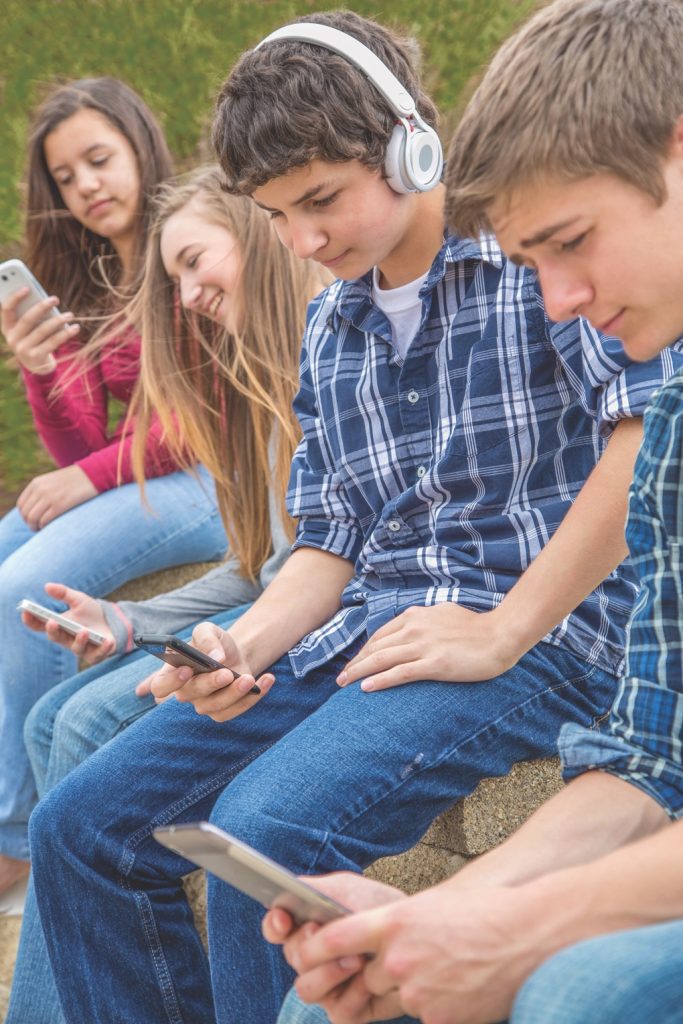
About 75% of Americans high school-aged and younger have smartphones, and school and parents alike grapple with how best to monitor cellphone use. Cellphone bans during school hours are trending, and many parents set an age limit for when their kids can have their first smartphone. (Photo courtesy of MetroCreative)

Washington High School and junior high students will put their cellphones in Yondr pouches during the school day. The school district is prohibiting use of cellphones to decrease distractions and improve academic performance. Pictured are a Yondr unlocking magnet and a Yondr pouch. (Photo by Jon Andreassi)
news@greenecountymessenger.com
While it’s become increasingly common to see younger and younger faces illuminated by a screen, some school districts and parents are hitting pause on 24/7 access to technology.
According to the National Center for Education Statistics, during the 2009-10 school year, 90% of U.S. schools prohibited the non-academic use of cellphones during school hours. By the start of the 2015-16 year, that number dipped to about 65%.
But with advances in and increased reliance on technology, school smartphone bans are now trending. In 2019, nearly 77% of schools nationwide implemented policies prohibiting cellphone use in the classroom – with varied enforcement – and, while no data is available yet for this school year, that number is expected to have increased.
Last year, Washington School District joined thousands of districts across the country in the YONDR trend: at the beginning of each school day, Washington’s junior high and high school students lock their smartphones in YONDR pouches, which remain on their person but inaccessible, except in the case of emergencies, until dismissal.
“It was a new experience for me,” said high school principal Matthew Mols, who joined the district in March. “I had some skepticism. I gotta tell you, I’ve been pleasantly surprised. It limits the distraction that the phone provides during the day. It also provides the security of the students having that phone to and from school.”
Mols said the investment in the pouches has been worth it.
“(There’s) less bullying. There were plenty of times where we would get, ‘So-and-so said this to me and texted this to me.’ The victim can’t be victimized because they don’t have a phone. The bully, more importantly, doesn’t have that outlet here at the school,” Mols said.
He noted learning at school isn’t limited to curriculum: “Dealing with folks from different socio-economic backgrounds, or a different religion, that sort of exposure face-to-face is something that can’t be simulated in a virtual world.”
Phone-free classrooms help students branch out and have increased engagement, Mols said. And while some students do spend a great deal of time on the school-provided Chromebooks, or try to sneak phones during the day, for the most part, there hasn’t been much pushback regarding the policy.
“If I told you there was 100% compliance every single day and we’ve totally eliminated the cellphone situation, that would be not true,” he said. However, “You spend a day here, the kids don’t seem like they’re less entertained. It doesn’t feel like there’s a void here. There’s no, something’s missing. Students rarely complain because I think they got that all out of them last year. It’s the expectation now.”
Expectations for school phone use may be clear-cut, but when to gift children their first smartphone is an issue modern parents still grapple with.
According to a Pew Research Center fact sheet published in April 2021, 75% of Americans high school age or younger own a smartphone. The majority of those young people take their phones to school each day.
“That is such a cultural norm now,” said Sara Popson, Masontown Elementary School PTO president and mother of two. “Every kid has an iPad, too.”
Every kid, it seems, except her children, Sophie Popson, 10, and Samuel Popson, 8. The Popsons began discussing their family’s cellphone policy about four years ago, she said, when Sophie went off to school.
“I was seeing kindergartners who had phones. We really discussed what our expectations were with one another,” Popson said. “We found early on, especially with Sophie, that even with television screen time, she was wild. I don’t know if it just overstimulates her little brain, but I’m also really thrilled because my kids will go outside and play for hours. I like to think that my husband’s and my encouraging lesser screen time and not having as much access to that technology has also encouraged them to be more active.”
Masontown Elementary is part of Albert Gallatin Area School District, which has not banned phones on campus but does stress devices may not be used or displayed during the day. Specific phone expectations are set by building principals, but the district prohibits students from video recording or taking photos on the bus or at school, using phones during standardized testing, and contacting parents regarding disciplinary actions or early dismissal due to illness.
The policy isn’t something Popson’s kids have to think about yet, but the family’s personal phone-free policy is more than just a way to encourage movement and socialization. It’s also a safety precaution.
“I had a client in the salon,” said Popson, a hairstylist, “share a story of messages she found to her daughter that she was unaware of. She was a preteen. It’s too easy for the world to creep in.”
Certain apps, among them the usual suspects like Snapchat and even educational ones like Saturn, contribute to some parents’ hesitancy to give their kids phones.
Marielli Edwards, an interventionist at Smithfield Elementary, got her oldest son a smartphone when he entered fifth grade, and though she doesn’t regret the decision, she does have issues with social media.
“We felt the pressure to get them smartphones because everyone has them. Your kid is ostracized if they don’t,” said Edwards, whose two sons are now 15 and 11. “We’re really rural where we live, so our kids don’t necessarily go outside and go to a neighbor’s house. The way they socialize is through the phones. I think they socialize via phone even when they’re in person, or in the same room.”
Edwards said she and her husband resisted social media for a “very, very long time,” but her son’s friends communicate through Snapchat, and other parents seemed OK with the app. So the Edwardses said yes to social.
“I think my son is more anxious” after getting social media, Edwards said. “We try to convey that social media is not real, that even adults use filters and don’t always put their troubles out there for everyone to see. It’s had a negative effect.”
Cellphone effects on kids
Dr. Bruce Cotugno, who works in Washington Health System’s adult neurology center, said mental health issues are associated with teens and smartphones.
“Cyberbullying, that’s the big concern. When you have people texting about you, talking about you 24/7, that’s hard to turn off. That can lead to problems, loss of self-confidence, isolation, depression, anxiety,” Cotugno said.
Brains don’t mature until about age 26, and kids’ prefrontal cortexes, which regulate emotional responses, are still developing, which makes them more susceptible to online bullying and comparisons, he said.
Continuous exposure to screens can also impact young people’s ability to sleep, since blue light decreases melatonin production, and to concentrate.
“People say you can multitask. You can’t multitask. If you’re trying to concentrate on schoolwork and your phone is dinging, I think that’s where your concentration is going to change,” Cotugno said. “Phones are helpful for people: you can look things up easily, you can look at videos, you can have more interaction with your peers. These are all good things. How it can be bad, it can effect your memory and the way you process things. Making decisions, like complex decisions, potentially that could be affected. The concern is that you may decrease the frequency of analytic reasoning.”
Cotugno said there’s not enough evidence to show that smartphone or social media use has negative long-term effects on brain development; in fact, younger generations are more adaptable to phone tech.
And sometimes, phones do come in handy.
Edwards’ youngest son got a cellphone when he entered middle school, and both kids use their phones as alarm clocks. She sets parental controls so some features, social media apps among them, can only be used at certain times a day. The phones also serve as a lifeline of sorts between parent and child.
“When I was growing up, I would get on my bike and my parents didn’t know where I was. I like to look on Life360 (app). It tells you in real time where your child is, it shows you if they’re in a vehicle, it even shows you how fast they’re going. When you can track them, just as a parent you feel so much calmer,” Edwards said.
Though she sometimes regrets allowing her sons to be on social media at a young age, she doesn’t regret giving them smartphones.
Popson is equally at peace with her choice to keep her kids cellphone-free, for now.
“Everybody’s situation is different, especially for communication purposes, but surprisingly, I haven’t gotten a whole lot of flak about it,” she said. “I just see a lot of the kids talking about things they’ve seen on TikTok, or … talking like little teenagers. Our goal for our kids is to let them be little as long as they can be little.”
She said she’s fortunate Masontown Elementary is a small community school where she doesn’t worry about getting in touch with her kids if the need arises; their teachers, she said, are excellent communicators.
Still, there will come a time when Sophie Popson will ask for a cellphone.
“The tentative discussion has been junior high,” Popson said. “They’re going to ride the bus. They’ll probably be involved in activities. That’s when you’ll potentially be away from home a little bit more.”