

Cabral will fit right in on WVU’s coaching staff
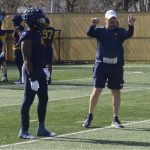
MORGANTOWN, W.Va. — You knew right away that the new man brought in to coach West Virginia’s outside linebackers was going to fit right in with the assistant coaches who have brightened up things around the Mountaineer program over the years even before Mike Montoro, who handles the football public relations, introduced him for his first media session.
As he sat down at the speaker’s table, he, joshing, asked the camera crews, “Y’all got my good side so I can do it like Saban?”
Montoro then stepped forward and said, “We have outside linebackers coach Vic Cabral,” but before the words had reached the cameras in the back of the room he set the record straight.
“Or you could call me Victor, either way, and it’s like Ca-BRAWL, like the Brawl, the Backyard Brawl,” he said.
The immediate thought was, this is a guy the West Virginians are going to like.
Right away, he showed himself to be their kind of person as he offered up a quick observation when asked about jumping from a mid-major school like Appalachian State to the Big 12.
“I’ll tell you what, the greatest occupation in the world is coaching at any level,” he said. “Jan. 18, when I got the nod up here, it was an unbelievable blessing to be a part of Coach Brown’s staff and the vision that he has been able to establish over the last few years.
“The kids are the same. I know at times it gets kind of crazy in the world of college athletics, but at the end of the day these guys want to help win. They want to win and they want to help make West Virginia proud and for us coaches, we have to continue to raise that bar for them.”
WVU has always had its share of characters as assistant coaches, whether it was that miniature pit bull Rick Trickett throwing his hat at the huge offensive lineman he handled every day from a height of maybe 5-foot-8 to the colorful Bill Kirelavich, who was a man who turned the art of turning four-letter words into a philosophy lesson for his D-lineman, to Phil Elmasian, who, according to his Wiki page, made WVU a one-year stop on a coaching career that took him to no fewer than 20 schools.
Cabral comes to WVU to coach the Spurs, which is what the Bandit position was called last season, and to help create a stronger outside pass rush. A year ago, he was at Appalachian State as defensive line coach on a defense that improved in every pass rushing statistic, finishing with 35 sacks and 86 tackles for a loss.
“We’re primarily edge rushers, run stoppers and pass droppers,” Cabral said of his assignment. “It’s sort of three-headed monsters.”
WVU last year had similar statistics with 33 sacks — which led the Big 12 — and 84 tackles for loss, but defensive coordinator Jordan Lesley and head coach Neal Brown felt that number would have been much higher if it had gotten more production from edge rushers.
Lesley had his eye on Cabral for some time.
“I’ve known him a long time. We coached and recruited against each other in the Sun Belt Conference,” Lesley said. “As a recruiter, you’re always trying to find an edge, and the thing that really stuck out to me, everywhere I thought I was by myself, that guy walked in. It may have been a Saturday morning wrestling tournament, but every recruit I had to fight for, I usually had to fight Vic because we coached the same position and recruited the same players. And he was always there working really hard to recruit the guy I was. That was tough competition, but I loved his energy.”
“I’ve been known as a high energy guy for a long time,” Cabral admitted. “I overcame talent with excitement. I did that as a player. Everything I have I owe to this game. I met my wife, I got two degrees from it. Got my profession. It took me out of where I grew up. I was the first person in my family to ever go to college.
“I owe that to the game and to the coaches that helped me get to that point. So, I have to bring it every single day. This game has given me so much that I have to give it all the energy I can. I’m going to be wrong a bunch of times, say some things I shouldn’t say, but it comes from the right place. Everyone’s a little different, but that’s who I am.”
Cabral is a player’s coach and showed that right from the moment he walked into the Puskar Center.
“The first thing I did was call all the players in the group,” he said. “I wanted them to know who I am and what I’m all about and how I want them to be great. That’s all I want for them.”
His idea isn’t to be a tyrannical coach.
“I don’t believe in tough love,” he said. “I believe love is love and time is love and you have to love them up whether it’s good, bad or ugly. This is a people business and we have to be servant-minded for these players and give them everything we’ve got.”
That is especially important when your players are being asked to battle through a defensive tackle or tight end, then a running back to get to the quarterback and foil a pass play.
He, however, has an interesting philosophy about pass rushing.
“What we have to do a great job of is understanding the mentality you have to have when rushing the passer. As a unit, we led the Big 12 in sacks, right? As a team they did a great job, but as a position they had only about 2.5 sacks. There was a bunch of times we affected the passer a bit.
“I think pass rushing is patience. They have to understand that simple is better.”
If there is one word that doesn’t seem to fit pass rushing, it is “patience.”
You wait, you lose, or so it seems. But Cabral sees it differently.
“Put it this way, if you look at how many times in a season the other team throws the ball. Might be 500. Say an individual has double digit sacks, but when you see how many times they threw the ball it may not seem like much but if you only had 10 sacks, you’re playing in the Pro Bowl.”
So, they don’t come often and you can’t get itchy to get one. That’s what he means. You just have to go at it the same way every time, cherishing those you get and trying to add to your total each time out but not being discouraged if you don’t get there.