

Agile gems: Hummingbirds are delightful accents to summer
 Ben Moyer
Three bald eagles graced a recent outing on the Youghiogheny River near Ohiopyle-two stunning white-headed adults and one more plainly plumed juvenile. Unknown here 30 years ago, eagles are now seen daily along the Yough by those who seek them out.
These impressive birds of prey have the broadest wingspan of any resident bird you’ll encounter in this region. Females are larger. Their wings can span 8 feet. The smaller male eagle’s wingspan averages about a foot less.
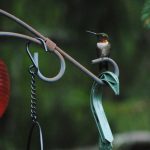
But the bald eagle’s great size does not grant it exclusive claim to our awe and admiration. Although more commonly seen than eagles around homes and gardens, the ruby-throated hummingbird is no less amazing. This hummingbird’s wingspan averages around 4 inches. Its body weighs less than a nickel.
Hummingbirds are the only birds that can fly backwards and vertically upward. They rotate their wings in “figure 8” fashion while beating the wings 70 to 100 times per second. That’s why you’ll often hear the throb and hum of the wingbeats before you see the bird.
Hummingbirds live only in the Western Hemisphere. None are native to Africa or Asia. Over time, hummingbirds developed an anatomy and flight abilities that enabled them to exploit the vast array of flowering plants that grew wild in American forests, grasslands, and deserts. With their long bill and probing tongue, they can lap nutritious nectar from deep inside flowers, and their unique flying skills allow them to hover while feeding, and maneuver throughout a stand of blooms. In exchange for their sugary meal, hummingbirds serve their host plants by transferring pollen among flowers-like large bees.
The ruby-throated hummingbird is named for the bright red on the male’s throat, which females lack. Interestingly, it’s the only species of hummingbird that lives and nests across the entire eastern United States, including western Pennsylvania. It ranges from about the Mississippi River eastward to the Atlantic, and from southern Canada nearly to the Florida Peninsula’s tip.
If you were to travel to Arizona, and pay attention to birds in various habitats, you could see 14 different species of hummingbirds in that state. On first learning that, it seems odd that one state could host so many hummingbirds, and another so few. But geography and landscape make the difference.
Arizona has many radically different ecosystems jumbled together within its borders. There, and over much of the Southwest, you can travel only a few linear miles and pass through desert, grassland, chaparral, pine forest, and alpine terrain. That’s often a function of rapid change in elevation, where each different system has its own distinct community of flowering plants. Those plants, too, display vast differences, owing to their specialized tactics for obtaining water, and in their competition for the pollinating services of hummingbirds and bees. So, different kinds of hummingbirds have evolved to thrive best under different circumstances. Additionally, sub-tropical hummingbird species from Mexico and Central America sometimes wander northward into Arizona. Some hummingbirds of Arizona and the Southwest include the black-chinned hummingbird, Allen’s hummingbird, Anna’s hummingbird, berylline hummingbird, blue-throated mountain gem hummingbird, and the broad-billed hummingbird.
By contrast, habitats across the entire eastern United States are less diverse. To a hummingbird, a flowered forest edge in North Carolina is not that different from one in Pennsylvania. The landscapes of the eastern United States are older and more settled, geologically and ecologically. Even the ascent we make from Hopwood to the top of Summit Mountain on Rte. 40 is not enough to make a significant difference in ecology and habitat. As a result, one hummingbird-the ruby-throated is best suited to thrive across the vast expanse of eastern America.
The ruby-throated hummingbird is thriving. Originally a denizen of woodland edges and riverbanks where sunlight promoted flowering, it has adapted well to rural and suburban ornamental flowers. Artificial feeders filled with sugar-water syrup have accelerated the ruby-throated’s acclimatization to humans and human-altered places. Hummingbirds appear to have now learned to seek out syrup feeders. They find them fast and remain near them all summer.
But feeders should be kept clean to prevent spreading disease among the birds. If you feed hummingbirds, clean the feeder regularly with hot water. There’s no need to buy red-dyed syrups or powders. A simple syrup of four parts water to one part sugar is all they need. Add the sugar to boiling water and boil, while stirring, for about a minute. Let cool and fill feeders.
Our ruby-throated hummingbird is a delightful accent to summer. They’re raising their young now in nests about the size of a walnut. They’ll be around until the middle of September, then will return next May. Enjoy and admire their agile beauty.
Ben Moyer is a member of the Pennsylvania Outdoor Writers Association and the Outdoor Writers Association of America.