

Independent filmmaker’s visit aims to draw awareness to rare spinal disease
Sixteen years ago, Cassie Phillips had no idea that she would one day be filming the man she turned to for information about a rare disease afflicting both.
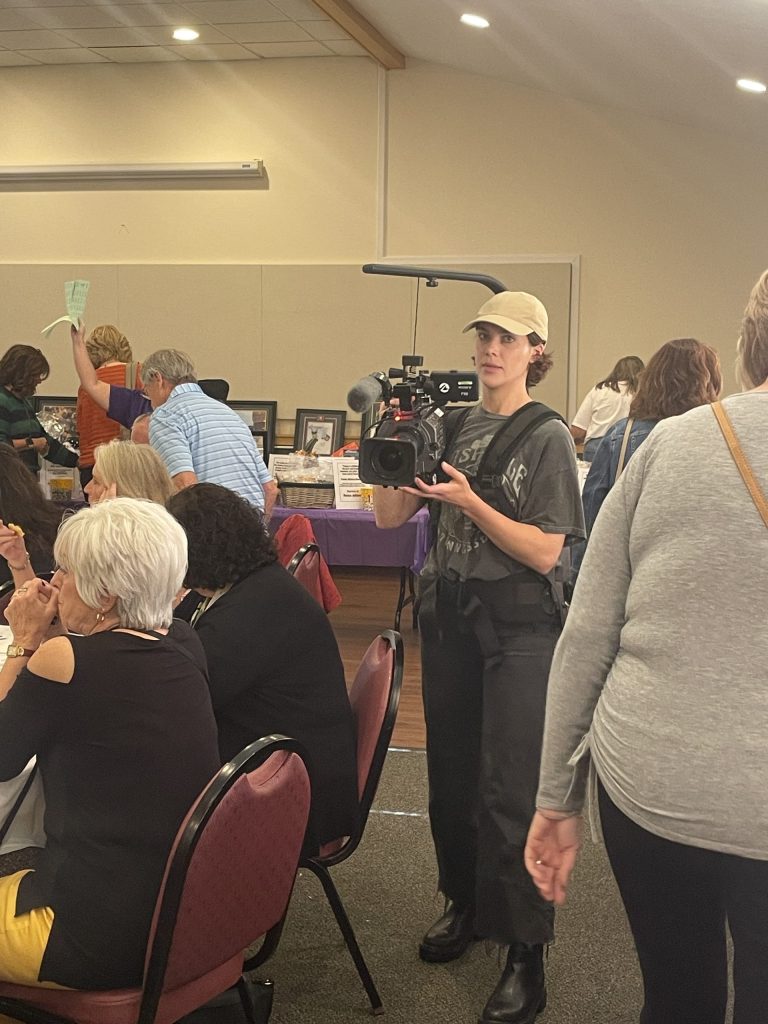
Phillips, 27, an independent filmmaker, traveled from her home in Los Angeles, Calif., to Bridgeville earlier this month to attend the Scheuermann’s Disease Fund’s annual fundraiser as part of her documentary about the disease and the people who suffer from it. She was diagnosed at age 11 with Scheuermann’s, which affects between 2 and 8% of the population, “after having really bad low back pain that wouldn’t go away,” she said.
Phillips is filming the documentary to shed light on the need for further awareness and research. Until recently, she hadn’t met anyone else with Scheuermann’s disease.
“Looking back, everything was so nonchalant,” Phillips said. “We didn’t know anything about this disease. I was prescribed physical therapy. We asked for a brace at some point, but it was always, ‘No, it doesn’t work.'” She expressed regret in not having a brace. “I know I would have stuck to wearing a brace because of how badly, even at a young age, I wanted it to go away.”
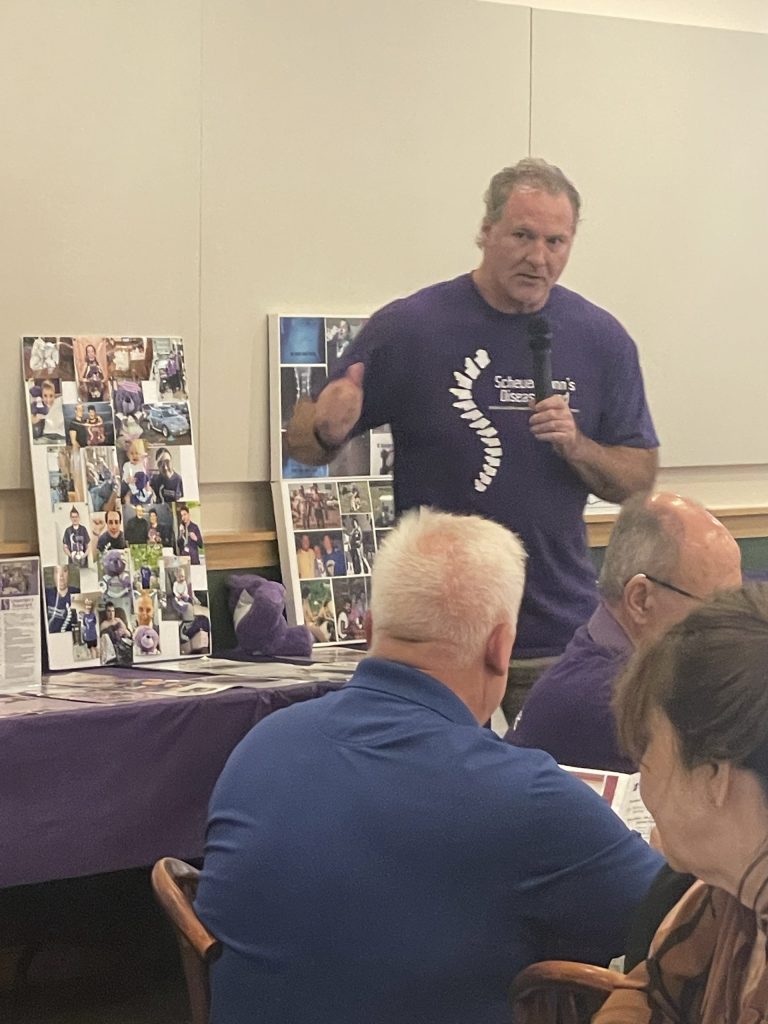
Scheuermann’s disease (SD) is a form of kyphosis, also referred to as Scheuermann’s kyphosis, and is typically diagnosed in children during adolescence, and many times occurs during a growth spurt, according to Scheuermann’s Disease Fund founder Doug Strott, of McMurray, who was diagnosed at the age of 17. The cause remains unknown.
While scoliosis causes the spine to form an “S” curve, with Scheuermann’s, the person’s spine has an accentuated “C” curve, or “hunchback,” occurring in either the thoracic or the lumbar areas.
Unlike scoliosis, Scheuermann’s causes physiological changes to a person’s body, Strott said. The shape of the vertebrae changes from a brick shape to a wedge shape, which can lead to early onset degenerative disc disease, among other possible complications. Once an individual’s bones stop growing, the changes become permanent, and non-invasive treatments, such as bracing and therapy, are no longer effective treatments, according to Strott.
At that point, for those suffering from severe curvature or significant pain, or both, the only proven treatment is spinal fusion surgery, he said. “As you age, if you don’t have the curvature corrected, it can cause significant damage to your spine,” Strott said.
For those whose bones are still growing, a form of therapy called Schroth therapy, coupled with bracing, can be helpful in reducing the curvature, according to Strott. That is why early detection is so important.
Some states, including Pennsylvania, still have spinal screenings in the schools for scoliosis, but it is no longer mandated by the federal government. “Parents think it’s been done in schools, pediatricians think it’s being done in schools, but most of the time it’s for scoliosis,” Strott said.
Through their efforts, Strott and Phillips hope to raise awareness about the disease.
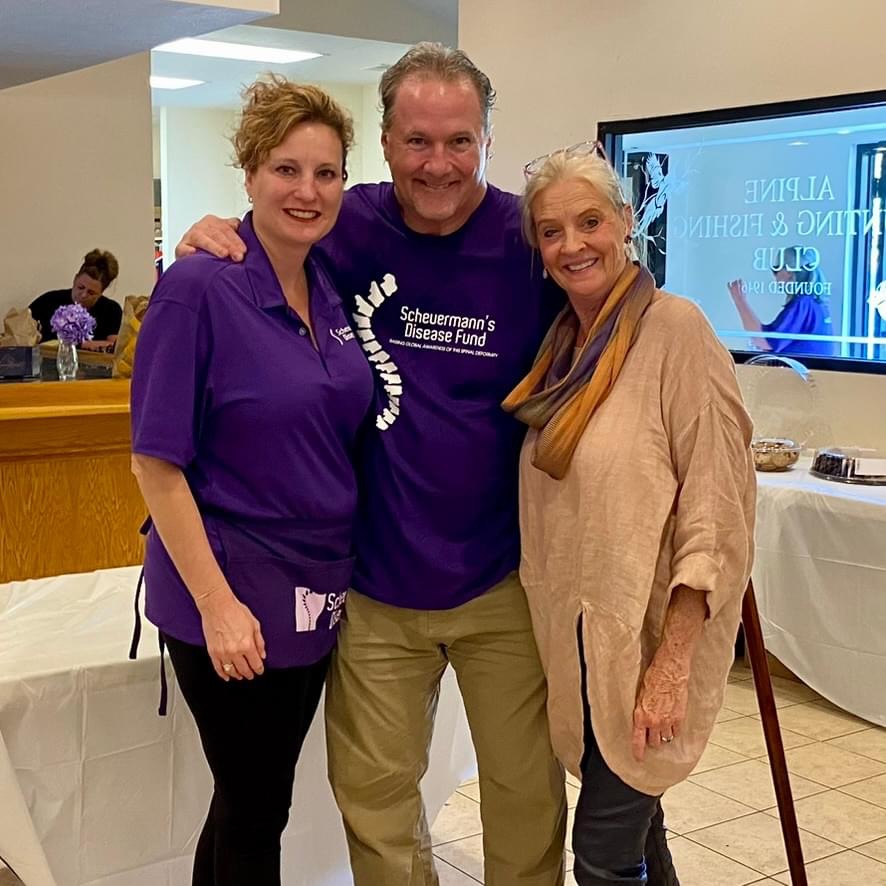
Strott, 59, created the Scheuermann’s Disease Fund in 2014. After five difficult and painful spinal fusion surgeries over a period of three years, his spine “failed” at the age of 45, and he was forced to retire. He set out to research the disease that robbed him of his career and much of his mobility and found there was little available online. He began a blog, sharing his experiences, frustrations, hopes and fears.
Phillips found Strott’s blog. “When I was first diagnosed, there was nothing on the internet. The only information we could find was his blog. And it’s crazy that now, 16 years later, I’m filming him,” said Phillips.
Along with the charity, Strott developed an international database of doctors who are either members of the Scheuermann’s Disease Fund’s advisory medical or research initiative or have been referred by someone with Scheuermann’s.
At the annual fundraiser, held Oct. 6 at the Alpine Club, Phillips stood straight, a camera strapped to her back, moving carefully through the crowd, often breaking into a smile.
She said her curvature has increased since she was diagnosed and her pain level with it. She believes she will need surgery within five years. Active in high school and college soccer, she suspects that delayed her Scheuermann’s progression, “but it’s always been an everyday struggle,” she said. “Every time I’d go to seek help – and as the years went on it would be less and less with more and more time in between – I’d hear, ‘You’re not a candidate for surgery’ because your curve needs to be 75 degrees or higher.” Her curvature is 65%.
At a 2019 spinal deformity conference at Johns Hopkins Hospital, Strott said he learned that the lower the apex of the curvature in a Scheuermann’s patient’s spine, the more pain and health problems they tend to experience.
Bill Kachinski, 34, of Chicago, made his way to the fundraiser with the help of his uncle to meet Strott and support the charity. He was diagnosed with Scheuermann’s at 14.
“For the first 10 years the pain was pretty manageable,” he said. But it’s been increasing each year. Kachinski said he’s been unable to work since 2023 and can’t sit or stand for long periods. He hopes to have surgery in December or early in the new year, after losing 35 or 40 pounds, as required by his surgeon.
He said his appearance isn’t what bothers him. It’s the pain.
“I really have no choice, because of my lungs. The doctor says I’m at 50%. I can’t breathe deep and I get winded.”
He found Strott’s Facebook page a few years ago. “Everytime I have a panic attack about my health, I text him,” he said.
Lee Hall of Clyde, N.C., found out about the charity after her son passed away. She went to the fundraiser for the second year to support the effort, which this year raised nearly $22,000. Her son, John Michael Hall, was diagnosed at 14. He died in October 2023 at the age of 26 after an unattended fall, Hall said. She wishes he had had the opportunity to meet Strott.
“He was diagnosed at 14. We saw six different surgeons. It’s such a risky surgery; none of them were willing to do it. They said to wait till he gets through puberty and it should stop, but it never did.”
A talented athlete, Hall said it was suggested that he wait and have fusion surgery, probably by the age of 30. “But my son was such a driven kid, he thought, ‘I just want to have it now and I’ll get through it.’ He didn’t know how bad it was going to be. He made it through the surgery, but he was never the same.”
“It’s such a rare thing. The people who do the research, the funding, it’s very much needed. It’s very debilitating,” said Hall.
For years, Phillips said, she didn’t tell anyone she had the disease. “I think only my mom knew.” But, now, “The more I talk with people, the more I’ve seen this a very shared experience, the more this is a real issue and there’s very little research out there and very little understanding of the disease,” Phillips said. “That’s really my push for this film and hope for this film, to keep spreading awareness and to really show what each person is going through. I know every person’s journey is different.”
Phillips’ documentary will follow four people with Scheuermann’s. She and her film crew spent three days in Pittsburgh with Strott and followed him to the International Spine Study Group’s annual conference in Las Vegas. There, Phillips’ team filmed Strott’s presentation on the charity’s joint Scheuermann’s advocacy efforts with the ISSG as well as interviewing ISSG Founder/President Dr. Shay Bess and adult spinal deformity surgeon Dr. Alan Daniels, the Chief of Spine for the Orthopedic Department at The Miriam Hospital and Rhode Island Hospital. Both are members of the Scheuermann’s Disease Fund Medical Advisory Board.
Her plan is to submit the film to some of the top film festivals for 2025-26 as early as February. “We will look for distribution through the festival circuit,” she said and is hoping for a wider release. The working title for the film is “The Hunchback.”
Phillips said she received approval for fiscal sponsorship by the International Documentary Association, making contributions tax-deductible. She has launched crowdfunding efforts and will apply for additional grants to complete the film. Updates will be posted on the SDF Facebook site.
“Even if it’s a generation after me, I feel there will be better treatment,” Phillips said. “Doug has changed the game for us,” she said. “Without him, none of this would be here, pointing people toward resources, educating people. Without doubt there wouldn’t be any moving forward.”
The Scheuermann’s Disease Fund can be found at https://www.sdfund1.org/.