

Education leaders testify before policy committee
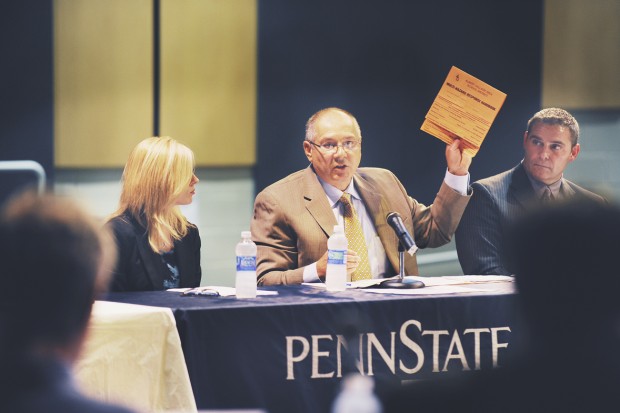
Carl Bezjak (center), Superintendent, Albert Gallatin Area School District, holds up a multi-hazard response handbook to stress how recent state funding cuts could affect student safety. Seated to the left are Dr. Tammy Stern, superintendent, Connellsville Area School District, and Jesse Wallace, superintendent, Laurel Highlands School District.
Roberto M. Esquivel/HeraldStandard.com
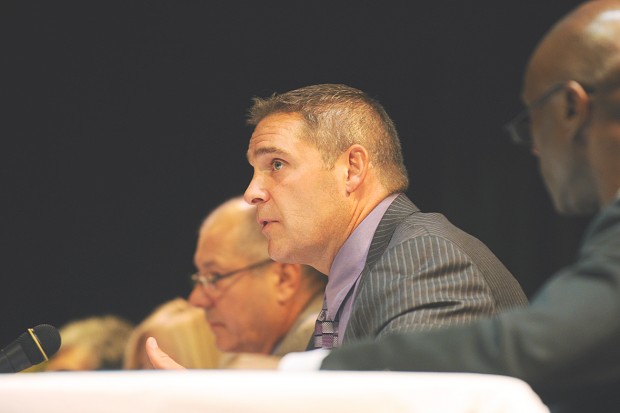
Jesse Wallace, superintendent of the Laurel Highlands School District, addresses members of the House Democratic Policy Committee Tuesday afternoon.
Education leaders from across the county testified Tuesday before the House Democratic Policy Committee during a public hearing regarding the effects of the state budget cuts.
Officials representing Albert Gallatin, Brownsville Area, Frazier, Uniontown Area, Connellsville Area and Laurel Highlands school districts and Penn State Fayette, The Eberly Campus, provided testimony describing how the state billion-dollar cut in education has impacted their institutions.
鈥淎s I listened to others in other parts of the state talk about how the state cuts have impacted them, I thought it was important for members of the policy committee to hear the impact of this budget on my municipalities 鈥� my school districts and my townships,鈥� said state Rep. Deberah Kula, D-Fayette/Westmoreland, who co-sponsored the event held at Penn State Fayette.
Jesse Wallace, superintendent at Laurel Highlands, told the committee that the drastic cuts in education will affect class size, academic programming and perhaps athletic programs next year. He said one of the areas that took the biggest hit in his district this year was technology.
鈥淥ur students live in a world with instant information from technological advances. We need to embrace and invest in these educational vehicles,鈥� he said. 鈥淏ut the implications of the budget cuts drastic decrease our technology funding, affecting a 21st century education.Technology growth is solid in the education realm. We are now handicapped in how we can promote, develop and deliver in these areas.鈥�
Wallace told the committee that the decrease in funding trend for the state will leave 鈥済aping holes in future years and will result in massive cuts鈥� to more programming and staff.
Also testifying Tuesday was Dr. Francis Achampong, chancellor at Penn State Fayette, who told the committee that the $68 million Penn State University lost from state budget cuts meant a 2.9 percent tuition increase for students at the Fayette campus.
鈥淭his university didn鈥檛 want to put the burden of the cuts fully on the backs of the students,鈥� he testified. 鈥淏ut the impact from the appropriation is about 6.5 million dollars. We鈥檝e had to adjust health benefits, institute wage freezes and program cuts. Fewer citizens may not be able to afford higher education and it鈥檚 affecting global competitiveness.鈥�
Achampong said the campus is going through a review process of proposed cuts to make up for the loss in state funding, and as a result, may have to cut about 40 programs.
Dr. Tammy Stern, interim superintendent, curriculum coordinator and director of federal programs for the Connellsville Area School District, testified that the district is struggling to deal with a $4.3 million dollar loss in funding from the state.
Stern said some of the biggest issues are budgeting to accommodate multiyear contracts and adhering to state mandates without enough funding.
鈥淭here should be a reduction in state mandates to reduce the cost to the district at least enough to equal the cuts,鈥� Stern said. 鈥淪tudents can choose a cyber school outside of their district. The district should not have to pay local funding to educate our students outside of our school district.鈥�
Also testifying about the state鈥檚 impact on education were Dr. Philip Savini, Brownsville superintendent; Kenneth Meadows, Uniontown Area School Board director and interim superintendent for Frazier; and Carl Bezjak, district superintendent for Albert Gallatin, who all testified about measures taken in their districts due to the state cuts.
鈥淭hank you for your testimony because we are hearing in Harrisburg that this is really not happening out there, and we are hearing differently,鈥� said state Rep. Mike Sturla, D-Lancaster, who chairs the committee. 鈥淭he governor is hoarding 800 million dollars and forcing you to make cuts in the school districts in the state.鈥�