

Uniontown couple restores stately mansion
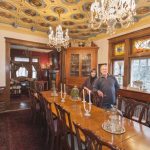
When Tom and Christine Buckelew bought their home in 1973, they found a once stately mansion had been turned into a duplex, its fine oak woodwork covered with white paint.
Today, the house at 145 S. Beeson Ave., Uniontown, is once again stately, serving as the home for the Buckelew family into the 21st century.
The house was built in 1905 for the Dr. Jaco family. Jaco, a local dentist, also had the Jaco Building, the former flat iron building that was fronted by 鈥淢abel at the Fountain,鈥� a water feature donated to the city by the Women鈥檚 Christian Temperance Union in the late 1800s. Both were located near where Church Street parking garage stands.
鈥淥ne of the last surviving members of the family sent us a photograph of what the house looked like shortly after it was built. There was a Ford Model T in the driveway and two maple tree saplings in front. When we bought the house, there were two dead maple trees that we had to remove, which were once those saplings,鈥� Tom Buckelew said.
While they don鈥檛 know who constructed the house, the Buckelews have done everything they can to bring it back to its original glory. Features include built-in glass-doored china cupboards, pocket doors, solid oak flooring and hand-carved decorative elements.
鈥淲e kept it as a duplex when we first bought it. Rent from the other part of the house offset the mortgage payment in those days.
In 1988, we removed a wall down the middle of the hallway to make it a single-family dwelling again,鈥� he said.
During the years, the Buckelews and their three children, who are all grown now, worked at what Tom Buckelew described as a 鈥渇everish pace鈥� to strip the white paint from the oak woodwork, restore original elements of the home and add on to the rear for a larger kitchen. 鈥淐hristine told me that if we bought this house, I鈥檇 have to add on to the kitchen,鈥� Tom Buckelew said.
鈥淚 knew nothing about doing any of this when I started,鈥� he said, adding that his father-in-law guided him in constructing the add-on. 鈥淗e told me I would need a footer. When I asked him how to do that, he said, 鈥榊ou know how to use a shovel, don鈥檛 you?'鈥� His father-in-law also showed him how to lay the cement block foundation for the addition.
Also, when they began the restoration, the Buckelews found that murals had once emblazoned the walls.
Unfortunately, they were not able to rescue any of them.
鈥淗ow they did it was to press canvas into the wet plaster. Then when it dried, the artists had a canvas to paint,鈥� Tom Buckelew said.
Removing the white paint from the oak woodwork was another labor-intensive chore. 鈥淲e used chemicals sparingly,鈥� Tom Buckelew said, adding that some of the hand-carved elements took longer to clean. 鈥淲e had to pick the paint out of the crevices.鈥�
Another feature, although not original to the house, is a decorative ceiling in the dining room, its complexity obvious from its gold medallions, carefully shaped octagons and squares and three-dimensional woodwork.
鈥淭his was something I wanted,鈥� Chris Buckelew said. 鈥淚 wanted at least one decorative ceiling in the house.鈥� While traveling, they found the design in a book about a member of the Dupont family and the home he built in France.
鈥淭he ceiling cost $1,200 to do,鈥� Tom Buckelew said, 鈥渁nd $850 of that was for the medallions,鈥� which he purchased online. Smaller medallions he made using liquid glue and a candy mold. Some of the trim was recycled from another home in Uniontown that had been demolished.
鈥淲e have done this work ourselves rather than call anyone to come and do it for us,鈥� Chris Buckelew said.
They also have furnished the house with some antiques and a number of reproduction pieces that Tom crafted himself.
鈥淲hen he started doing these pieces, he had a carpet knife and a table saw. He carved everything by hand,鈥� Chris Buckelew said.
It鈥檚 hard to tell the difference between what is genuinely old and what isn鈥檛.
Several colonial-era highboys, a German wardrobe called a 鈥渟chwark,鈥� and a multi-leaf maple dining room table are some of his creations.
The house contains 25 rooms, nine of which are bedrooms. There are about 4,500-square feet of living space and three bathrooms.
The Buckelews don鈥檛 know how much it cost to build the home more than 100 years ago, but the quality of the workmanship is evident.
Tom Buckelew is a retired professor of biology and physiology from California University of Pennsylvania. Chris Buckelew, is president of the Fayette County Historical Society.
Chris said they bought the home with a sense of obligation.
鈥淪omeone needs to keep these places going. We took on a responsibility when we bought the house,鈥� she said.
Jim Pletcher writes a weekly real-estate story for the 缅北禁地 from a variety of angles. If you have an interesting story about buying or selling a home in Fayette County and would like a story written about it,, please contact 缅北禁地 Executive Editor Mark O鈥橩eefe at 724-439-7569.