

Sheriffs look to legislation to increase powers to fight drug epidemic
State Rep. Tim Mahoney is revising a bill introduced in 2015 that would expand law enforcement services provided by sheriffs to aid local police departments that have seen a decrease in police academy enrollment.
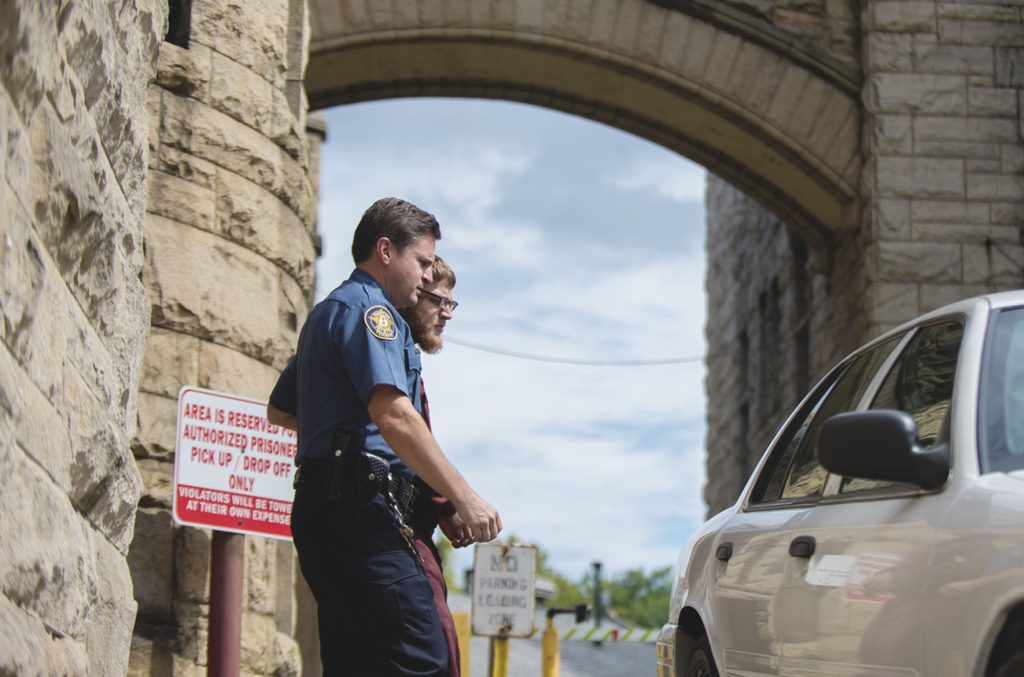
Fayette County Sheriff James Custer transports a prisoner out of the Fayette County Prison as part of his duties as sheriff. Representative Tim Mahoney is revising a bill introdouced in 2015 that would expand law enforcement services provided by sheriffs to aid local police departments that have seen a decrease in police academy enrollment.
Area sheriffs say proposed legislation to increase their investigative powers would increase manpower to fight the drug epidemic.
With a dwindling number of state troopers and a hefty bill to train new ones, State Rep. Tim Mahoney, D-South Union Township is drafting a legislative bill he hopes will enable sheriffs to serve as countywide investigators.
Mahoney proposed a previous version of the legislation, House Bill 733, which was co-sponsored by State Rep. Pam Snyder, D-Jefferson Township, and sat in committee. After a meeting with Fayette County Sheriff James Custer last week, he is drafting a simplified version he plans to propose later this year.
Custer said individual counties would decide whether to adopt the option to have sheriffs and their deputies serve as law enforcement. The legislative action could add 2,500 additional investigators across the state to help combat a state police shortage. He said Mahoney will present his draft to the Pennsylvania Sheriffs鈥� Association for review.
鈥淭he sheriffs aren鈥檛 looking to replace any type of law enforcement, but just be there as an equal partner where there may be gaps,鈥� Custer said.
Mahoney said that state police at the Uniontown barracks are already short by four or five troopers, and many municipal departments are only part time.
鈥淲e鈥檝e already had a shortage here,鈥� he said. 鈥淗opefully we can move forward with (the legislation) so that we can get more police on the street.鈥�
The shortage is due in part to state police retirement rates. In the next three years, 2,000 will be eligible for retirement. In addition, it costs $10 million to train every class of 100 cadets.
Mahoney said the additional training for sheriffs would be equivalent to municipal police training and cost substantially less. The price tag would be picked up by the county.
鈥淚t wouldn鈥檛 cost the state anything,鈥� Mahoney said.
Snyder said granting sheriffs additional powers would be especially beneficial to rural counties, such as Fayette and Greene. She said sheriff departments investigating drug crimes would be especially advantageous.
鈥淚 know it would have a huge impact on my district,鈥� she said.
Westmoreland County Sheriff Jonathan Held described the proposed legislation as action that would modernize sheriff departments, which have been written out of laws as new ones are developed.
鈥淭he original regional police in Pennsylvania were sheriffs, since centuries ago,鈥� he said, adding that Mahoney鈥檚 legislation would 鈥渃lear up the cloudiness of the law.鈥�
He said that narcotics laws, for example, were not specifically written to include sheriffs as enforcers of the law.
鈥淚t鈥檚 not that our powers were stripped. It鈥檚 that when the laws were updated, we were not included specifically. The word 鈥榮heriff鈥� was not written into the law,鈥� he said.
President of the Pennsylvania Sheriffs鈥� Association and Butler County Sheriff Mike Slupe said that in his conversations with other sheriffs, they do not want to supplant troopers, but want the ability to investigate crimes they are involved in from the beginning instead of transferring the investigation to police.
鈥淏asically what we are lacking is the ability to investigate a crime that we don鈥檛 see,鈥� he said.
Sheriffs departments in most counties investigate only civil cases. Their duties include transporting prisoners, traffic patrol and serving warrants.
鈥淚f we come across something that requires further investigation, we should be able to do that, instead of having to wait for state police who are already overtasked in their ability to take calls,鈥� he said.
Greene County Sheriff Brian Tennant said his lack of investigative powers is a source of aggravation to him when residents ask him for help in criminal cases.
鈥淚 have mothers coming to me crying, begging me to help them with the drug problem or with their son and all I can do is refer them to police,鈥� he said. 鈥淎nd it鈥檚 very frustrating to me.鈥�
He said he is certified as a police officer, but is crippled in his powers. He said that if he sees someone fighting, he is able to make an arrest. But if someone walks into the office with blood on their face, saying they were assaulted, the matter must be transferred to police.
鈥淚t just doesn鈥檛 make any sense and I think something definitely needs to change in that regard,鈥� he said, adding that more manpower is especially necessary to investigate drug crimes. 鈥淲ithout sheriffs in the fight, we basically have 2,500 people on the sidelines who were sworn in to protect and serve.鈥�
Washington County Sheriff Samuel Romano said his department is already working in partnership with the Drug Enforcement Agency and District Attorney Task Force to investigate drug crimes.
鈥淲e are helping, but I think we could do a lot more and help out a lot more,鈥� he said.
Charleroi Regional Police Chief Eric Porter and Connellsville Police Chief Bill Hammerle said they rarely rely on state police, except for occasional serious crimes or to call for backup.
鈥淚n the state police, they have a shortage, and they also have an enormous area,鈥� Porter said.
He said he expects the impact of fewer troopers would be much greater in areas without a municipal department.
Hammerle said he would be concerned if the number of troopers at the Uniontown barracks drops lower.
鈥淭heir coverage area is very large, and they don鈥檛 have enough troopers in their barracks to handle their number of calls,鈥� he said. 鈥淭heir number of calls is crazy.鈥�
But neither chief said they were concerned about their caseloads expanding with fewer troopers.
Southwest Regional Police Chief John Hartman, whose department covers municipalities in Fayette, Washington, Greene and Westmoreland counties, said the crux of the matter is a changing economy in which the government must reassess how services, including police coverage, are delivered to the people.
鈥淩ight now, the issue is police services. What about fire department services? It鈥檚 the whole panoply of services the government provides,鈥� he said.
Hartman said that because of varying tax bases, some municipalities are thriving while others are failing.
鈥淚 think the issue is that people have to become a part of the solution. Don鈥檛 stand on the sidelines and yell,鈥� he said. 鈥淲e鈥檝e got to do something different because the old ways don鈥檛 work. What the solution is to those problems, I don鈥檛 profess to know.鈥�