

Lawsuit continues over closed Donora Zinc Works emissions
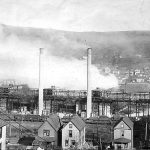
U.S. Steel Corp’s Donora Zinc Works belched out some five million pounds of cadmium during the 42 years it produced zinc for use in steel manufacturing.
Six decades later, the elevated levels of cadmium found in soil and household samples in the vicinity of the former plant are an important thread for lawyers hoping to prove those emissions are tied to ongoing contamination in the area.
“Of these metals, cadmium is the most reliable fingerprint for zinc smelter contamination because it is intimately associated with zinc deposits in nature,” wrote George Flowers, a geoscientist, in a recent filing submitted to Washington County Court of Common Pleas. “There are no cadmium ore deposits, and it predominantly occurs as an impurity in zinc ores.”
Flowers is one of the expert witnesses for a legal team that hopes to persuade the court to recognize a class of plaintiffs that would include people living within seven miles from the old site of the zinc works, which closed in 1957, and those who lived there within the last 30 years, but no longer do.
As part of the more than two-year-old lawsuit, the plaintiffs are seeking to have U.S. Steel pay the tab to remediate soil and homes contaminated by zinc, lead, arsenic and cadmium that allegedly came from the emissions, and for monitoring of the health of those who may be exposed to those elements because of their presence.
Flowers wrote the presence of zinc and cadmium together at levels highest within an area close to the plant was part of the findings that led him to conclude emissions from the facility caused heavy metal contamination in the proposed class area with “a reasonable degree of scientific certainty.”
He said that a major indicator of that was the presence of cadmium and zinc together, with higher concentrations in the area closest to the site.
As the plaintiffs draw support from his and other expert reports, U.S. Steel is fighting the allegations.
On Dec. 10, reams of opinions from U.S. Steel’s own experts were filed on behalf of the multibillion-dollar company, which is represented by attorneys from the Pittsburgh law firm Babst Calland.
Several of the people the firm consulted were from Gradient Corp., a Cambridge, Mass.-based consulting shop with a reputation for drawing conclusions that favor industry clients during litigation and regulatory discussions.
U.S. Steel’s experts questioned the alleged link between the sampling results and the old smelter, including by positing other reasons for the presence of the metals in the heavily industrialized region.
“There are numerous other potential sources for arsenic, cadmium, lead and zinc in both the indoor and outdoor environment that result from both homeowner use of various products as well as current or past industries,” wrote Teresa Bowers, a Gradient principal, in one of the documents.
The plaintiffs in the case are Louise Kowall and Donna Kopecek, who live in Donora, and Evelyn Vehouc, who resides in Charleroi, but owns a house in Donora occupied by her child and grandchild. They are suing the Pittsburgh steelmaker and its subsidiary USX.
The lawsuit – which the company tried to have dismissed but Judge Michael Lucas allowed to proceed in a ruling more than a year ago – is a new chapter in the history of U.S. Steel’s facilities in that part of the Mon Valley.
The zinc plant was the largest of its kind when U.S. Steel subsidiary American Steel and Wire Co. opened it on the riverbank in 1915.
In 1948, a temperature inversion acted as the cover of a lethal Dutch oven and trapped thick, yellowish smog in the valley for days in what became known as the Donora smog. More than two dozen people were killed, and the health of thousands more probably suffered in the long term. It took more than two decades, but the event helped give traction to the movement that resulted in the passage of the federal Clean Air Act in 1970.
The plaintiffs aren’t claiming what’s known in legal parlance as an “acute injury.’ They argue chronic exposure to the elevated levels of those metals heightens the risk of certain health problems for people in the area.
John Hanger – an attorney and former secretary of the state Department of Environmental Protection who now has his own small consulting firm – said building a case for medical monitoring is “less complex and demanding” than proving a specific injury arose from an environmental cause.
Hanger was not familiar with details of the zinc works case and hadn’t reviewed it. But generally, he said, it is “relatively easy” to demonstrate contamination by metals.
The question of how they got there can be trickier.
“I’m not the scientist here, but burning coal can release some of these metals,” Hanger said. “Not all of them, and that gets back to what’s on the property and the characteristics of the property.”
Whether or not a property changed hands and what the new owner was told when that happened are usually important questions when dealing with a case seeking property reclamation.
Lucas has set a hearing for August on whether or not to certify the case as a class action following written filings from both parties.
The plaintiffs’ expert reports, which were filed in October, provide details on how they intend to support their case. Flowers drew from 960 soil and 1,995 surface-dust samples, plus 12 bulk dust samples, from 342 residential properties as far as nine miles from the old plant.
Among his findings was that apparent contamination in household dust by the metals and soil was more frequent within 2,500 feet of the plant than farther out from the site, and concentrations of the metals in some of the samples exceeded regulatory agencies’ guidelines.
Because of activities like remodeling and houses being built at different times, Flowers wrote, it was also “possible for contaminated and uncontaminated houses to occur in close proximity.”
Environmental consultant Marc Glass – who earlier this decade was the court-appointed technical expert for remediation related to a class-action settlement in litigation over a former zinc smelter in West Virginia – estimated the costs of removing heavy metals from a 1,500-square-foot house, plus relocating a family of four, at more than $19,000.
In the West Virginia case, he wrote, the price of decontaminating a three-tenths-acre yard was about $25,000.
U.S. Steel’s team noted that the price of cleanup varies among different properties.
As for health risks, arsenic and cadmium are known carcinogens. Lead is classified as “probably carcinogenic to humans.” Exposure to cadmium is also linked to noncancer health problems, including kidney failure.
Lead poisoning causes a host of effects on people, according to physician and public-health expert Charles Werntz, another professional the plaintiffs’ lawyers consulted. That’s especially true when it comes to children, for whom it can mean lifelong cognitive effects.
Werntz’s report included recommendations for screening and remediation based on levels of contamination found in the area and the ages of those at risk of exposure.
Michael Jacks – a Morgantown, W.Va., attorney who’s part of the plaintiffs’ legal team – declined to comment on those reports. He said he and his colleagues preferred to let the filings speak for themselves.
U.S. Steel spokesperson Amanda Malkowsi said the company doesn’t discuss pending litigation.
Hanger noted plaintiffs in a civil case have to meet a burden known as the “preponderance of the evidence” instead of “beyond a reasonable doubt,” as in criminal trials.
“In mathematical terms, it’s 51% certainty as opposed to 99.9% certainty,” Hanger said. “It’s easier for a plaintiff to win a civil case than it is for a prosecutor to win a criminal case, or at least it should be.”
Still, Hanger said there can be “strong pressure” on both sides to settle. And if a decision is left to a jury, there’s an element of “Russian roulette” at play.
“It’s a long road that the plaintiffs are on there,” Hanger added.