

NASA’s Lucy spacecraft swoops past first of 10 asteroids on long journey to Jupiter
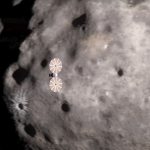
CAPE CANAVERAL, Fla. (AP) — NASA’s Lucy spacecraft on Wednesday encountered the first of 10 asteroids on its long journey to Jupiter.
The spacecraft on Wednesday swooped past the pint-sized Dinkinesh, about 300 million miles (480 million kilometers) away in the main asteroid belt beyond Mars. It was “a quick hello,” according to NASA, with the spacecraft zooming by at 10,000 mph (16,000 kph).
Lucy came within 270 miles (435 kilometers) of Dinkinesh, testing its instruments in a dry run for the bigger and more alluring asteroids ahead. Dinkinesh is just a half-mile (1 kilometer) across, quite possibly the smallest of the space rocks on Lucy’s tour.
Lucy’s main targets are the so-called Trojans, swarms of unexplored asteroids out near Jupiter that are considered to be time capsules from the dawn of the solar system. The spacecraft will swing past eight Trojans believed to be up to 10 to 100 times bigger than Dinkinesh. It’s due to zip past the final two asteroids in 2033.
NASA launched Lucy on its nearly $1 billion mission two years ago. The spacecraft is named after the 3.2 million-year-old skeletal remains of a human ancestor found in Ethiopia in the 1970s. Lucy will next swing past an asteroid named after one of the fossil Lucy’s discoverers: Donald Johanson.
One of two solar wings on the spacecraft remains loose. Flight controllers gave up trying to latch it down, but it is believed to be stable enough for the entire mission.
Wednesday’s flyby caps what NASA is calling Asteroid Autumn. NASA returned its first samples of rubble from an asteroid in September. Then in October, it launched a spacecraft to a rare, metal-rich asteroid named Psyche.
Unlike those missions, Lucy will not stop at any asteroids or collect any samples.
It will take at least a week for the spacecraft to send back all its pictures and data from the flyby.
Until now, Dinkinesh’s only been “an unresolved smudge in the best telescopes,” Southwest Research Institute’s Hal Levison, the lead scientist, said in a statement.
The Associated Press Health and Science Department receives support from the Howard Hughes Medical Institute’s Science and Educational Media Group. The AP is solely responsible for all content.