

South Carolina justice warns judicial diversity is needed in only state with all-male high court
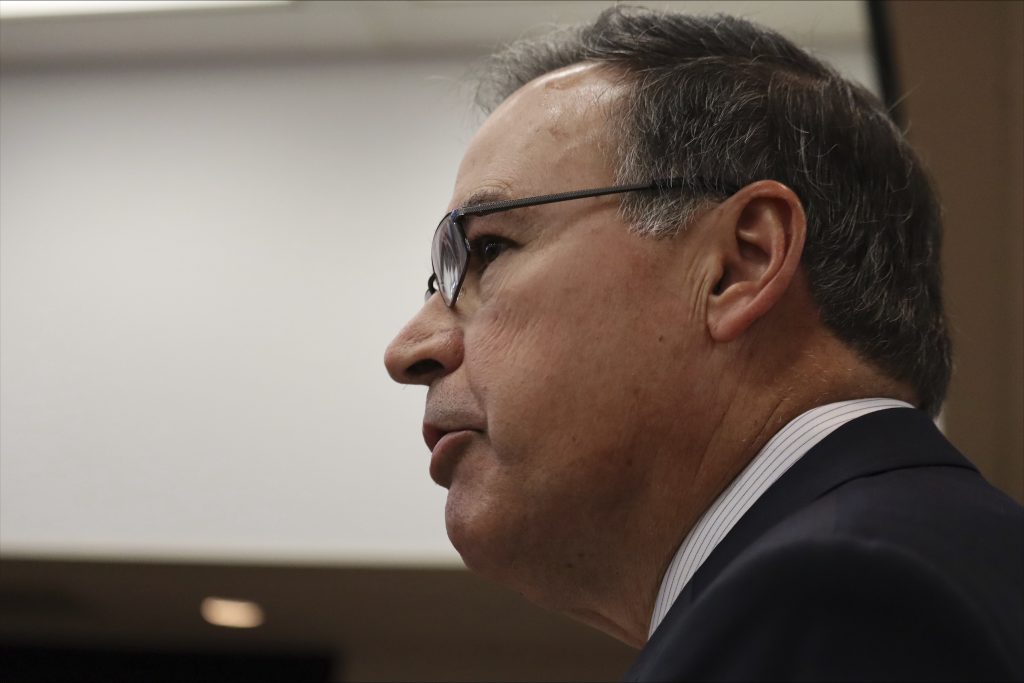
South Carolina Supreme Court Justice John Kittredge speaks at a legislative committee meeting on Tuesday, Nov. 7, 2023 in Columbia, S.C. Kittredge, who is expected to become the next chief justice, wants lawmakers to be mindful of the judiciary's diversity when selecting judges.
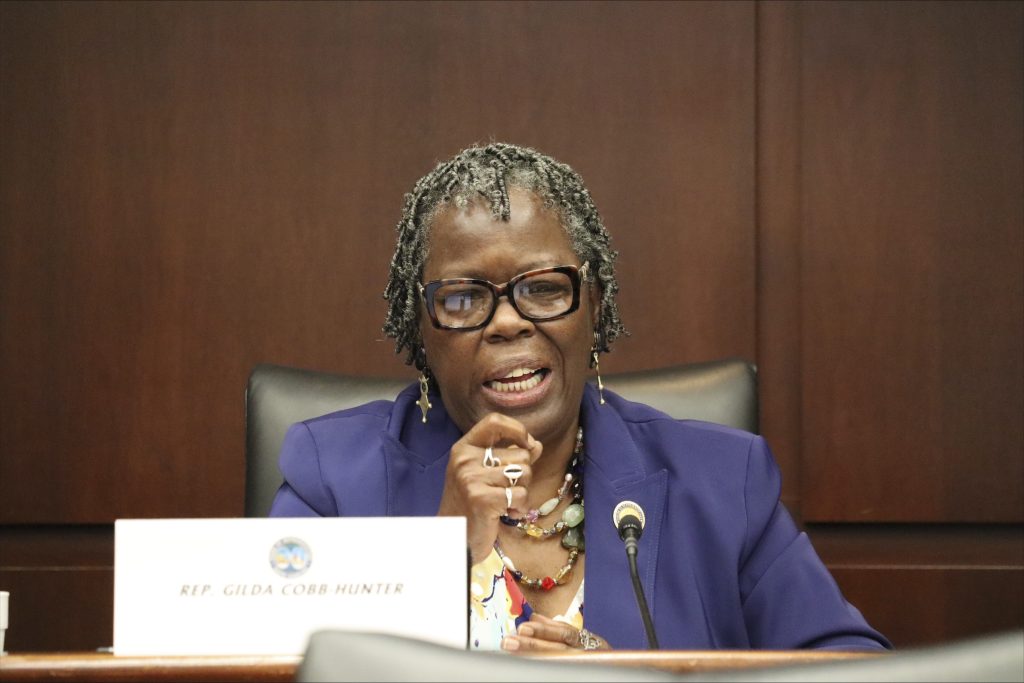
Democratic state Rep. Gilda Cobb-Hunter speaks at a legislative committee meeting on Tuesday, Nov. 7, 2023 in Columbia, S.C. Lawmakers are considering changes to the state process for selecting judges.
COLUMBIA, S.C. (AP) — The man expected to become the next chief justice of the South Carolina Supreme Court vowed Tuesday to support judicial diversity in the only state with an all-male high court.
Foregoing the usual black robe for a navy suit during a rare public appearance before lawmakers, Justice John Kittredge asked that a legislative panel weighing changes to the judicial selection process be sensitive to increasing the number of women and racial minorities throughout the bench.
“We have a great system. But if it does not reflect the people of South Carolina, we are going to lose the respect and integrity of the public that we serve,” said Kittredge, the lone applicant to replace retiring Chief Justice Donald Beatty, who is the only Black member of the state Supreme Court. “That belief by the public in the integrity of our judicial system is absolutely critical to a functional, working and fair justice system for all South Carolinians.”
His warning came toward the end of a year featuring several high-profile court decisions that have heightened interest in remaking the system of picking judges.
South Carolina’s process is fairly unique. The entire General Assembly elects judges after candidates are screened by a 10-person Judicial Merit Selection Commission that includes six legislators. The members conduct background checks, collect questionnaires and hold open hearings to determine applicants’ public standing, temperament and qualifications. The panel can approve up to three candidates per vacancy for the full legislature’s consideration.
Recent cases have highlighted the lack of diversity and given fodder to stakeholders across the political spectrum who believe an imbalance of governmental powers exists.
In February, the Republican-led Legislature replaced the only woman on the state Supreme Court — who retired after writing the leading opinion in a narrow January decision to overturn an abortion ban — with a man who later helped uphold similar restrictions.
In March, retiring Judge Clifton Newman received praise for his even-handed demeanor throughout the highly watched six-week murder trial of Alex Murdaugh. The saga also brought dismay to observers reminded that Newman is one of four recently retired or retiring Black judges in the state.
The next month, the state Supreme Court ruled that a judge acted outside his authority when he secretly reduced the sentence of a convicted murderer represented by a defense attorney who also serves as a lawmaker on the commission that vets judges.
Amid charges from elected prosecutors that undue sway is held by lawyers who are also legislators, Kittredge rejected what he called the “narrative that lawyer-legislators get preferential treatment.”
He noted that Democratic state Rep. Todd Rutherford — a so-called “lawyer-legislator” who sits on the JMSC — lost the spring ruling against the convicted murderer’s early release. He added that longtime Democratic state Sen. Dick Harpootlian failed to leverage his public office to win the Murdaugh case.
“Tell Sen. Harpootlian that the system is rigged in favor of lawyer-legislators,” Kittredge said.
Kittredge endorsed incremental tweaks, rather than a wholesale overhaul. He recommended that the General Assembly empower the executive branch by allowing the governor to appoint members of the JMSC. He also urged lawmakers to reconsider the three-person cap on the number of candidates that can be approved by the JMSC.
Republican state Rep. Tommy Pope, a lawyer himself, suggested that Kittredge’s focus on “big cases” ignored the smaller examples that make up the many axes others have to grind. Kittredge said critics tend to focus on the bad “optics” of the process because they cannot cite evidence of improper “lawyer-legislator” influence.
Democratic state Rep. Gilda Cobb-Hunter said public perception is still a problem worthy of lawmakers’ attention, and remained open to questions regarding the role of “lawyer-legislators” in the process. She referenced concerns that some lawmakers receive preferential scheduling for their legal cases. She added that the existing three-person limit could be a contributing factor to the lack of diversity.
Tuesday’s meeting marked the first of several scheduled hearings about the judicial selection process. Pope said the committee will focus next week on the criminal justice system and plans to take public testimony on Nov. 28.
—
Pollard is a corps member for the Associated Press/Report for America Statehouse News Initiative. Report for America is a nonprofit national service program that places journalists in local newsrooms to report on undercovered issues.