

The US Supreme Court notched big conservative wins. It’s a key issue in Pennsylvania’s fall election
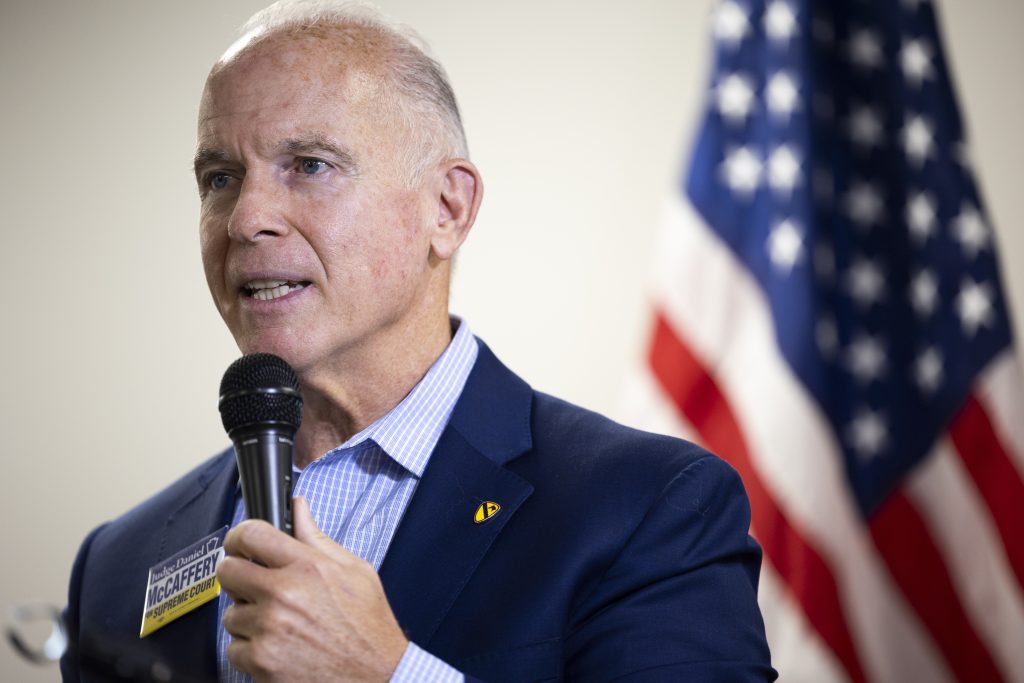
FILE - Daniel McCaffery, Democratic candidate for Pennsylvania Supreme Court judge, speaks at a women's organizing event and canvass launch hosted by the Montgomery County Democratic Committee, Sept. 30, 2023, in Norristown, Pa. The U.S. Supreme Court's current conservative majority has delivered major victories for conservatives, and now, liberal discontent over those rulings is playing a major role in Pennsylvania's top-of-the-ballot election this fall.
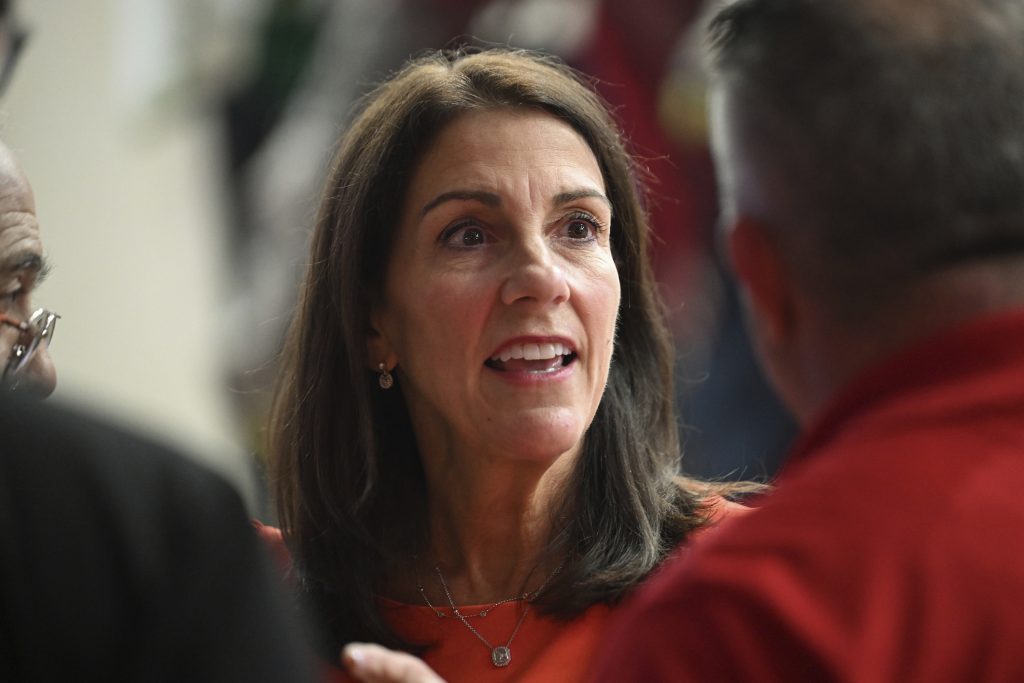
FILE - Montgomery County, Pa., Judge Carolyn Carluccio, Republican candidate for Pennsylvania Supreme Court, campaigns, Oct. 6, 2023, in Connellsville, Pa. The U.S. Supreme Court's current conservative majority has delivered major victories for conservatives, and now, liberal discontent over those rulings is playing a major role in Pennsylvania's top-of-the-ballot election this fall.
HARRISBURG, Pa. (AP) — The U.S. Supreme Court’s current conservative majority has delivered major victories for conservatives — and now liberal discontent over those rulings is playing a major role in Pennsylvania’s top-of-the-ballot election this fall.
The Democrat running for an open seat on Pennsylvania’s Supreme Court has told audiences over and over that the nation’s highest court poses a threat to rights that Democrats have fought for, now with three appointees by President Donald Trump giving it a 6-3 conservative majority.
Dan McCaffery, the Democrat, portrays his candidacy as a bulwark against a U.S. Supreme Court majority that he says is undoing federally protected rights and leaving it to states to fill the vacuum.
“We couldn’t do anything about the appointments of a federal judge, but in Pennsylvania we fight back, and the reason we fight back and the way we fight back is by getting judges elected,” McCaffery told an online audience of the Rev. Alyn E. Waller of Enon Tabernacle Baptist Church in Philadelphia.
Still, the campaign reflects the new reality in which political polarization is moving more deeply into the courts. Especially where state high court justices are elected, advocates across the political divide have come to realize the importance of controlling the courts at every level, on everything from abortion politics to civil rights to redistricting.
Abortion rights, for example, were the dominant theme in this year’s only other state Supreme Court contest, with the fate of Wisconsin’s abortion ban on the line. A Democratic-backed Milwaukee judge won the high stakes Wisconsin Supreme Court race, ensuring liberals would take over majority control of the court for the first time in 15 years.
That election followed the U.S. Supreme Court’s decision last year to overturn Roe v. Wade and end nearly a half-century of federal abortion protections — igniting court battles over abortion rights at the state level.
On the ballot in Pennsylvania, McCaffery’s opponent for the seat is Republican Carolyn Carluccio, and the election won’t change the fact the state high court has a Democratic majority, currently 4-2.
But the U.S. Supreme Court is perhaps McCaffery’s most frequent target when he is asked about the race, his candidacy or the courts.
“The U.S. Supreme Court, if nothing else, they have really crystallized in Americans’ minds how important electing judges and judges who share your values to these courts that will either protect those rights or will scale those rights back,” McCaffery told another Democratic audience.
Like in Wisconsin’s race, Democrats in Pennsylvania’s high court race have drummed on the court’s abortion ruling, making it a key avenue to attack Carluccio. McCaffery frequently raises that decision and a couple others in trying to make the case that other rights are on the line as well.
To the audience at Waller’s predominantly Black Enon Tabernacle church, McCaffery noted that the U.S. Supreme Court in June had struck down affirmative action in college admissions, declaring that race cannot be a factor.
At other times, he has pointed to a defeat for gay rights in which the U.S. Supreme Court’s conservative majority ruled that a Christian graphic artist who wants to design wedding websites can refuse to work with same-sex couples.
Carluccio suggested McCaffery is a hypocrite.
“I think it’s a little bit ironic that he talks about them, he mentions three judges in particular, calls them activist judges, says ‘they’re taking away all these rights’ and all this, and yet he’s willing to go out there and say that ‘I won’t put up with this’ and ‘the document is living,'” Carluccio said in an interview. “It’s almost like he wants to have his cake and eat it, too.”
Carluccio declined to discuss her views on issues or the U.S. Supreme Court.
McCaffery, however, says Carluccio will be just like the U.S. Supreme Court’s conservatives on a state bench that has been pivotal in major voting rights cases, including rejecting GOP-drawn congressional districts as unconstitutionally gerrymandered and rejecting a Republican effort to overturn the 2020 presidential election in the battleground state after Trump, a Republican, lost to Joe Biden, a Democrat.
McCaffery’s targeting of the highest court comes at an important time for the institution.
Ethical questions are swirling around the court, and public trust in the institution has dipped to a 50-year low.
About one-third of Americans say they have hardly any confidence in the people running the U.S. Supreme Court, with Democrats (50%) and Independents (39%) more likely than Republicans (18%) to say this, according to an October poll from The Associated Press-NORC Center for Public Affairs Research.
The court’s rightward shift, however, has not necessarily brought with it a higher penchant to override court precedent or laws.
Jonathan Adler, a law professor at Case Western Reserve University in Cleveland, said the current court is overturning precedent and striking down legislation at a significantly slower rate than its post-war predecessors.
“That’s different than what a lot of people assume,” Adler said in an interview.
The courts of Chief Justices Earl Warren and Warren E. Burger that McCaffery sees as expanding rights were far more aggressive than the current court, led by John Roberts, Adler said.
The current composition of the court is relatively new, however, and the court’s conservative majority could become more aggressive over time, as litigants work to bring cases to it, Adler said.
McCaffery warns about that, pointing to Justice Clarence Thomas’ call last year for his colleagues to do more and to revisit the court’s cases acknowledging rights to same-sex marriage, gay sex and contraception.
“These are issues that are basically being slowly stripped away, like the layers of an onion,” McCaffery said in a livestreamed Pennlive.com editorial board interview. “And they’re being thrown back into state courts.”
AP polls and surveys reporter Linley Sanders in Washington contributed to this report. Follow Marc Levy at twitter.com/timelywriter.