

Shoaf played at Brownsville, Wabash
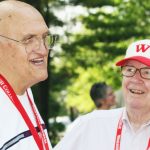
Former Brownsville High School football standout Gil Shoaf was a giant during the era of football that he played in and, oddly enough, he wound up playing his college football for a team called the “Little Giants.�
Shoaf was a massive lineman at 6-5 and 300 pounds.
“I was pretty big for the day,� Shoaf joked. “I was big, but I didn’t move like the guys can today.�
He was a part of some competitive teams at Brownsville on teams that posted records of 3-4-2 in 1950, 6-4 in 1951 and 5-5 in 1952.
“I really started getting significant playing time my junior year,� Shoaf stated. “I played a little bit as a sophomore. I played tackle on offense and middle guard on defense.�
Brownsville was a part of the Big Six and played some tough teams like Donora and Charleroi, but Redstone was always the main rival.
“They were knock-down, drag-out affairs,� Shoaf recalled. “We had a long winning streak against Redstone dating back before me and coming up through my years, but we ran into a buzz saw by the name of Bobby Locke, he was an outstanding football player at Redstone, he was an outstanding athlete. They beat us when Locke played.�
Shoaf was very aware of Brownsville’s great football tradition and his family was a big part of that legacy.
“My folks and my family were friends with the Sutton family,� Shoaf said. “My brother Jim and my brother Joe played at Brownsville before me. Jim played college ball at Iowa.�
Shoaf played for Warner Fritsch during his playing days at Brownsville.
“I had a good relationship with Fritsch,� Shoaf said. “He was more with the lineman than he was with the running backs, but he was the head coach and was in charge of everything. We had a guy named Charlie Slick who was a good assistant coach, he was a hard worker and Fritsch was the same way.
“We had some talented players like Ace Grooms, who was a year ahead of me. He was a good all-around athlete, he was very talented.�
Shoaf was named second-team Class AA by the Uniontown Evening Standard in 1952.
Track was another sport that Shoaf participated in at Brownville, his events were the shot put and the discus.
“I did not have much success in track,� Shoaf offered. “To be honest with you, I was just trying to use it as a method of keeping in shape.�
When Shoaf graduated from Brownsville in 1952 there were some schools interested in giving him a football scholarship.
“I had a couple of offers from Pitt, I was going to visit Tennessee and Miami (Fla.),� Shoaf explained. “My senior year in high school was the year that they dropped the two-platoon system in college football. When you went to college you had to play both ways. My teammate at Brownsville, Tom Marchando, had several scholarship offers, but when they made the rule that you had to play both ways, they thought that Tom was too small and I was too big.
“Tom and I talked it over and we were both losing scholarship offers. We had a contact from Wabash College, his name was Owen Huntsman and he recruited Pennsylvania, he and his wife graduated from Thiel College. He was a great salesman. Tom and I both decided to go to Wabash College.�
Shoaf was a part of some solid teams for the Wabash Little Giants. They were 6-2-1 in 1953, 7-1-1 in 1954, the loss was to Ohio Wesleyan 28-14 and the tie was with Bradley 7-7. In 1955, Wabash finished with a record of 5-3-1 and they were 6-2-1 in 1956.
“Our record while we were in school, we averaged 6-2-1,� Shoaf said. “We had some talent and as a matter of fact our starting line had nine players from Western Pennsylvania. Our head coach was Garland Frazier, he was kind of low key, he wasn’t as domineering as some coaches are. He wanted the most he get out of you, but he was quiet. He demanded that you play ball and get the job done.�
Shoaf was named Honorable Mention Little All-America in 1956.
Wabash started a wrestling program in 1956-67 and Shoaf, who didn’t wrestle in high school, was part of a team that went 6-3 in its first season.
“We held our own,� Shoaf stated. “It was a starting program where we learned, Tom Marchando and I both wrestled and we learned from kids that came to our program from high school programs. I won most of my matches and did fairly well.�
Shoaf is glad that he made the decision to go to Wabash.
“Marchando and I went to Wabash with the idea that we were going to get an education and we did,� Shoaf said.
The Philadelphia Eagles drafted Shoaf in the 11th round of the 1957 NFL draft.
“I got drafted and went to training camp in Hershey,� Shoaf recalled. “I got hurt, I had a bad knee prior to going to Wabash and when I got to the pros I hurt the knee and that was the end of my pro football career.�
Shoaf went to work in northwest Indiana in the steel business. He then worked for the Simmons mattress company for four years. He then went to work for the Paul J. Smith sporting goods company. He took over the company after Smith died. He broke away and formed his own sporting goods company and owned the company for 20 years. He retired in 2000.
His wife, Patricia, passed away four years ago. Shoaf, 79, resides in Schererville, Ind. He has two daughters, Dawn and Candice. Dawn has three adopted children and Candice has two adopted children.
Shoaf was inducted into the Wabash College Athletic Hall of Fame in 1988.