

Duck hunting more about education than success
Something about hunting ducks grips my imagination. I like fooling with decoys and sneaking around in man-powered boats. I also like being in swamps and marshes, those mucky places the naturally energetic American perspective long considered “wasteland,� but to which our lately-enlightened society now affords some official recognition as “wetland.�
Around here, you have to be inquisitive and a little creative to be a waterfowler. This being an upland landscape, we don’t have extensive wetland habitats like some regions. To even pretend at duck hunting you need to remain always attentive during routine pursuits throughout the year, watchful for low swales among hills, curious about the impounded upper reaches of reservoirs, resolved to investigate meandering stream bends, indebted to beavers.
You also need to be aware of weather, hoping that a northern cold front pushes some migrating mallards or teal through during our short, one-week, early, South-Zone season (which ended Oct. 24), or that fall rains swell shallow streams, making them accessible by kayak or canoe. It’s rare that all those factors come together when it’s legal to hunt.
I don’t bag many ducks in my exploratory efforts but I do see interesting things. A couple of weeks ago, anchored (meaning grounded on a mud flat) in my kayak, a splash sounded from the starboard side. A blue-and-white flash rose from the mire and a kingfisher alighted on a snag 20 feet beyond my bow. The bird grasped a three-inch fish in its bill at about mid-body. Once comfortably perched, the kingfisher slammed its catch against the wood with violent jerks of its head and bill. The resulting “slaps� were surprisingly loud, suggesting the fish would be, at very least, stunned senseless when consumed. I looked forward to watching the avian angler gulp down its prey, but it flew off to another perch to finish the meal.
On that same duck-less vigil, six lovely Canada geese dropped, honking and hooting, onto open water amid my decoys, a stirring event to behold. But, alas, we live in a world of wildlife-rules (thankfully) and though the geese were vulnerable and well within range, they were also well out of season.
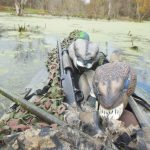
Floating green mats of duckweed and algae surrounded my hide and a muskrat entertained me while I waited for mallards that never arrived. The muskrat would surface amid the thick vegetative “soup� and plow through with snout poked high and its long rat-like tail sweeping, snake-like, behind. The ‘rat made a dozen trips back and forth across the swamp, sometimes within five feet of my concealed kayak, but it never saw me.
I learned something about bluebirds while sitting there–well, I actually learned later when I related this to a biologist friend. Five or six eastern bluebirds seemed deeply interested in a dead woody snag that poked from the water nearby. The snag featured a round hole where a limb had died and fallen away. The bluebirds took turns entering the cavity, rummaging around and then emerging with some bit of debris in their bill, which they promptly dropped.
Bluebirds, of course, require such holes for nesting. But nesting is a spring-time event, and this was October. My friend told me that bluebirds roost communally in such cavities throughout the year. They fill the space with six, eight or a dozen birds and share the common body-warmth during cold nights on their fall migration southward. I hadn’t known that. So, the ones I saw must have been preparing that night’s refuge.
On the last day of the early season a great blue heron winged in from behind me and alighted on a branch to my left, squawking out its hoarse croaking call as it settled in. But herons are built to detect the slightest motion of fish or frog, and they don’t miss much. It must have seen my involuntary jerk of surprise, and it launched off again as quickly as it appeared. They are huge birds, long of bill, neck, wing and leg, all capped by a pair of big yellow eyes. When you watch a heron it’s hard to avoid the conclusion that–yeah, birds and dinosaurs do share some distant but common kinship link.
Sometimes, I actually get a shot at a duck. I was dragging my kayak across the dry-land margin of a beaver swamp when a big greenhead mallard drake flushed straight up from behind an undercut bank. That mallard rose in seemingly odd leisure, wings pumping slow-motion while the iridescent head, so near, blazed in October sun.
I mounted the gun with resolve, dead-sure of a kill, swung the sight up through the ascending mallard to the bright yellow bill and squeezed. The duck’s continued ascent stunned me. The lead had looked perfect and I could not comprehend a miss. Somehow that pattern of shot had fitted itself perfectly around that duck’s outline and it flew off unscathed. That’s my story anyway and, as they say, I’m sticking to it.
The late duck season opens here in Pennsylvania’s South Zone on Nov. 14 and runs through Jan. 14. Time to dress warm for the fun to come.