

Fire and ice: Mike Sullivan is the rock on which Penguins stand
PITTSBURGH – On a recent spring morning, Mike Sullivan stood stoically at center ice at PPG Paints Arena shouting instructions to his players. Through his thick New England accent, Sullivan was dropping R’s — “skate hahd!” “fastuh!” – and knowledge on the Penguins.
The players dutifully obliged, moving briskly around the coach, retrieving pucks scattered around the giant Penguins logo, then skating in and firing shot after shot on the two goalies at either end.
A regular observer notes that this is the most hands-on he’d seen Sullivan during Penguins’ practice in some time. Coming off a dismal loss to Philadelphia two nights earlier, the Penguins’ third straight defeat and first in regulation, Sullivan was, apparently, leaving nothing to chance with the start of the Stanley Cup playoffs on the horizon.
It was a bit of a throwback for the 49-year-old coach, who before landing the Penguins job last December, had spent much of the previous decade toiling as an assistant, often instructing players and setting up drills in a similar manner.
But make no mistake, “Sully,” the most Bostonian of nicknames, is in charge.
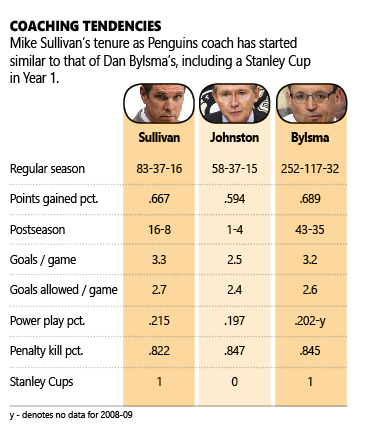
Mike Sullivan’s tenure as Penguins coach has started similar to that of Dan Bylsma’s, including a Stanley Cup in Year 1.
Despite a laundry list of injuries that had recently shelved Evgeni Malkin, Kris Letang and seemingly the rest of Pittsburgh’s defense corps, Sullivan has the Penguins in a good place.
The Penguins will make their 11th straight postseason beginning Wednesday for Game 1 of the Eastern Conference quarterfinals against Columbus after finishing with the second-best record in the NHL this season.
Given all the injuries, it’s a remarkable feat. Then again, after last year’s run to the franchise’s fourth Stanley Cup, maybe it shouldn’t be any surprise.
While Toronto’s Mike Babcock, Edmonton’s Todd McLellan, and Columbus’ John Tortorella have garnered most of the attention for the Jack Adams Award as the NHL’s top coach, the Penguins believe Sullivan should be at the forefront of that conversation.
“I think with the injuries we’ve had this year, going all the way last year, all the challenges that you’re faced with when you try to do it all over again, it’s not easy,” Penguins captain Sidney Crosby said. “I think guys have played a lot of different situations and he’s had to juggle the lineup a lot. I think him and the coaching staff deserve a lot of credit.
“It’s not easy to lose so many guys, especially the guys — (Kris Letang), who logs a lot of ice time, different guys, top three-four defensemen in ice time at one point — it’s good that you find a way, but they certainly deserve a lot of credit.”
—
When Jack Parker recruited Sullivan to Boston University in the fall of 1986, it was a bit of a coup to land a player who had attended Boston College High School, just three miles west on Commonwealth Avenue.
The Terriers’ legendary coach’s first impression wasn’t “this kid is going to be a future coach,” but Sullivan’s leadership skills were fairly evident to him even at a young age.
“I remember thinking to myself that he was going to be captain of the team when he was a senior because he was a real mature kid and very determined, about as good as you can be,” said Parker.
The third-winningest coach in NCAA Division I hockey history and owner of three national championships then laughs.
“I also thought he was going to be a real good player if he could get a little quicker,” he said. “I thought he had good size coming out of high school but he wasn’t as quick as I thought he’d be. (But) that got dispelled quickly when he got on the ice with us. He was much better skater than I gave him credit for and he got much better as he progressed.
“Once we got him, it was obvious he was going to have a chance to play at the next level.”
Speed, as it turned out, would later serve Sullivan’s teams well in Pittsburgh, but strong fundamentals were part of his game going back to his youth.
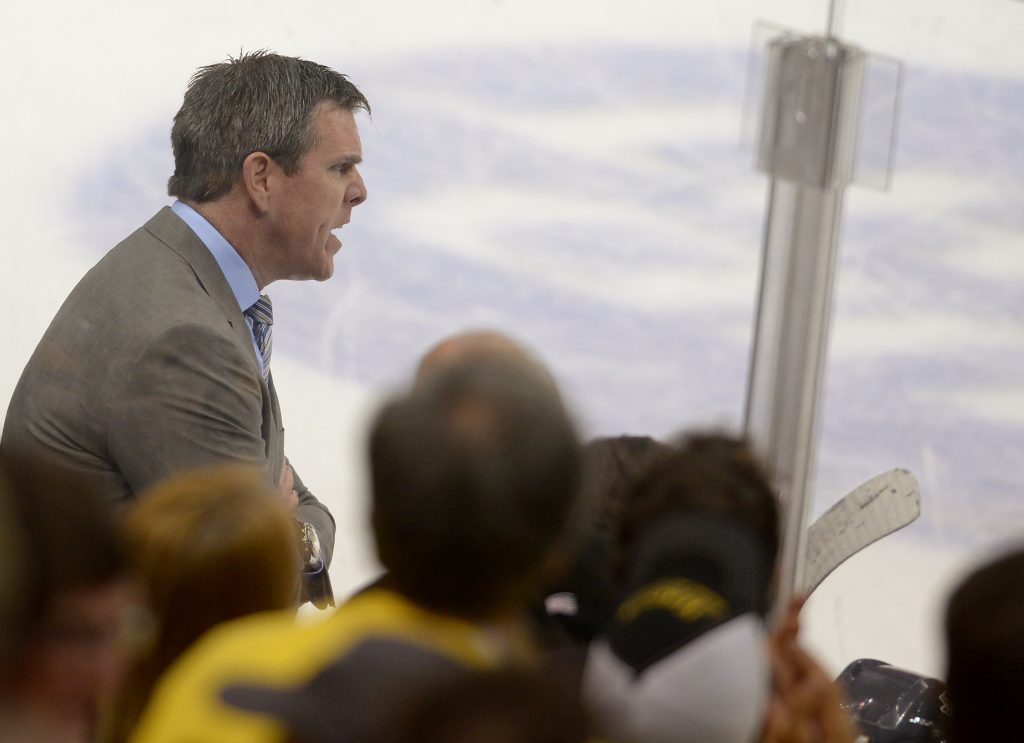
Kevin Lorenzi/The Times
Penguins head coach Mike Sullivan yells from the bench during the third period of the Penguins’ 2-1 win in Game 7 of the Eastern Conference final on Thursday at Consol Energy Center in Pittsburgh in 2016.
Sullivan grew up in Marshfield, a stone’s throw from Plymouth Rock along Cape Cod Bay on the Massachusetts coast. And like many kids his age, George and Myrna Sullivan’s son was bitten hard by the hockey bug during a golden era for the game.
Though always popular in the area, high school and college hockey in particular, the sport reached new heights during Bobby Orr’s heyday. Buoyed by the success of the Big Bad Bruins, the Metropolitan District Commission constructed rinks throughout eastern Massachusetts in the ’70s, making ice time readily available.
Then, in 1980, when Sullivan was an impressionable 12-year-old, Mike Eruzione and Jim Craig – two of Parker’s star pupils at BU – helped lead the U.S. Olympic team to the greatest upset in sports history at Lake Placid.
“I remember vividly watching the (Soviet Union) game and the influence that it had on me as a young player at the time,” Sullivan said. “I think those types of experiences or those types of influences, they can’t help but continue to foster participation in the game. That’s what they did in the New England area and certainly for me as a young player.
“You look at those experiences when you’re in the driveway or on the pond and you’re playing games and your imitating those types of experiences and trying to visualize and envision yourself in that circumstance.”
The New York Rangers made Sullivan their fourth-round pick (69th overall) in the 1987 draft, but he opted to stay in school. In his four seasons at BU, Sullivan was nearly a point-per-game player, registering 138 points (61 goals) in 141 games and captained the Terriers — along with Tony Amonte and Shawn McEachern — to the NCAA Frozen Four in 1990.
Boston University hockey was very much a family affair for the Sullivans. George, an accountant at State Street Bank in Boston, attended every game. Myrna, a full-time nurse and mother of five, was a “mother hen” for the program, taking care of out of town players, according to Parker.
“A real nice family,” he said.
—
After breaking into the NHL with the expansion San Jose Sharks in October 1991, Sullivan went on to play parts of a dozen seasons with San Jose, Boston, Calgary and Phoenix. By no means was Sullivan a star – he never scored more than nine goals or 21 points in a season — but one doesn’t last 709 games in the NHL by being merely good. It takes hard work, dedication and a meticulous attention to detail. Sullivan was an honest, prototypical, bottom-six center. Of his 54 career goals, 16 were shorthanded. As a player, Sullivan never won the Stanley Cup, never even advanced beyond the first round.
According to Hockeyfights.com, Sullivan had just one career fight, a 1992 bout against the New York Islanders Rich Pilon, a defenseman “immortalized” in a statue outside PPG Paints Arena being burned by Mario Lemieux.
Sullivan was out of the league by 2002 at age 33 but far from out of the game. As his playing career was winding down, Sullivan turned his eye toward his future.
“I didn’t think he’d be dumb enough to get into coaching,” Parker said.
But the coaching seeds were planted, Sullivan said, by watching and playing for Parker at BU.
“We learned so much about the game from him,” Sullivan said. “I was always so impressed with his ability to articulate the game in a simple way, so that we could take what his message was and apply it. I think that’s the challenge that we all have as coaches: We have to find ways to simplify the game and be able to articulate it and communicate it to our players and get them on the same page and working cooperatively in the same direction.
“I think Jack is as good as I’ve seen coaching-wise to make that happen. The impression that he made on me early in my college career was probably the first hint of, ‘Jeez, this is something that I’d like to try someday.'”
Just 10 months after playing his final game, Sullivan was behind the bench of the Providence Bruins, Boston’s top minor-league affiliate.
After posting a 41-17-9-4 record in one season in the AHL, Sullivan was promoted on June 23, 2003, becoming the 26th coach in Boston Bruins’ history and, at the time, the youngest coach in the NHL at 35. For a kid who grew up a B’s fan, it was a dream come true. And for a season, it was.
Led by Joe Thornton and rookie Patrice Bergeron, the 2003-04 Bruins won 41 games and posted 104 points, their most since the heydays of Ray Bourque and Cam Neely. The Bruins won the Northeast Division but lost their first-round series to longtime nemesis Montreal in seven games.
But whatever momentum Sullivan had built was lost the following fall when the 2004-05 season was wiped out by a labor dispute. In Pittsburgh, the NHL lockout helped the Penguins land the No. 1 overall pick in the 2005 draft, a phenom from Nova Scotia, but it effectively cost Sullivan his job in Boston.
When the league resumed play, the Bruins, who didn’t retain many veterans, stumbled badly. Off to an 8-13 start, the Bruins dealt Thornton to San Jose in a shakeup that backfired. Sullivan went 29-37 and wasn’t retained by incoming general manager Peter Chiarelli.
“I think he earned an awful lot from that,” Parker said of Sullivan’s experience with the Bruins. “I think you make mistakes, you see how to handle players. How to handle the general manager and the people above you.”
—
Other with Parker, no coach has had a greater influence on Sullivan than John Tortorella, another gruff, straight-speaking Bostonian. Coincidentally, Tortorella will be Sullivan’s counterpart in the Penguins’ first-round matchup against the Blue Jackets.
From 2007-14, Sullivan served as an assistant under Tortorella in Tampa Bay, the New York Rangers and Vancouver. In that role, Sullivan was able to play the good cop to the fiery Tortorella’s bad cop. But in a prescient gesture, knowing that Sullivan yearned to be a head coach and fearing that his colleague and friend might be typecast as a career assistant, Tortorella requested that the two part ways. Sullivan quickly joined the Blackhawks’ player personnel department. In his first season not being on the ice, he helped Chicago win the Cup in 2015.
As GM, Ray Shero guided Pittsburgh to the Cup in 2009 when he replaced Michel Therrien with Dan Bylsma as coach. Seven years later, and a year after he was fired in Pittsburgh, Shero inadvertently helped the Penguins win again.
When Shero plucked John Hynes to be the head coach of the New Jersey Devils, it created an opening for the Penguins in Wilkes-Barre/Scranton.
“He kind of got stuck in an assistant coach’s mode for a while and it’s kind of hard to go back to be a head coach in the minor leagues after you’ve been a head coach and assistant coach in the NHL,” Parker said. “But he knew he had it in him, that he had another run as a head coach and you want to get that chance and that was the best way to do it: To go to Wilkes-Barre.”
Wanting a coach with a track record of development, new Penguins GM Jim Rutherford tabbed Sullivan for the Baby Pens’ job. Little did anyone know that Sullivan’s time in the AHL would be short-lived. With the Penguins scuffling out of the gate under Mike Johnston, going 15-10-3, Rutherford had seen enough by Dec. 12.
Even in a league filled with coaching retreads, rarely does one get the chance to write a second act a decade later. Yet, there Sullivan was, older and wiser, back behind an NHL bench.
No, the Penguins didn’t take to their new coach instantly. They lost their first four games. But Sullivan was able to quickly establish an identity that had the Penguins play to their strengths: Speed and skill.
Those traits served the Penguins well. Not only did they go 33-16-5 under Sullivan down the stretch, they did something in the postseason that no one could have accused of them of since 2009: They played to their potential. The Penguins had the goods to win the Cup in 2010 and ’12 and ’13 and ’14. But in 2016, a team of chronic underachievers may have even overachieved under Sullivan.
As much as the brilliance of Crosby, the timeliness of Phil Kessel, the goaltending of Matt Murray and the Penguins’ team speed, Sullivan was as big a reason as any for the Cup win.
Sullivan challenged star players Crosby, Malkin and Letang to elevate their games. Much to Parker’s delight, Sullivan relied heavily on speedy U.S. college products, an astounding 15 of them, including Nick Bonino, Conor Sheary and Bryan Rust.
“When I first got here last year from Edmonton, I wasn’t playing much,” said Penguins defenseman Justin Schultz, a former University of Wisconsin star who flamed out with the Oilers but has found success with Sullivan in Pittsburgh. “They just played me to my strengths and it helped me get my confidence back and started building it up.”
By winning the Cup in his first season, Sullivan clearly earned his place in Penguins’ lore. But he won over Pittsburgh fans, disillusioned by the postseason disappointments of the previous seven springs, with two simple words: “Just play.”
Actually, Sullivan’s motto morphed into “shut up and play” during the second round series against Washington when the coach was caught on camera berating his team on the bench after the Penguins appeared to lose their composure after a questionable call against them.
Under Sullivan, there’s no whining, no excuse-making.
“He likes to keep his players abreast of what he’s thinking,” Parker said. “He doesn’t want any surprises with his players. One of the things I always did and I think Mike does even better, he is extremely sincere with his players and lets them know where they stand all the time and he’s not trying to con them. It’s ‘this is what it is, we’d like to do that and if you don’t want to do it? Then don’t. We’ll find someone else who will.'”
—
Even after winning the Cup last spring, it could be argued that this season has been Sullivan’s finest coaching job, worthy of Adams Award consideration.
“There’s a lot of good coaches out there, (but) the job he’s done here and turning it around here, obviously a really good season so far this year, he has to be one of the top candidates for sure,” Schultz said.
Sullivan has gotten the most out of a team that has battled injuries all season long, yet has shown no signs of a Cup hangover. Before their four-game skid in late March, the Penguins’ longest losing streak had been just two games.
After winning the Conn Smythe Trophy as playoff MVP last spring, an inspired Crosby never slowed down, winning MVP at the World Cup of Hockey and leading Canada to the title in September. He’s followed that up with what Mike Milbury – yes, him — said is the best hockey of the Penguins captain’s career. Crosby led the league in goals for just the second time in his career and finished in the top five in the points race.
That’s a compliment to Crosby, of course, but also to Sullivan.
“It’s hard to handle superstars and mix in the younger guys that are on their way to being real good players in the NHL,” Parker said. “He’s done a masterful job of handling personalities and egos, and rising egos.”
Of course, repeating as Stanley Cup champion will be difficult, and nearly 20 years of recent history suggests it’s impossible. Even Joel Quenneville’s Blackhawks haven’t done that. The last team to win consecutive Cups was the Detroit Red Wings in 1997-98.
Since the 1967 expansion, only four coaches have led teams to consecutive titles: Philadelphia’s Fred Shero, the New York Islanders’ Al Arbour, Edmonton’s Glen Sather and Scotty Bowman, who did it with both Montreal and Detroit. Not coincidentally, all four are enshrined in the Hockey Hall of Fame.
No one is putting Sullivan in that class yet, but dare to dream. The challenge might seem daunting but Sullivan, true to form, isn’t backing down from it.
“It’s a hard trophy to win. It might be the hardest trophy in all of sports (to win),” Sullivan said. “Our health is going to be important for us. We’re going to have to have the commitment level to play the game our way as we say, and defining that for our group.
“I think given those things, we believe in this group that we have. As I said to the players, nothing is an inevitability. Just like last year, it wasn’t an inevitability that we won the Stanley Cup. We have to go out and earn it, and we have to earn it. Just because the statistics or the history says we can’t, we can’t treat that it’s inevitable either. We believe that we have what it takes to win. We’re going to do everything in our power to try and make that happen.”
Parker, for one, wouldn’t be surprised if it does happen again for Sullivan and the Penguins.
Four years after he retired from Boston University, Parker is still coaching. Sort of. A few days earlier, Parker said Sullivan called asking for advice about an issue. Turns out, Parker was more of a sounding board. Sullivan had already figured out his answer.
“I’ve been proud of him for a long time,” Parker said. “I knew he’d be a success at whatever he did.”