

Rat snake an interesting, harmless local reptile
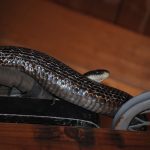
At least two readers I know will register complaints after reading this. They鈥檝e warned me to warn them before any snake photos appear in this column. I respect their ophidiophobia but sometimes ideas for column content don鈥檛 come until late in the cycle, so there鈥檚 no time for customized cautions. And then, other readers might benefit from the same information.
This idea came from just such a reader, who expressed her loathing for all snakes but was desperate for some understanding of the large black-colored snake she鈥檇 seen slithering inside an old barn on the place. Even though she admitted to 鈥渉ating snakes,鈥� she needed to re-enter the barn frequently, so was willing to learn all she could about the intruder 鈥� a decidedly rational approach.
Whether the subject is birds, trees, flowers or snakes, noting a few details about size, color, location and behavior provides a fairly reliable prediction of the identify of any wild thing. This reader described a uniformly black-colored snake, between four and five feet long, that had climbed up among the rafters of the aging structure. She encountered the snake while looking for some item she鈥檇 stashed up there.
From the clues she provided, I assured our reader that the creature inhabiting her barn was a black rat snake, harmless and beneficial. 鈥淏lack rat snake鈥� is the accepted name for the serpent we commonly call simply 鈥渂lack snake.鈥� It鈥檚 called a rat snake for a reason. It will eat every rat it can find, and our reader is less likely to encounter rodents in her barn because of its invasion.
The black rat snake is the largest serpent inhabiting the northeastern and Appalachian regions. Some specimens have reached over eight feet in length but the ones typically encountered range from three to five feet. Black rat snakes are one of the few snakes in our region that are skilled climbers. So, when you consider the combined observations cited 鈥� uniform black color, large size, and climbing ability 鈥� the process of elimination yields 鈥渂lack rat snake鈥� with confidence.
Black rat snakes are abundant but that commonness makes them no less interesting. One distinguishing trait is the shape of their body in cross-section. If you could view a 鈥渟lice鈥� of the body of most snakes, it would appear circular. But a rat snake鈥檚 body in cross-section resembles a loaf of bread 鈥� domed at the top, with straight, vertical sides. This provides the rat snake with a broader base, an aid in climbing. Black rat snakes are an upland species, closely associated with forest, old fields, barns and outbuildings. They are seldom found around water. A high proportion of snakes killed by cars on local roads are black rat snakes.
Black rat snakes have no venom, nor fangs to deliver it. Their jaws are lined with sharp but small teeth that hold onto prey seized in the snake鈥檚 mouth. These snakes kill their prey by constriction. Once a rat snake has grabbed some unfortunate small animal with its jaws, it coils around the prey with loops of its muscular body, then squeezes tightly until the animal suffocates. When the prey animal stops struggling, the snake swallows it whole.
The temperament of this reptile toward humans is variable. Most are docile and can be handled freely, if you鈥檙e so inclined. Other individuals are more surly and will strike and bite if disturbed. But no black rat snake ever mistook a human for something it could eat. Therefore, it wants no contact with humans if it can avoid it. Left alone, it will peacefully pursue its secretive life. Their diet consists entirely of small mammals and birds, sometimes birds鈥� eggs. Rats, mice, voles, moles and chipmunks likely make up the bulk of any rat snake鈥檚 menu.
Here in southwestern Pennsylvania, we live near the heart of the black rat snake鈥檚 range. It occurs from central New England, west to eastern Kansas and Oklahoma, and south to northern Georgia. Other species of rat snake, notably the yellow rat snake, gray rat snake, Everglades rat snake, red rat snake (corn snake) and Texas rat snake live along the southern Atlantic and Gulf coasts, and the Mississippi Delta region.
Sometimes, after they鈥檝e shed their skin (a natural process that can occur several times each year), black rat snakes will exhibit a faint pattern of white and brick-red tints among the black scales. This coloration is much stronger in young individuals. Some people use that faint and temporary color as justification for the old fable: 鈥渂lack snakes are mating with copperheads, and they鈥檝e become poisonous.鈥� That myth isn鈥檛 true and it never was. Don鈥檛 believe it.
Now, in mid-summer, anyone who enjoys the outdoors might potentially encounter a snake. Most are entirely harmless. Those which are potentially dangerous 鈥� timber rattlesnake and northern copperhead 鈥� are normally shy, non-aggressive and live in remote mountainous places. Fear of snakes is no reason to shut oneself inside. A little knowledge can tame the phobia, and will even help one reader work in her barn.