

Hunting ringnecks in South Dakota gives Great Plains perspective
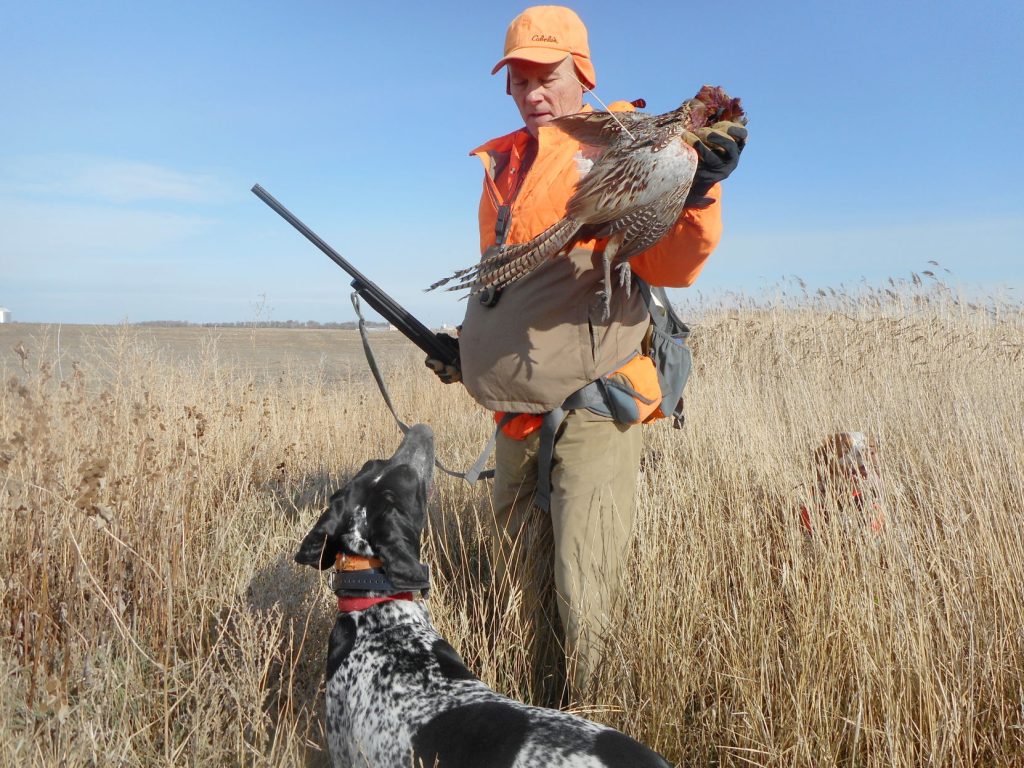
Chip Brown of State College accepts a South Dakota ringneck rooster retrieved by Lucy, one of his three German shorthair pointers.
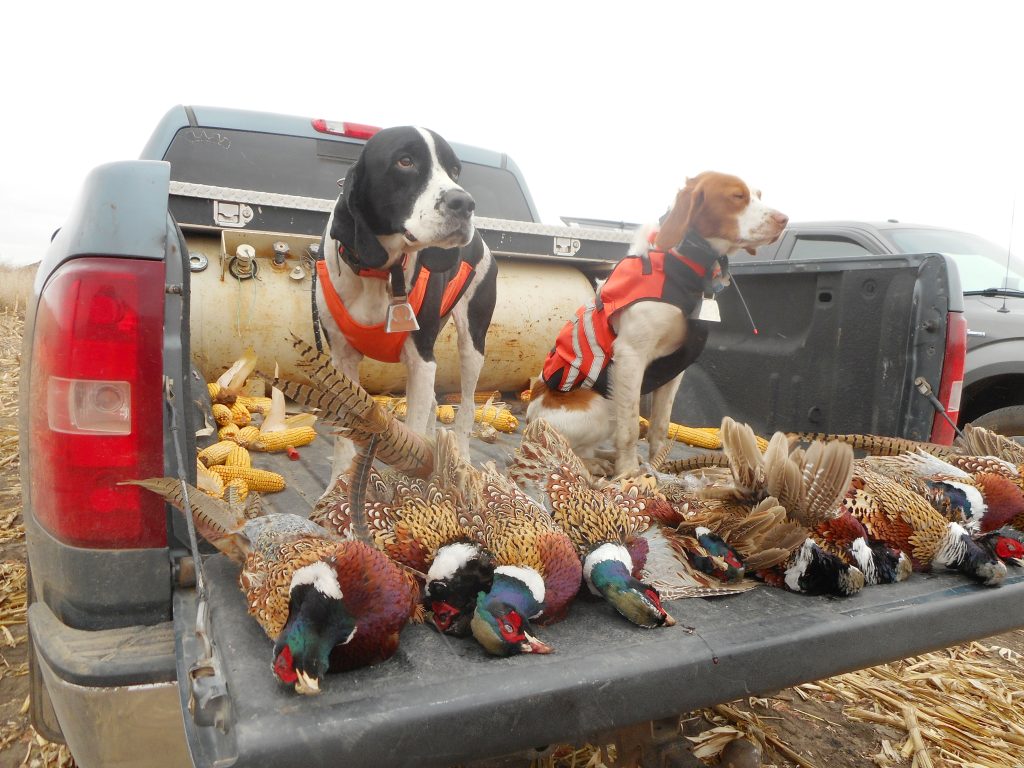
Kevin Gather鈥檚 Springer spaniel, Max and Dennis Ford鈥檚 Brittany spaniel, Dasher pose in a host landowner鈥檚 pickup with pheasants taken during a South Dakota hunt. Daily bag limit in South Dakota is three cock pheasants per hunter.
Ben Moyer
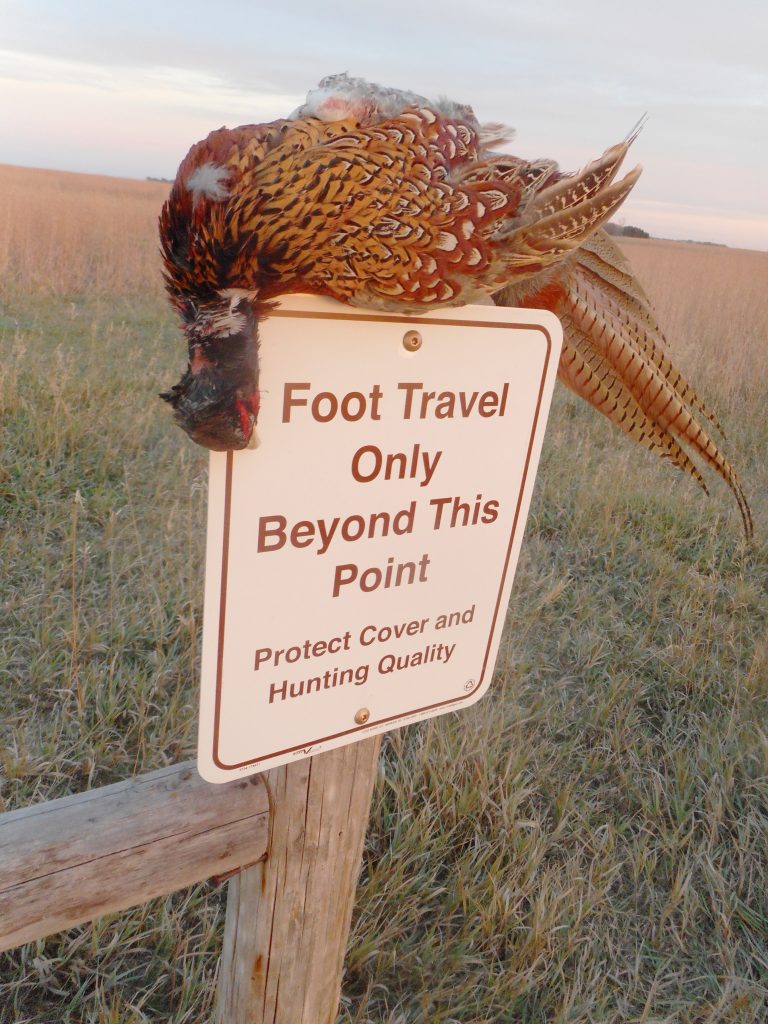
Lands open to public hunting are abundant in South Dakota. This sign welcomes hunters to a U.S. Fish and Wildlife Service waterfowl management area where pheasants also prosper, and encourages responsible stewardship.
Even when you鈥檙e expecting it, standing behind a pointing-dog whose stance tells you it鈥檚 about to happen, the flush of a ring-necked pheasant rooster knocks you off your game. That鈥檚 part of why you go.
His flashy plumage, so garish yet so harmoniously blended, initiates the surprise. Couple that riot of color with his raucous cackle and the explosion of his broad wings, and composure crumbles. Then that long coppery tail rises out of the tawny weeds like an appendage on some mythical creature. It鈥檚 a sight so splendid that, for some shred of a second, you don鈥檛 quite believe it鈥檚 happening. It鈥檚 all you can do to fumble for the safety and raise the gun.
Long-time friends Dennis Ford and Kevin Gathers from Erie, and Chip Brown from State College are so captivated by that experience that they, with their hunting dogs, travel to South Dakota every fall to hunt wild pheasants on the Dakota plains. They鈥檝e invited this writer along for years, unsuccessfully. But this fall I made the trip鈥�1,300 miles (one way), two vehicles, four maturing men and five dogs. I鈥檓 glad I went nonetheless.
Besides pheasants, South Dakota has two things in abundance that Pennsylvania will always struggle to maintain鈥揼rass and space. Those two factors explain why ringnecks still thrive in the Dakotas, Iowa, eastern Montana, southern Minnesota, Kansas and Nebraska, while Pennsylvania鈥檚 once impressive wild flocks are now only memory.
East-central South Dakota is sparsely populated. The state averages about 11 people per square mile, compared to Pennsylvania鈥檚 285. It鈥檚 not as flat as I鈥檇 expected but neither is it rugged. It鈥檚 more like open ocean, with broad swells that rise gently then fall away. From any high ridge you can see the brown ranks of corn and soybeans flanked by expanses of grass鈥揵rown grass, red grass, yellow grass, tall and short grass. Randomly flung among the corn and grass are the prairie potholes, shallow wetlands that claim every low-lying depression, ankle-deep water studded with cattail, where millions of ducks that migrate across North America are hatched each spring. The average prairie pothole is about the size of the main parking lot, along Rte. 119, at Penn State Fayette Campus but they occupy all kinds of contorted shapes.
That jumbled landscape provides everything pheasants need鈥揻ood, winter cover, brood and nesting cover, water and windbreaks. More about wind later.
Thousands of pheasant hunters make autumn trips like ours to South Dakota from all parts of the country. In conversations around the motel we met hunters from Ohio, Alabama, Kentucky, Pennsylvania and California. Non-resident pheasant hunters pump about $250 million into South Dakota鈥檚 economy annually, a fact not lost on the locals. We found the people unfailingly friendly. Everywhere you go someone asks you: 鈥淗ow鈥檚 the hunting?鈥� or 鈥淵ou fellas finding birds?鈥� Often people willingly suggest good places to hunt.
We did find birds, owing to skilled canine cooperation and another attractive facet of South Dakota鈥檚 outdoors. At least in the region we hunted, abundant land is open to public access. My friends had purchased a phone app that shows various public tracts in different colors. As we drove along the arrow-straight roads, a green or red swath would appear on the screen, along with corresponding classifications and hunting regulations. We鈥檇 park in the convenient spaces provided, let out the dogs and hunt, as far as we鈥檇 care to walk, mindful of the long hike back.
Because of the importance of prairie potholes, much of the public land is owned by the U. S. Fish and Wildlife Service, nearly all of it open to hunting. The South Dakota Game, Fish and Parks agency offers additional tracts. Surprisingly, though, most of the acreage open to public hunting is privately owned, which is related to why pheasants thrive there.
Since 1985 when it began, many South Dakota farmers and ranchers have enrolled part of their land in the Conservation Reserve Program, known as CRP. In Conservation Reserve, farmers and the federal Dept. of Agriculture enter into 10- or 15-year contracts through which the farmer receives a rental fee for each acre of marginal land retired from crop production but devoted instead to permanent grass, shelterbelt trees or wetland. This approach accrues farm income for acres that are marginally productive while preventing soil erosion and keeping streams clean. The grass cover also benefits pheasants and other prairie wildlife. Wildlife biologists in South Dakota note that the historic peaks in pheasant populations there have always corresponded to peak enrollment in CRP or the similar Soil Bank program that preceded it.
As a federal agricultural program, Conservation Reserve is available to Pennsylvania farmers too, but the initiative has a greater cumulative impact on wildlife in the open spaces of the West and Midwest. Most CRP contracts have a provision requiring the landowner to make enrolled acres available for public hunting and fishing.
Unfortunately, Congress has continually reduced CRP funding for a decade. CRP acreage reached its nationwide peak in 2000 when more than 32 million acres were enrolled. Today CRP lands are down to 24 million acres with contracts covering millions of acres set to expire. Congress will soon consider CRP reauthorization and funding in the 2018 Farm Bill. Pheasants Forever, the conservation group that promotes pheasant conservation through wise land use urges hunters, bird-watchers and fishermen to ask their congressmen to support robust CRP funding.
Many South Dakotans we met confided that pheasant numbers were depressed this year due to severe drought. That may be but, from our perspective as visitors, the hunting was great. Dennis鈥� Brittany spaniel, Kevin鈥檚 Springer spaniel and Chip鈥檚 three German shorthair pointers would scamper through the grass and continually hit pheasant scent. Dense grass that was close to standing corn was always the best bet.
The hard part came in hitting the birds, a feat that was complicated by wind. Here, in the hilly, forested East, we don鈥檛 always comprehend the presence and power of wind. On the open Great Plains, wind boring down from the Arctic, unobstructed, is a force of nature. The dogs pointed, the pheasants flushed, we鈥檇 recover our composure and swing for the shot. But when the birds hit that wind they鈥檇 veer off at unpredictable angles, and we missed most of them, which was fine. We still got to witness that captivating rise from the tangled grass. It鈥檚 a sight to behold and remember, especially on the high and windy American Great Plains.
Ben Moyer is a member of the Pennsylvania Outdoor Writers Association and the Outdoor Writers Association of America.