

First Wild Trout Summit engages, informs
The rainfall over the past few days was the welcomed kind. Unlike the extreme torrents that fell throughout the summer, this week’s precipitation was sustained but gentle, the manner of rainfall that nurtures much in the natural world, including wild trout.
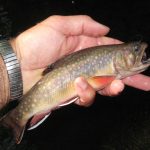
Our wild trout here are primarily brook trout — the only trout native to the region — and to a lesser extent brown trout, which have become somewhat naturalized since their introduction from Europe decades ago. Both species spawn in the fall, so the recent moderate rains will help maintain stream levels at a critical time for trout reproduction. Fall-spawning trout benefit from adequate water that allows them to reach gravel beds where they lay eggs, and makes them less vulnerable to predators like herons and raccoons. But floods at the wrong time (fall), can disrupt the reproductive cycle for an entire year.
After long neglect, wild trout now attract more interest from anglers and conservationists. After the widespread damage to streams in the 19th century, fisheries managers relied heavily on stocking hatchery-raised trout to provide fishing recreation, a practice that became enormously popular with anglers and remains so today. Repeated stocking of artificially raised trout, however, accomplished nothing toward sustained populations of fish.
Today, partly because stocking hatchery fish is so expensive, but mostly due to the dawning realization that promoting wild trout populations is the right thing to do, there is more emphasis on wild fish and their future.
Concern for wild trout was evident at Pennsylvania’s first-ever Wild Trout Summit, convened last month at Bellefonte, Centre County by the Fish and Boat Commission.
Nearly 300 people attended the summit. Fish and Boat had to find a larger venue midway through the registration period because of enthusiastic interest. Biologists and managers from the Fish and Boat Commission, U.S. Fish and Wildlife Service, Trout Unlimited, Dept. of Conservation and Natural Resources, and Penn State University presented an engaging agenda.
Summit attendees learned that until the mid-1920s, the Fish Commission and State Legislature viewed wild trout primarily as a food source for rural people. The first-ever creel limit was 25 fish, and at that time fisheries management had no grounding in science. This notation from an early conservation officer indicates the degree of scientific guidance in fisheries decisions: “Fished hard by locals. Stock 30 cans.”
Presenters outlined our known wild trout resource, which is more widespread than assumed only a few years ago. Of Pennsylvania’s 90,000 miles of flowing water (more than any state except Alaska), 15,043 miles are known to support wild trout. Additionally, 20,273 miles of tributaries to those streams are classified as wild trout streams. That results in 35,316 total miles of recognized wild trout water — approaching 40 percent of all flowing-water miles.
Encouragingly, 12,362 miles (35 percent) of wild trout water is on public land where it can be somewhat better protected. A map of wild trout watersheds looks something like a mushroom — broad across the top (north), from the Allegheny National Forest eastward to the Poconos, then narrowing and stemming southward along the ridges, especially the Laurel Highlands, to the Mason-Dixon Line. Only four counties lack any known wild trout population: Beaver, Washington, Greene and Philadelphia.
This refined knowledge about wild trout is due to a creative and successful partnership — the Unassessed Waters Initiative. Spurred by concerns about Marcellus Shale gas development, but knowing their own staff and money was insufficient to the task, Fish and Boat teamed with universities across the state, trained faculty and students, and asked them to survey streams that, otherwise, would have gone ignored. The university teams turned up wild trout with more frequency than expected. Documentation of a wild trout population earns a stream a greater degree of protection by the Dept. of Environmental Protection.
A new tool in prioritizing future surveys was revealed by speakers from the U. S. Fish and Wildlife Service. They can now take water samples from the mouth of a stream and identify by DNA analysis all the diverse organisms that live in the watershed above — trout included. That technology will allow survey teams to direct their efforts to the most promising places.
Several speakers addressed climate change and its implications for wild trout. Their message was that while climate change may not immediately doom wild trout in a direct sense, even a few degrees of increased stream temperature will heighten their vulnerability to other threats — marginal water quality, invasive species, genetic isolation, flood and drought.
As managers of 2.5 million acres of state forest and park land, mostly aligned with the “mushroom” described above, the Dept. of Conservation and Natural Resources presented its Wild Trout Plan. Key parts of the plan call for DCNR to continue efforts to improve biological control of hemlock woolly adelgid (an invasive insect that kills hemlock trees that provide cooling shade to streams), and to begin replacing culverts under state forest roads that block fish passage.
Connectivity, summit attendees were told, is vastly important to wild trout population survival. A seminar on trout movement revealed that studied brook trout populations contain some “stayers,” who “play the odds” and protect the species’ future by remaining in known favorable environments, and some “movers,” risk-takers that benefit their kind long-term by prospecting for new habitats. So, removal of unneeded dams and cleaning up polluted “dead-zones” open watersheds to wild trout dispersal and population resilience.
Wild trout in our region are almost always small fish, rarely exceeding eight inches in length. But they live in remote, beautiful places that are a joy to visit and fish. It is good to know that a lot of smart people are working to ensure that experience for anglers of the future.
Ben Moyer is a member of the Pennsylvania Outdoor Writers Association and the Outdoor Writers Association of America.