

Snow days: Lasting snow a bonus this deer season
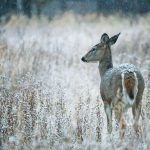
This past deer season offered the rare pleasure of hunting on persistent snow. Except for the wind-blown rain torrents of opening day and the first Saturday鈥搘hich, ironically, are the two days of greatest hunter participation鈥搒now covered the ground for the rest of the season. Even in the lowlands a thin white blanket remained in the woods.
The benefits of snow to deer hunters are poorly understood by those who do not hunt themselves. When snow is imminent, non-hunting acquaintances who know of my own incurable affliction will offer, 鈥淵ou鈥檒l be able to track them, right?鈥�
What they envision is a hunter following closely along the tracks of an individual deer until the animal is overtaken and dropped in the last tracks it ever made. But in modern hunting that鈥檚 mostly romance. Except for our biggest blocks of public mountain woods, most hunters today are so constrained by posted land, safety zones or roads that tracking a deer for a long way isn鈥檛 practical.
The real advantage of snow is that, most of the time, it improves a hunter鈥檚 chances of seeing deer. There are exceptions, such as the first day of this past bear season when puffy snow stuck to the icy rime that adhered to every tree branch. The result was a curtain of snow-laden branches that restricted vision to about 30 yards. Personally, I don鈥檛 hunt bears, but it was obvious conditions weren鈥檛 ideal that day, due to fresh snow suspended in the woods at eye-level.
Under most conditions, snow aids visibility. Snow on the ground enables you to see a deer much earlier in the encounter, which is a huge boost to your chances. Snow renders the deer a conspicuous silhouette, when otherwise it would blend into the background, unseen, until much nearer. That helps because when you first see a deer you almost always need to adjust your position to make the shot. You might need to shift to your left, twist around to your right, or adjust your stance. You always need to level the rifle, rest it on a knee or branch, and prepare to shoot. When there鈥檚 snow, and you see the deer much farther out, you can do all that without it detecting you. Snow allows you to be ready when opportunity arises.
Snow is a definite boost when it remains for days because it records deer behavior. You can cruise the woods and make note of where deer have been moving, and places they鈥檝e avoided, then adjust your approach as the season unfolds. It does no good to sit and watch woods where there鈥檚 been no fresh sign, even with a snowpack improving visibility. In that case, you just see empty woods better.
Snow can make it quieter for a hunter to move through the woods. Fresh powdery snow, at moderate temperatures, can be silent to walk in. But don鈥檛 count on snow muffling the sound of your footsteps. When it gets very cold, the friction between your boot sole and the snow makes a crunching sound or even a 鈥渟queak.鈥� Snow of any kind can conceal sticks and twigs that snap loudly under your weight. And a snowpack that becomes slushy in warmer weather, then refreezes, is like walking on eggshells with the crunching magnified. On a frozen crust it鈥檚 better to pick a stand and stay put, then listen for the deer to do the moving. Under those conditions, even deer make noise. If you hunt deer around here it鈥檚 easy to understand why Eskimo cultures are said to have hundreds of different words for snow鈥揺ach precisely describing different snow properties. To those people, hunting is more serious business and the aspects of snow on any given day may be crucial to survival.
On balance, a deer hunters鈥� best use of a snowy day is to remain motionless and vigilant for long periods, hoping deer will reveal themselves by moving.
Despite the dismissal of long-range tracking above, snow can be a tremendous aid in finding a hit deer that might otherwise be lost. Blood shows up on snow, and it can reveal a lot about the nature of the wound and how far the deer is likely to go.
As the deer seasons roll by, another advantage of snow becomes clearer to this columnist. All things being equal, it鈥檚 much easier to drag a deer over snow than over dry or muddy ground. That鈥檚 especially true if you鈥檝e planned your hunt well so that your vehicle or a road are downslope from the kill site. A deer鈥檚 coat is sleek and smooth, and if dragged head-first, as they should always be, a downed deer will practically 鈥渟led鈥� to where you want it to go.
There鈥檚 no intention here to infringe on weather columnist Jack Hughes, but it seems to snow less frequently in deer season than in the late 鈥�60s and early 鈥�70s when I first began to hunt. Jack probably has the hard data, while all I have are my memories, in which classically snowy deer-hunting days may stand out as the perceived norm, while in truth they may have been no more than the same infrequent bonus they are today.
Ben Moyer is a member of the Pennsylvania Outdoor Writers Association and the Outdoor Writers Association of America