

Going with the flow: Dominion Energy grant helps volunteers and partners improve Dunbar Creek for fish and fishermen
Ben Moyer
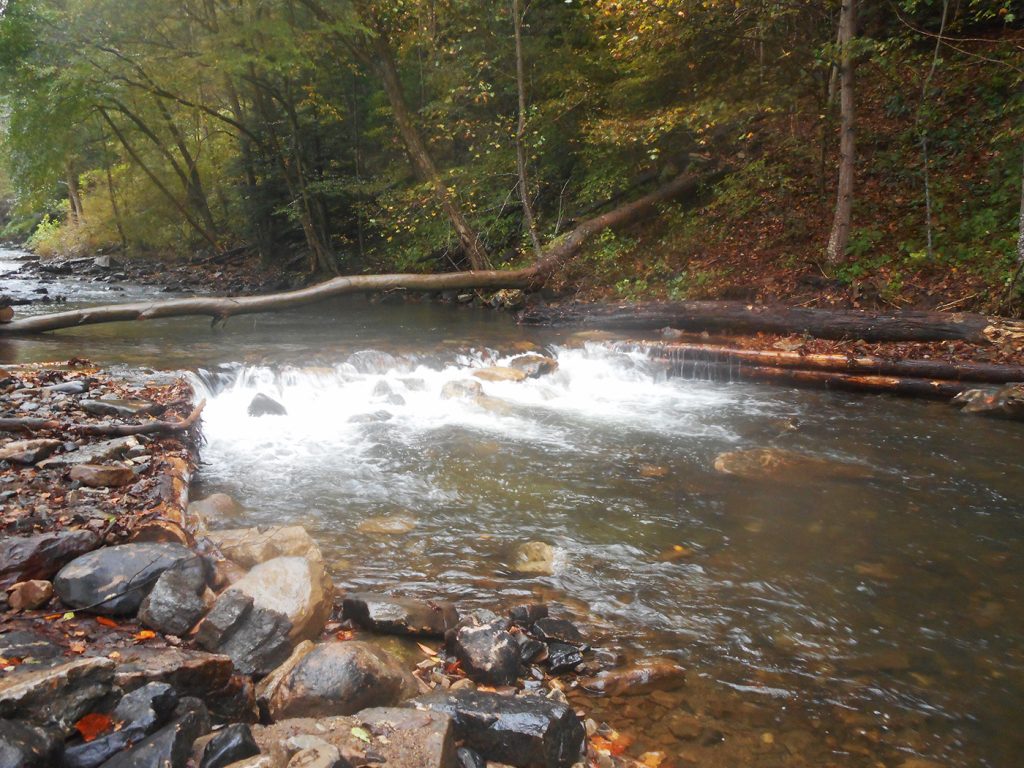
Ben Moyer This cross-vane replaces an old flood-ravaged jack-dam on Dunbar Creek. The structure creates pool habitat upstream and downstream, while allowing trout to pass over the discharge chute at the center.
Submitted
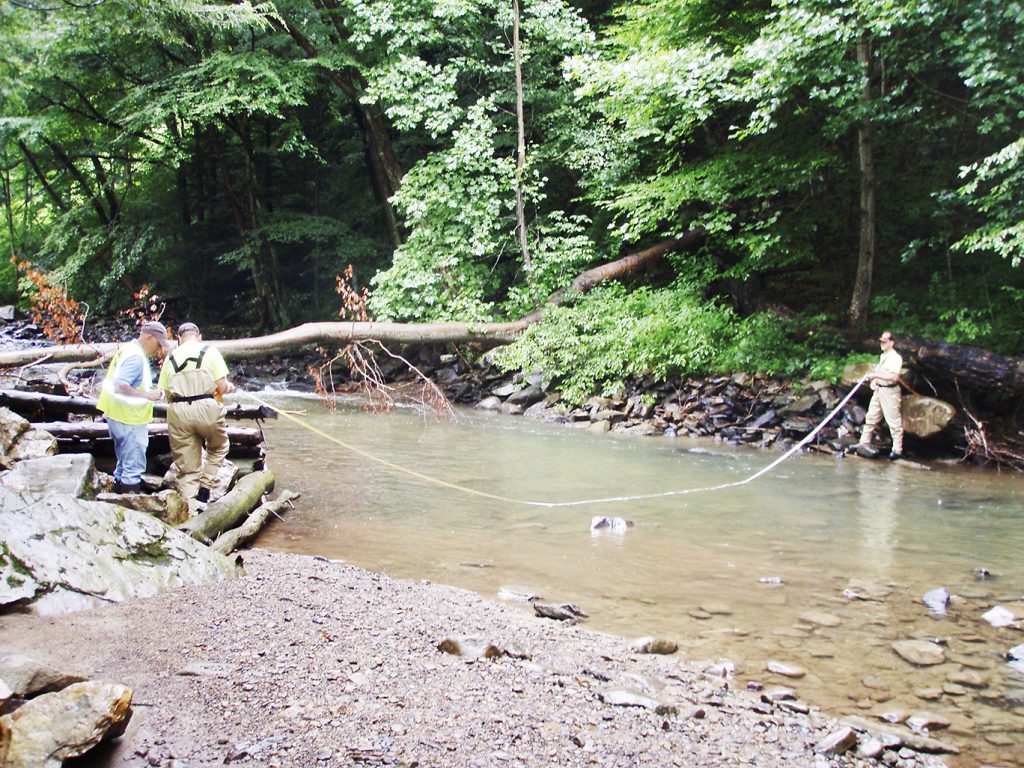
Technicians with California University of Pennsylvania-based Partners for Fish and Wildlife measure Dunbar Creek for placement of a cross-vane structure to improve trout habitat. Materials were purchased through a grant from the Dominion Energy Watershed Mini Grant Program, administered by the Western Pennsylvania Conservancy.
Trout anglers who fish Dunbar Creek will recall the familiar “jack dams� that formed deep pools in that stream until an all-night downpour washed them out in August 2014. The wooden dams were built years ago by well-intended anglers to improve trout habitat. But depending on which fishermen you asked, those structures were a blessing or a curse. They impounded deep “holes� where trout flocked in schools, but they also formed a vertical waterfall that blocked fish below the dams from moving upstream. Ironically, structures intended to benefit fishing posed the same obstruction to fish movement as poorly placed road culverts that trout anglers condemn.
After the 2014 flood, the stream span formerly impounded by a jack-dam flowed shallow and featureless, offering no refuge for trout and no cover for aquatic insects. Some Dunbar Creek fishermen wanted the dams rebuilt, others advocated open flow that permitted fish migration. Early in 2018 the Chestnut Ridge Chapter of Trout Unlimited initiated a compromise where the remains of the best-known jack-dam still jutted from the creek near the end of Betty Knox Road. Chapter representatives consulted Jose Taracido, director of the Partners for Fish and Wildlife Program based at California University of Pennsylvania. Partners for Fish and Wildlife is a collaboration of university, government, and private resources that implements “on-the-ground� conservation projects across Western Pennsylvania, with guidance from the U.S. Fish and Wildlife Service. Taracido recommended placing an innovative design called a “cross-vane� in Dunbar Creek where the former jack-dam had impounded the flow.
Cross-vanes can be built from rock, logs or concrete. They are “V� shaped structures with the tapering end pointed upstream. Many older habitat-improvement designs, including the old jack-dams, taper downstream.
Taracido also offered the help of Partners for Fish and Wildlife in designing the structure and installing it in the stream.
“A cross-vane immediately forms an upstream pool but directs the force of the outflowing water to the center of the streambed, digging another pool downstream� Taracido said. “In the past, structure designs would shoot the water off to the side and sooner or later would erode the banks and the structure would fail.�
A unique feature of cross-vanes is that the structure is passable by fish in either direction, upstream as well as down. “Water from the upstream pool discharges in a chute instead of a vertical fall,� Taracido explained. “No structure we build can impede the migration of aquatic organisms in any way. All our projects must enhance connectivity within streams.�
Fishery managers’ understanding of the importance of “connectivity,� or open passage for trout and other organisms, has advanced in recent years. Researchers at Penn State studied wild brook trout populations in tributaries of Loyalsock Creek in Lycoming County. They captured brook trout, implanted them with radio-transmitters, then released the fish and tracked their movements. The team presented their findings at a Wild Trout Summit held at State College in August 2017.
One of the things we’ve learned is that some brook trout are ‘movers’ and some are ‘stayers,� said Tyler Wagner, assistant leader of Penn State’s Cooperative Fish and Wildlife Research Unit, and an adjunct professor of Fisheries Ecology. “Having both traits in populations favors the long-term resilience of brook trout as a species, but they need to be able to move throughout the system.�
Wagner explained that “stayer� trout maintain the species in established habitats, which is important to long-term species survival. But “movers� are equally important because these fish find new locations that offer a refuge if some force, like a flood or sudden pollution event, causes negative change in the original habitat.
Chestnut Ridge Chapter of Trout Unlimited liked Taracido’s suggestion but needed funds to purchase materials to construct the cross-vane, and to cover the cost of securing required permits from DEP and the Fish and Boat Commission to work in the stream.
The chapter applied for and won a $3,000 grant from the Dominion Energy Watershed Mini Grants Program. Dominion provided the funding through its Dominion Energy Charitable Foundation, dedicated to the economic, physical and social health of the communities served by Dominion Energy companies.
The Western Pennsylvania Conservancy administers the Dominion Energy Watershed Grants Program in commitment to its mission of conserving Western Pennsylvania’s diverse ecosystems through science-based strategy, leadership and collaboration.
Taracido recommended logs as the primary building component for the cross-vane, backed up by various sizes of crushed stone for support. A stipulation posed by the Fish and Boat Commission required all work be completed by the end of September 2018 to avoid disrupting the brook trout autumn spawning season.
Taracido’s crew hauled in heavy equipment owned by Habitat Forever, part of the Fish and Wildlife partnership, and after two long days of work in rainy September weather, finished the job.
“We appreciate Dominion Energy’s interest in and commitment to resource conservation in this region. We could not have attempted this improvement without their financial support and we believe we put it to good use,� said Dale Kotowski, Chestnut Ridge Trout Unlimited president. “And we applaud the partnership with Western Pennsylvania Conservancy that makes the grant program a reality for local volunteer organizations such as ours.�
Kotowski explained that the local Trout Unlimited chapter has taken a holistic approach to improving Dunbar Creek for the enjoyment of local and visiting anglers.
“Our work to remediate acid mine drainage pollution in Dunbar’s Glade Run tributary has shown impressive returns, and each year our members clean up litter along the stream before the trout season opens,� he said. “Improving the stream’s physical habitat with this cross-vane installation is one more aspect of a broad approach outlined in the Middle Youghiogheny River Conservation Plan that guides our efforts.�
Kotowski stays in touch with a network of anglers who fish Dunbar and other streams throughout the Laurel Highlands.
“I understand the fishing has been good on Dunbar this fall, and we’ve heard of some especially large trout caught from the lovely pool that’s formed above the cross-vane,� Kotowski said. “Our hope is to install another vane immediately downstream of the first one. That would result in a really nice pool between the structures, while still maintaining fish passage, which is more important to a trout fishery than any of us understood in the past.�
Taracido found little time to fish for trout this fall but was pleased to hear the report of good fishing at the cross-vane.
“The importance of this project is that there are groups with great ideas to restore their local natural resources but are short of funds or don’t have the equipment or expertise to implement a concept,� Taracido said. “Our partnership is eager and proud to help get these projects done for the benefit of fish, wildlife and people who value them–really a better environment that benefits everyone.�