

Renewing ritual: Grouse hunt a refreshing tradition
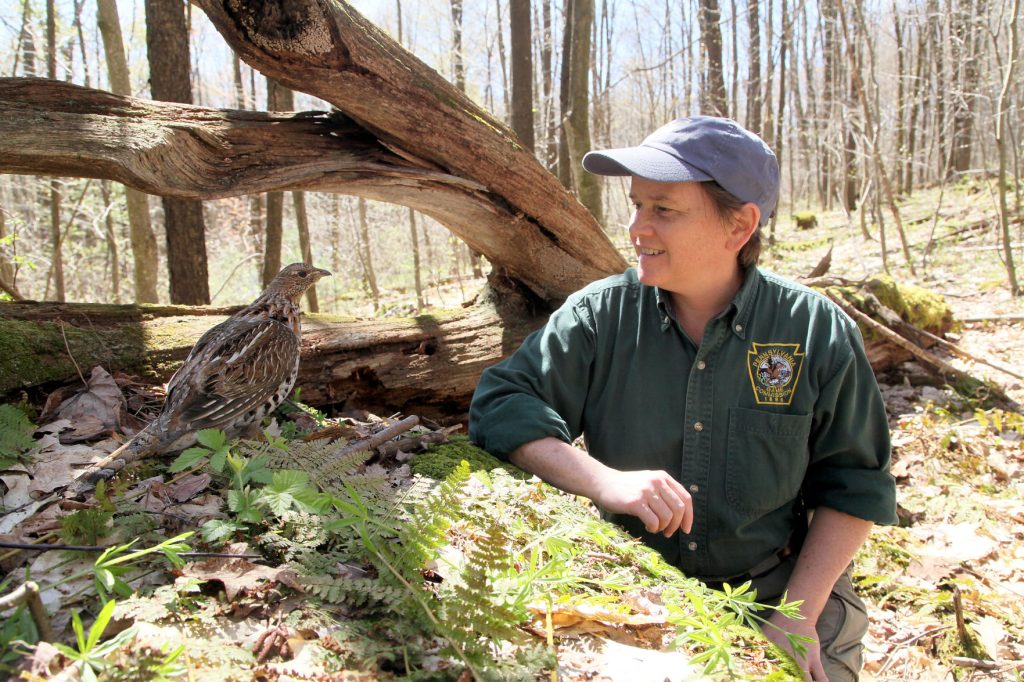
Game Commission Biologist Lisa Williams has spent the last several years studying ruffed grouse populations in Pennsylvania, which have steadily declined in the last decade. (Submitted)
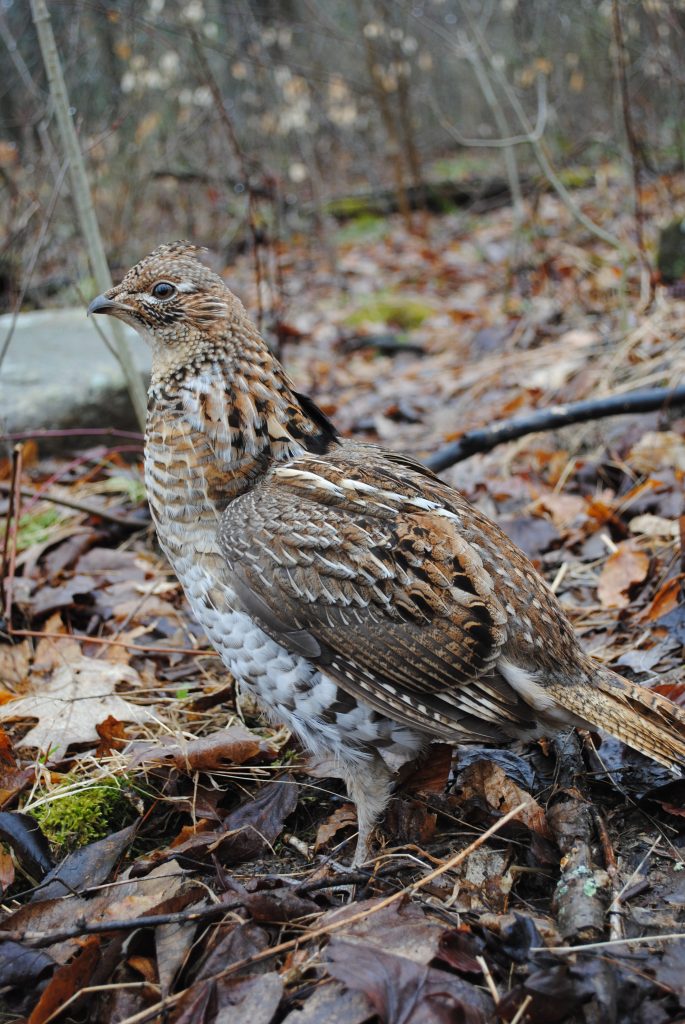
Ruffed grouse populations have plummeted in recent years, due largely to infection by West Nile virus. Game Commission biologists monitor the species鈥� status closely, and the Commission has canceled this year鈥檚 winter season in response. (Photo courtesy of Ben Moyer)
There鈥檚 no photo of a downed ruffed grouse to make this column complete. That鈥檚 fine. I didn鈥檛 kill one the lone day I hunted grouse this year. It wasn鈥檛 for lack of trying that I did not down a grouse that day. I came home with two empty shell casings to show for three windy, snowy hours tramping through greenbriar tangles on a ridge-crest. But I was hunting grouse, and that鈥檚 what seemed to count.
I attribute much of my interest in the outdoors and nature to grouse hunts as a kid, when my dad, uncles and their friends took me to the Dunbar mountains to tag along, and I could barely keep up. On those hunts, the rocky, overgrown slopes seemed alive with grouse. That grandest game bird was abundant then, and I assumed it would always be.
Today, the ruffed grouse is facing tough times. To reduce grouse mortality, the Game Commission cancelled this year鈥檚 winter season, which has normally run for about a month starting the day after Christmas. Most people who are serious about grouse hunting feel that鈥檚 a good thing. I can鈥檛 claim to be a serious grouse hunter anymore, but I agree with the closure. My recent hunt at the end of the autumn season was largely ritual. It was done less to kill a grouse than to recall earlier days outdoors, and the people who shared those days. It was done to feel the thrill of that thunderous flush of a bird that belongs in these woods, and now is hard to find there.
The decline of grouse, like most things in nature, results from a complex range of factors. Grouse populations have always been cyclical, alternating from high numbers to low at roughly 11 year intervals. But the cycle bottomed out about 15 years ago and never bounced back. That bottoming-out of grouse numbers coincided with the arrival and spread of West Nile virus throughout temperate North America. West Nile virus is an invasive pathogen first identified in the West Nile region of Uganda, Africa, that has spread around much of the globe this century.
West Nile infects many species of birds. In fact, birds serve as a sort of reservoir for the disease. Various mosquito species that feed on the blood of birds spread West Nile. When a mosquito draws blood from an infected bird for a meal, it can spread the disease to its next host. Something about ruffed grouse behavior, habitat, or ecology seems to make them especially susceptible. In laboratory experiments, most infected ruffed grouse die.
Scientists believe that climate change has enabled West Nile to spread as it has in recent years. It is known that in warmer weather the pathogen multiplies faster and the mosquitoes that spread it are more successful. We tend to think of melting ice-caps as the symptoms of changing climate, but it can also be seen close to home in less publicized clues like the decline of ruffed grouse, the Commonwealth of Pennsylvania鈥檚 official state bird.
Game Commission biologists, who have studied West Nile in grouse more intensely than any other scientists, have noted that the bird seems less vulnerable at high elevations. In this state, anyplace over 2,500 feet above sea level is high indeed. Mostly likely, the cooler temperatures along the ridge-tops suppress both West Nile Virus and the mosquitoes that transfer it.
My ritual hunt that opened this column began in a conversation with a friend. He told me he owned some property on one of our highest ridges, that grouse were still to be found there, and he invited me to hunt them any time I liked.
I couldn鈥檛 allow such an invitation to pass unfulfilled. On the next-to-last day of the open season I drove up there, parked my truck in a windswept field and trudged toward the woods. A briar thicket bristled at the forest edge, and my first step into the tangle flushed a grouse. I hadn鈥檛 heard those booming wing-beats for a long time, so was late in recovering composure and my hopeless shot raked the treetops far behind the disappearing bird.
I reloaded the double-gun鈥檚 empty breech and took another step deeper into the thicket. A second grouse thundered out, almost from under my foot. This one was close and going straight away but I missed it too. My shot rang just after the grouse made a hard bank to its left and flashed good-bye with that signature broad, black-banded tail.
鈥淭wo flushes in the first 30 seconds,鈥� I mused hopefully. 鈥淚鈥檓 in for some fast action.鈥� But those two grouse were the last I encountered. Killing a grouse, though, was not important, which is a hard thing to explain, hard even to understand yourself. What felt important was to be just doing it again, knowing there might be a regal ruffed grouse in any thicket I trod.
Ben Moyer is a member of the Pennsylvania Outdoor Writers Association and the Outdoor Writers Association of America