

Best time to view our regional brand鈥擬ountain laurel
The name rolls off our tongues around here without thought to its source. I remember the first time I heard it. We were in our eighth-grade homeroom at the old North Union High School when someone announced over the wall-mounted speaker that the chosen name for the new consolidated district that absorbed the familiar North Union and South Union schools was 鈥淟aurel Highlands.鈥� I was stricken by its musicality and its nod to our slice of the Allegheny Mountains. As my high school alma mater, and a positive brand for the larger three-county upland region, it鈥檚 a phrase I鈥檓 fond of using.
Still, we seldom consider what inspired that name. Recently, I watched an artfully produced video promoting the Laurel Highlands region but noted no acknowledgement of the label鈥檚 origin.
Fortunately, this coming week is the prime time to notice, enjoy and appreciate mountain laurel, the spark for our local brand and Pennsylvania鈥檚 official state flower.
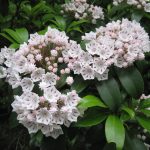
Mountain laurel sort of hides for 50 weeks each year. Its dark foliage lurks low in shadowy forests. Even in full sunlight, where laurel grows best, its low mounded shape gets lost among lesser vegetation. But mountain laurel makes a splash in early June when its creamy pink-and-white flowers crowd its branches so that, from a distance, each shrub resembles those pink coconut-frosted cupcake confections. Where there鈥檚 ample sunlight, such as mountain roadsides, exposed rock ledges or on utility rights-of-way, the visual impact of blooming laurel can be almost beyond belief 鈥� acres of massed, brilliant pink flowers ablaze in the sun of early summer.
Mountain laurel is a low-growing, gnarly shrub that likes dry, stony, infertile, acidic soil. That鈥檚 why it grows so abundantly in our local mountains, and throughout the Appalachian range and Piedmont foothills from southern Maine to Mississippi. Mountain laurel is also the state flower of Connecticut. Surprisingly, mountain laurel even grows well in panhandle northern Florida where the sandy soil creates micro-conditions similar to our highland slopes.
People often confuse mountain laurel with its relative, rhododendron. They鈥檙e both evergreen shrubs, but not conifers like most evergreens. The most obvious difference between the two is their leaves. Mountain laurel leaves are shaped similarly to rhododendron, and have the same leathery texture, but laurel leaves are much smaller, about the length of the typical lemon. Rhododendron leaves can be nearly a foot long.
In general 鈥� though not always 鈥� the two shrubs also grow in different conditions. While mountain laurel likes it dry and sunny, rhododendron exploits damp shade. That鈥檚 why it鈥檚 so prevalent along streams in our mountains. They also bloom at different times, native wild rhododendron (not the ornamental varieties planted for landscaping) blooms around the Fourth of July, about a month after mountain laurel.
Mountain laurel flowers are as interesting up close as they are stunning from afar. Typically, there are about 10 stamens evenly spaced around the pistil at the center. Each stamen is arced backward under tension and delicately anchored in a notch in the corresponding petal. When a bumblebee (the primary pollinators of mountain laurel) alights on the flower it jars the stamens loose from their anchor. The released tension causes the stamen to slap the bee and shower it with pollen. When the bee leaves to visit a different flower, it carries the pollen with it and fertilizes the next crop of mountain laurel seeds.
Though visually attractive, all parts of the mountain laurel are thought to be toxic to humans and livestock. Even deer seldom browse laurel unless faced with starvation conditions in hard winters. Some sources, though, refer to Native Americans using ointments of laurel for external treatment of cuts and sores.
The wood is hard and durable and is said to be easily carved. One alternative name for mountain laurel is spoonwood, so named because Indians and early settlers carved spoons, bowls, pipes and other implements from the wood.
Mountain laurel got its botanical name, Kalmia latifolia, from the Finnish botanist Peter Kalm, who was sent by his nation鈥檚 Royal Academy to study North America鈥檚 plant life and bring back any seeds that might prove useful in European agriculture. As war threatened on the frontier between England, France and their respective Indian allies, Kalm roved the American wilds from 1747 to 1751 cataloging and collecting plant specimens. Today, the blooming mountain laurel recalls his exploits and scientific contributions.
There are lots of local places to see mountain laurel in bloom this month. The Skyline Drive, south of Rt. 40 at Summit Mountain is a good one, and convenient. Almost any route around or near Mt. Davis in Somerset County is bound to present good views of blooming laurel. There are even better opportunities along some of the region鈥檚 trails. Because it follows the high, dry and infertile ridgetop for 70 miles, mountain laurel grows profusely along most of the Laurel Highlands Hiking Trail. The stretch between Rt. 30 and Rt. 271 is especially good. Any of the trails in higher terrain in the Quebec Run Wild Area, or the McCune Trail in Ohiopyle State Park are good places to see this regional icon at its seasonal best.