

Fowl Roundup: Game Commission biologists use mid-June flightless span to band Canada geese for tracking
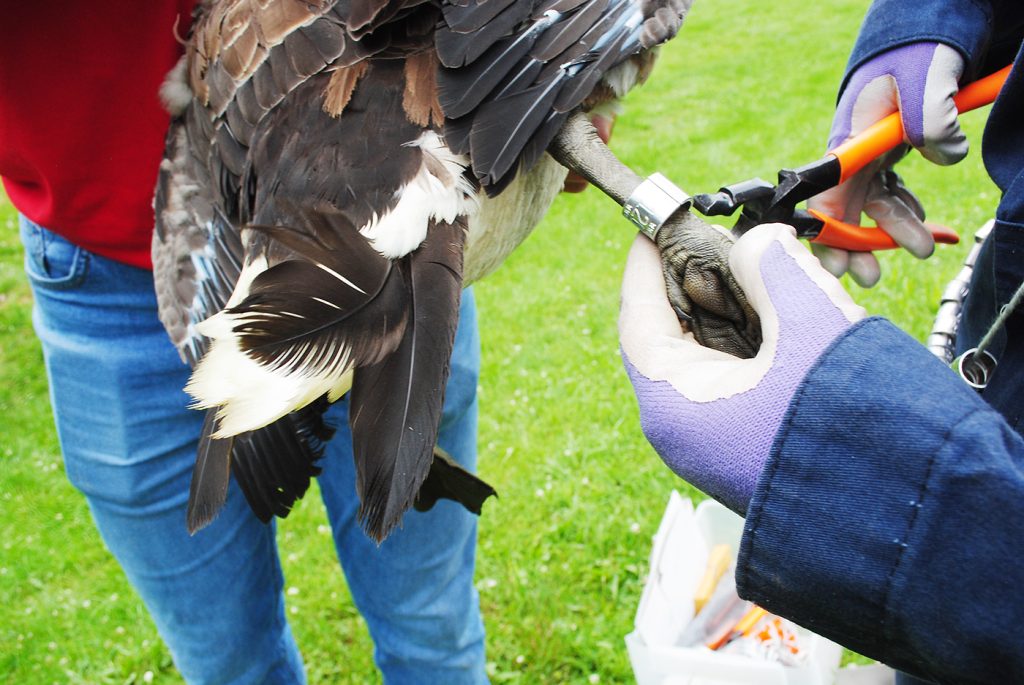
Biologists attach a 9-digit band to the leg of a Canada goose. The unique number is keyed to location, date, and the sex and age-class of the goose.
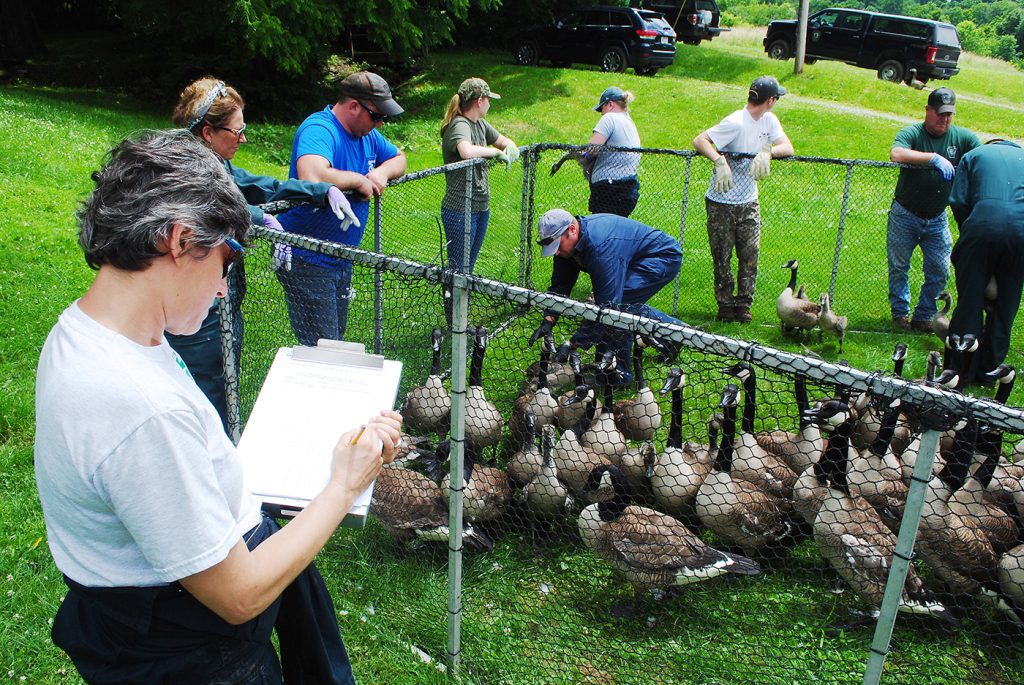
Game Commission Southwest regional wildlife management supervisor Samara Trusso (left) records data from a Canada goose banding operation at Colonial Reservoir near Perryopolis.
Watching wildlife management in action is interesting and informative, and it offers much to share with readers. This columnist nearly missed a recent opportunity due to a lapse in communication. More bluntly, a “technology gap,” nearly caused the loss.
I had received a media announcement that Game Commission biologists would be banding Canada geese in the state’s Southwest region on June 19, and that interested participants should meet in Ligonier at 7:00 a.m. The biologists would capture and band geese at Donegal Lake, then proceed to “various locations in Fayette County.”
I wasn’t free for the Ligonier assembly but surmised I might meet the group later during their Fayette operations. So, I called the Game Commission’s Southwest Region office and was told that the lead biologist would call me to coordinate our rendezvous, which she did. Southwest regional wildlife management supervisor, Samara Trusso, called and informed me her team was headed to Colonial Reservoir after they completed work at Donegal Lake.
Fayette County geography is an interest of mine, but the title “Colonial Reservoir” didn’t ring a bell.
“I think that’s along Rte. 51, south of Perryopolis,” I said, recalling the abundant Canada geese that loaf along that impoundment’s shorelines.
“I don’t know what road it’s on. I just have the name of the place and coordinates,” Samara replied. “I’ll give you the coordinates and we can meet.”
Samara, much younger and techno-savvy, undoubtedly assumed that I use a GPS, smart phone or some other device to get around. Wrong. I’ve spent a great deal of time along the county’s back roads and pride myself on navigation by memory.
“Well, thank you but I don’t have any way to make use of the coordinates,” I said.
An awkward silence hung between us.
“I’ll just take a chance and go where I think it is,” I finally offered, as much to break the stalemate as affirm a plan. “If I’m not where you’re going, we’ll try next time.”
“Okay, uh, see you there,” Samara said, a little dubious.
Another call to long-time friend and Perry Township supervisor, A. J. Boni, dependably knowledgeable and concise, confirmed that the impoundment I’d envisioned was, indeed, Colonial Reservoir.
So, I parked in that wide spot wedged between the lake’s dam breast and Rte. 51, and it wasn’t long before a surprisingly large fleet of Game Commission pickups, bristling with green kayaks, made the tricky left turn from the southbound lane to cram in beside me.
The biologists and their team were all business. Dividing into two groups, one squad took the kayaks back north on 51 to the Reservoir Road intersection, launched there and herded an indignant flock of honking geese down the lake. The other group concealed itself in the woods and high grass near the dam, cautioning me not to alarm the approaching geese while taking pictures. When the flock waddled onto shore ahead of the kayak-cowboys, the ground-team surrounded and proficiently confined them inside a portable pen.
Some biologists took up banding tools, which are specialized pliers. Others manned data sheets and pencils, while still more began reaching into the pen and grabbing geese by the feet. With two banding stations working simultaneously, it didn’t take long to affix aluminum bands–each with a 9-digit number–to one of each goose’s legs.
“This is part of a federally coordinated effort across the Atlantic flyway,” Trusso explained. “Each band’s number is keyed to a date, location, and the sex and age-class of the bird that wears it. We encourage birders who see and read the number, or, more likely, hunters who harvest the goose, to report the location of the kill. That data enables biologists to track the trends in Canada goose populations and their movements.”
Canada geese seen in early summer at Colonial Reservoir, Donegal Lake, and many other places across the Mid-Atlantic states and Midwest, are part of the relatively recent phenomenon known as “resident geese.” These geese have forsaken their species’ ancient seasonal migration patterns and chosen to live year-round in one favorable location. Biologists estimate there are about 250,000 resident Canada geese living in Pennsylvania, and they’re often considered a nuisance. Biologists use band-return data to design hunting seasons and bag limits that encourage liberal take of resident geese while minimizing harvest from populations that still migrate, as their ancestors always have.
Northwest regional wildlife management supervisor, Roger Coup, traveled from his office in Venango County to assist. “Even though the hunting seasons are designed to manage resident geese, they’re sometimes a challenge to manage because it can be hard for hunters to get at these flocks,” Coup said. “They tend to stay around places like day-use parks and golf courses that don’t offer a lot of hunting opportunity.”
Colonial Reservoir, incidentally, is private property and not open to public waterfowl hunting. But it’s still important for biologists to keep track of goose populations, and the lake’s owners allow the Game Commission access for its banding work.
“We try to band about 500 every year in the Southwest region, and we have a target of at least 2,500 statewide,” Trusso said. “That’s a banded sample of one percent of the statewide population.”
According to Trusso, who should know, mid-June is the best time to band geese because they are temporarily flightless.
“For a brief window around the third week of June, they are molting and growing new flight feathers,” she said. “They can’t fly then, but they need to stay close to their young at that time anyway, so it works out well for the species.”
The team placed bands on 49 geese not previously marked and recaptured 20 birds that were already banded. Those band numbers were recorded for later analysis.
As each goose received its band, the biologists dropped it gently onto the grass, and a long line of newly marked geese paddled back across the lake, unmolested.
Ben Moyer is a member of the Pennsylvania Outdoor Writers Association and the Outdoor Writers Association of America.