

Basic facts simplify fly-fishing鈥檚 mystery
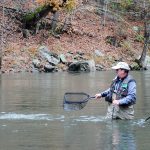
Some readers have recently expressed interest in fly-fishing. Fortunately, this is an apt time to prepare to sample this pleasurable approach to angling. Eventually, it will stop snowing, the mountain air will warm, and trout and their insect prey will get more active.
Fly-fishing carries an aura of difficulty it doesn鈥檛 merit. It鈥檚 simply the use of a set of tackle that enables casting a fly, so nearly weightless, that it could not be propelled with the gear used in other methods, such as spinning or bait-cast. With those tackle designs, the angler casts a bait of sufficient weight to pull line off the reel during the cast. Fly-fishing takes the opposite approach, casting a heavy line, which carries the fly along for the ride. With properly matched rod and line, anyone who can swing a golf club or eat soup can learn to adequately cast flies in one practice session, especially with some helpful coaching.
Fly-fishing came about because insects comprise a trout鈥檚 dietary staple, and insects are typically small and nearly weightless. So, to present an enticement that mimics buggy prey, a style of tackle and its use had to be developed.
Helpful to beginners and experts, modern fly tackle is graded by manufacturers by size or strength. The higher the number, the stouter the tackle and better suited to bigger fish, broader waters, or fishing in heavy wind. Generally, on our region鈥檚 mostly small streams, a 4- or 5-weight rod is ideal. Always match the fly-line to the rod. Use a 4-weight line on a 4-weight rod, and so on. Simple.
Fly lines offer a variety of designs, characterized by the uniformity of their thickness. Some are uniform diameter throughout their length and others are tapered. For most fishing choose a 鈥渨eight-forward, floating (WFF)鈥� line.
Fly rods are built in a range or lengths but it鈥檚 hard to improve on an 8- or 8.5-foot model. There鈥檚 a temptation to use a shorter 鈥� some are 5- or 6-foot lengths 鈥� rod for fishing tiny mountain brooks but experience will prove an 8-footer more effective and more enjoyable to fish.
Don鈥檛 be discouraged by the price of some rods. Some 鈥減restige鈥� fly rods cost thousands of dollars but that鈥檚 often just to market a name. Perfectly functional鈥揺ven excellent 鈥� fly rods can be had for way less.
In fly-fishing, the reel is almost an afterthought. Its main purpose is to store excess line when not in use. The fly can be cast, and a fish landed, without ever employing the reel, though there are exceptions. Choose any inexpensive fly reel that feels balanced on the rod you鈥檝e selected.
As noted, a heavy fly-line is needed to cast the weightless fly. But no trout was ever fooled by tying a fly to so heavy a line. The solution is a leader, a generally 7- to 10-foot section of lighter, nearly transparent line that links the fly to the casting line. In fly-fishing鈥檚 early days leaders were horse hair or silk. Today, they鈥檙e made of monofilament material, similar to lines used in spin-fishing, and far simpler to use than the originals.
Important 鈥� You can鈥檛 just tie on a hunk of conventional monofilament from your spinning reel and expect it to perform as a fly-fishing leader. An effective leader must be tapered 鈥� heavy and stiff at the butt-end that knots to the fly-line, and supple and thin at the terminal end that carries the fly. Pre-made tapered leaders are available at all fly shops and most sporting goods stores. The all-important taper allows mechanical energy from the rod to be conveyed throughout the system, allowing the fly to be cast.
Be aware that leaders are graded opposite from the rest of a fly-fishing rig. In leaders, the higher the number, the lighter the 鈥渢ippet,鈥� which is the fly-end of the leader. A 6X leader, for example, is far lighter and more fragile than a 3X leader. There are a lot of on-stream variables regarding leader selection but 4X is often a good choice for all-around use.
It鈥檚 encouragingly helpful to note that on our smaller streams, and especially early in the season, it鈥檚 often not even necessary to make the graceful cast seen in movies in order to fly-fish. Often, fly-anglers present to the fish a submerged 鈥渨et鈥� fly or nymph, sometimes accompanied by a split-shot clamped to the leader, that imitates the immature, underwater life-stage of aquatic insects. In this fishing, a simple lob of the fly is often sufficient. The angler lobs the fly into the current, allows it to drift naturally and stays vigilant for some twitch of the line that betrays a strike. Later in the season, fly-fishermen will cast floating 鈥渄ry鈥� flies that imitate the winged adults of these same insect species. Then, it is generally necessary to cast the fly in the conventional expected sense. In this approach, the trout rises to the surface and gulps the fly in full view of the angler. There is no greater 鈥渞ush鈥� in fishing and learning to fly-fish is worth that experience.
You may hear fly-anglers use the dreaded term 鈥渄rag,鈥� the one evil that every beginner must learn to manage. 鈥淒rag鈥� happens when the current pulls on the fly-line as it lies on the water between the rod-tip and the fly. If the current pulls the line downstream with greater force and velocity than the fly is naturally drifting, the line will 鈥渄rag鈥� the fly, which is entirely unnatural to an onlooking fish. By selecting where you stand in your approach to the stream, and by 鈥渕ending鈥� the line during the drift (meaning to continually flip the line-belly back upstream without disturbing the drifting fly; this takes some practice), drag can be overcome, and trout can be fooled.
Lodges or resorts in fishing country often offer per-hour fly-fishing instruction, but his can be pricey. Low-cost or free coaching is sometimes available through Trout Unlimited chapters, outdoor groups, state parks, or the Fish and Boat Commission. Watch outdoor-themed event calendars for instructional opportunities. Competently staffed fly shops, like Field & Stream in Washington, PA, are another good source of tips and help.
Fly-fishing is fun and, because it imitates the naturally occurring food-chain, it opens an enlightening perspective on trout stream ecology. Be warned, though, that fly-fishing often leads to fly-tying, another lifelong obsession.
Ben Moyer is a member of the Pennsylvania Outdoor Writers Association and the Outdoor Writers Association of America.