

Deer statistics hinge on hunter cooperation
Most people consider statistics to be tedious and boring. Include me in that company except when it comes to statistical data that biologists use to manage wildlife. That鈥檚 an application in which statistics come alive, because the subjects of research, like deer, bears, wild turkeys and waterfowl are fascinating as individual creatures and as populations that share our region鈥檚 landscapes.
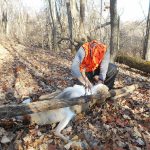
Deer season, which runs through Dec. 8, affords to biologists more statistical data on white-tailed deer than can be gleaned in any other way. Wildlife biologists, working for the Game Commission, use data from hunter reports and butcher shop surveys to estimate the total deer-kill by hunters, the ratio of males to females in the herd, and average age and weight of the surviving herd.
Naturally, there is a lot of interest among hunters in how the deer-kill is estimated. Wildlife management is the responsibility of the states, and all states have different ways of tabulating data and estimating their deer harvest. Some hunters are skeptical of Pennsylvania鈥檚 method, but it is reliable over time.
In Pennsylvania, all hunters who kill a deer are required to report the kill to the Game Commission within 10 days. Reports can be made on-line, by telephone, or by the 鈥渙ld school鈥� way of mailing in a pre-addressed postcard provided to all hunters when they buy a hunting license.
A snag arises, however, because not all hunters report their deer, and it鈥檚 impractical to enforce the legal requirement to do so. Game Commission biologists know, unfortunately, that only about a third of all deer killed by hunters are reported as required.
But, statistically speaking, that doesn鈥檛 matter. It doesn鈥檛 matter because biologists know the 鈥渞eporting rate.鈥�
Even if many hunters blow off their report, biologists can still confidently estimate the deer-kill because they know the proportion of hunters who actually do report.
It works like this. Teams of biologists and game wardens visit hundreds of deer-processing shops throughout the hunting season. They check the age and sex of deer being butchered, and also record the tag number attached to the deer. These teams examine between 30,000 and 40,000 deer statewide every year. Then, reports of deer kills received from hunters are checked against those tag numbers documented from butcher shops. The proportion of those checked deer that are ultimately reported is the 鈥渞eporting rate.鈥�
For example. If biologists record the tag numbers from 30,000 deer throughout the state, and 10,000 of those known deer are eventually reported by the hunters who killed them, the reporting rate is pegged at 33 percent.
Once they鈥檝e established a reporting rate, the biologists can estimate the kill. If they receive reports of 60,000 antlered buck deer, then the estimated statewide buck kill would be 180,000 (60,000/180,000 = 0.33).
Those numbers are hypothetical for this example. In 2015, the most recent year provided on the Game Commission website, biologists estimated that hunters killed 137,580 antlered bucks and 178,233 antlerless deer using this method. Different reporting rates are used to estimate buck and antlerless kills because hunters report bucks at slightly higher rates.
State methods for estimating deer-kill range widely. In West Virginia, successful hunters must take their deer to an official check station to be counted, the way black bears are checked and counted in Pennsylvania. But even that method has statistical uncertainty because there is no way of knowing the number of hunters who ignore the rule and drive by the check station without stopping. It鈥檚 also more expensive to run check stations than to use Pennsylvania鈥檚 method. And data gleaned is questionable because it鈥檚 often collected by untrained personnel employed at the gas station or convenience store that鈥檚 agreed to function as a check station.
In Michigan, hunters are not required to report their deer kills. But they are encouraged to fill out an on-line survey after the season, telling the Michigan Dept. of Natural Resources how many days they hunted, where they hunted and how many deer they killed. Hunters who do not complete the on-line survey are sent the same survey through the U.S. mail. All of Michigan鈥檚 deer-kill estimates are derived from these surveys, through information volunteered by hunters.
Florida also estimates their deer-kill through a survey, but the state agency doesn鈥檛 conduct it. The Florida Fish and Wildlife Commission hires a third-party consultant to survey Florida hunters.
Pennsylvania hunters will find Ohio鈥檚 method surprising. In Ohio, deer hunters are not issued the familiar tag that鈥檚 attached to a downed deer. Ohio hunters make their own tags, from a slip of paper, the back of a business card, or matchbook if they like. But they are required to promptly phone the Ohio Dept. of Natural Resources to report the kill. During the call the hunter is issued a 鈥渒ill number,鈥� which must be written on the home-made tag and on the hunter鈥檚 retained license. The hunter better not be caught with a deer that doesn鈥檛 match that number.
Estimating deer harvest is an inexact science because there is no other way. But with enough data, biologists are confident that their estimates reflect reality and represent a statistically sound way of tweaking the hunting season length and bag limits, so that everyone can responsibly enjoy the wildlife resource.
Ben Moyer is a member of the Pennsylvania Outdoor Writers Association and the Outdoor Writers Association of America.