

Saving a symbol: National Bison Range plays key role in bison鈥檚 renewal
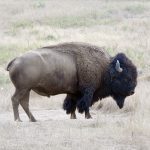
Depending on how you look at it, the American bison represents either a monumental ecological loss or a success story in conservation. As many as 60 million bison ranged across the prairies and Great Plains when Meriwether Lewis left Pittsburgh on a flatboat in 1803 to begin the Corps of Discovery trek to the Pacific. By 1890, after decades of slaughter, fewer than 500 bison remained alive in the wild. The bison, symbol of untamed America and largest and most widely ranging herbivore on the continent, seemed doomed to extinction.
But some forward-thinking Americans of the time resolved to prevent the bison鈥檚 complete disappearance. In 1905, William T. Hornaday, Ernest H. Baynes, and Theodore Roosevelt, president of the United States, founded the American Bison Society to raise money to purchase bison from the few captive private herds and transfer the animals to federal lands for protection. Suitable public lands were scarce, so Roosevelt persuaded Congress to appropriate funds toward the bison conservation effort. On May 23, 1908, President Roosevelt signed legislation authorizing purchase of a 19,000-acre tract (about the size of Ohiopyle State Park) in western Montana to become the National Bison Range, where a new herd, begun from private stock, could grow and its surplus could be moved to other protected sites in the future. The tract was tiny compared to the bison鈥檚 original range, but it helped conservationists save the species.
Administered today by the U.S. Fish and Wildlife Service, the National Bison Range is a place where visitors can gain a sense of the West as it once was. About 400 bison live on sloping grasslands that sprawl among sharp ridges bristling with pine forest.
A modern visitor center interprets the story of bison renewal, and all visitor activities are focused on viewing and photographing wildlife on the Range. Most wildlife-viewing is done by car on the two roads maintained for that purpose, but short trails offer hiking in identified zones. Hiking is limited to reduce disturbance of wildlife and for visitor safety.
The one-way, 19-mile Red Sleep Mountain Drive climbs, twists and loops over ridges, through ravines and across wide plains. Visitors need about two hours to complete the loop but expect a longer trip if a lot of wildlife is encountered. Steep grades, sharp curves and a gravel surface limit speed to a crawl, which is good since something of interest might appear at any point. Drivers can expect to see bison, and observant motorists have a good chance of spotting elk, mule deer, white-tailed deer, pronghorn antelope, bighorn sheep, and even black bears. Occasionally, fortunate visitors have seen a mountain lion or the rare grizzly bear that roams from the nearby Mission Mountains. Generally, most bison and pronghorns are seen on the low-lying grasslands along Mission Creek near the Range鈥檚 northern border. Elk, mule deer and bears are drawn to pine forests on the ridges, while bighorn sheep seek the rockiest crags. White-tailed deer like the strands of woodland along Mission Creek and can often be seen wading the stream.
The shorter Prairie Drive accesses the prime bison-viewing grasslands but carries more traffic, headed in both directions. A fee of $5 per car permits use of both roads.
Bison would quickly overpopulate a 19,000-acre fragment of Great Plains habitat if the herd were left unmanaged. Every year the U.S. Fish and Wildlife Service conducts a roundup of bison to remove excess animals that the National Bison Range cannot support. Visitors can see some of the paddocks and pens used in the roundup from the roads. Captured bison are re-located to other national wildlife refuges, national parks or to Native tribal lands where herds are being started or existing herds enhanced, fulfilling Roosevelt鈥檚 and Hornaday鈥檚 original vision. Besides bolstering their numbers, re-located bison from the National Bison Range play an important role in conservation by introducing genetic diversity into scattered herds that can no longer mix naturally, as they did when bison roamed freely over the plains. Today, about 18,000 bison live in populations considered 鈥渨ild鈥� on various public lands throughout the West. Many thousands more are kept in privately-owned captive herds.
Every bison from the National Bison Range carries a micro-chip so that its health can be monitored, and its location tracked. Any surplus bison remaining after distribution to federal, state and tribal lands are offered for sale to qualified private buyers.
Many visitors consider autumn to be the best time to visit the National Bison Range. Wildlife is active and in prime condition, and the scenic backdrop of snowcapped mountains behind tawny grasslands presents spectacular photographic opportunities. Winter weather can change quickly, however, and the Red Sleep Mountain Drive is closed sometime in October. The Prairie Drive remains open year-round unless conditions forbid public use.
The National Bison Range is about 40 miles north of Missoula, Montana via I-90, Route 93 north and Route 200 west.
Ben Moyer is a member of the Pennsylvania Outdoor Writers Association and the Outdoor Writers Association of America.