

Local uplands merit our attention
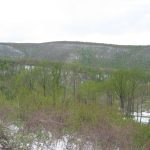
Recently, my wife Kathy wished to replenish our stock of some household items at a large retail establishment in South Union Township. Owing to a health issue, we had been mostly homebound for weeks, so the trip offered diversion. Still, when we reached the store, perched on a manmade plateau, I elected to remain in the vehicle and await my better half鈥檚 return.
I helped her out near the entrance, then parked nearby, facing east, away from the storefront, to ponder the view from atop the bluff, where all of Uniontown, its neighborhoods and suburbs roll out before the eye. But dominating all else, inescapable, was the bulk of our familiar highlands, stretching south and north to vision鈥檚 hazy limits.
It鈥檚 surprising that we, as a community and locale, don鈥檛 identify with those mountains even more than we do. Our mountains, it seems, are seldom considered except as a barrier to eastward winter travel.
Years ago, I taught courses as part-time faculty at Penn State Fayette, where the east windows face the ridge. Early in each term I asked the class, 鈥淲ho can tell us those mountains鈥� correct name?鈥� The small fraction of students familiar with the title 鈥淐hestnut Ridge鈥� was an unsettling surprise.
Our Chestnut Ridge is the westernmost flank of the Allegheny Mountains, which are the central and western shoulder of the vast Appalachian system that stretches from Labrador to Alabama. As a friend once observed from atop Dunbar鈥檚 Knob (at Jumonville Cross), 鈥淒ue west from here, there are no more mountains 鈥檛il you hit Colorado.鈥�
Chestnut Ridge was named for the dominant tree that clothed its slopes when European explorers first crossed the Alleghenies. The American chestnut thrived throughout the Appalachians and west into the prairie fringe so that what is now southwestern Pennsylvania was the dead-center of its range. Chestnut was so dominant on Chestnut Ridge that settlers crossing the mountains in June thought they saw snow on the crest, when chestnut flowers bloomed white.
In many ways, American chestnut was the wood that made America. It was abundant, strong, but easily (relatively easy) worked with hand tools of the day. It also resists rot, so that early Americans built homes, barns, fences, furniture and most everything else they needed from chestnut wood. The trees produced seeds in unbelievable plenty. Deer, elk, bears, turkeys and vast flocks of passenger pigeons gorged on the nuts, Native people used them in countless ways and settlers adopted them as a staple. My own most dimly remembered ancestors told of scooping up bushel-baskets of chestnuts as children. They were the last generation to know that privilege.
Early in the 20th century the invasive fungal Chestnut blight arrived on Asian chestnut trees imported into America. The Asian trees were immune, but their American relatives withered and died by the billions. By 1940, the American chestnut was, for practical purposes, extinct. Many consider the chestnut blight the greatest ecological disaster ever to befall North America. Today we lament the chestnut, but nature is resilient. White, red and chestnut oaks have taken over the role left vacant when the chestnut declined.
Ranging between 2,100 and 2,700 feet above sea level, Chestnut Ridge is not a high mountain by worldwide standards. But it is a significant feature in relative terms, looming 1,000 to 1,500 abrupt feet above bordering lowlands. From my parking spot at the store, the entire north-south span of Fayette County was in view, from Coopers Rock in West Virginia to the heights above Mt. Pleasant in Westmoreland County. Along the crest the well-known landmarks stood out in sequence鈥搕he wind-turbines above Haydentown, Laurel Caverns, Summit Inn, Jumonville Cross, and the Youghiogheny River water-gap at Connellsville. On that day, the ridge was white with snow and a distinct line of ice rimed the trees near the crest, contrasting the lowlands鈥� drabness.
It is interesting that the angle of light, time of day and season can morph the mountain鈥檚 appearance. At times, often at mid-day, in fog or overcast, the ridge appears as a dark and monolithic wall. But late in the day, especially in winter when the hardwoods are bare, the light strikes from a low angle that accents shadow, revealing hollows, coves, ravines and ledges in the mountain鈥檚 complex face that hours ago 鈥渨eren鈥檛 there.鈥� That late-day light makes it clear why Rte. 40鈥揳nd before that the National Road鈥搒nakes up and around the contours of Lick Hollow as it does.
On that same day the morning鈥檚 TV weather forecast played out in real life. Banks of darkly bruised clouds scudded along the ridge from the southwest, hauling behind them warm rain. I wondered how many viewers from that morning鈥檚 broadcast had the opportunity to see the real event unfold.
It is hard for me to overlook our local mountain. I grew up in Lemont Furnace, under its morning shadow, and it seems its hulking presence is always there to my east. Even when I travel somewhere else, I sense its absence. I am glad to live in a place where a natural feature of landscape, weather and even history is such a powerful part of life.
Ben Moyer is a member of the Pennsylvania Outdoor Writers Association and the Outdoor Writers Association of America.