

Feeding winter birds — big birds — a treat
Readers who feed birds know how the antics of small but energetic creatures can cheer a winter day. The comings and goings of chickadees, titmice, blue jays, nuthatches and woodpeckers offer welcome diversion. Male cardinals are especially striking. Their vivid red, posed against the winter woods, will stop you in your tracks as you step past a window.
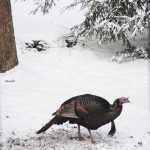
We enjoy these familiar recipients of our sunflower seed handouts, but through the recent cold snaps much larger visitors have entertained us. Two big wild turkey gobblers show up every morning to scratch beneath the feeders, picking up sunflower and nyjer seeds kicked out by the smaller birds. Jays are the turkeys’ best benefactor, spilling a half-dozen seeds for each one they consume or carry off to cache somewhere in the woods.
The gobblers seem out of place gleaning leftovers off the snow, just a few feet outside the windows. I am accustomed to thinking of them as wild, mysterious and independent, elusive as a hunted quarry and invulnerable to elements. But wild things must be opportunists as much as independents, and these two gobblers have found the concentrated food source beneath our bird feeders fits their immediate lifestyle.
Once the gobblers arrive, they linger for hours, lending insights to wild turkey behavior you might never otherwise get. Turkeys are social creatures of habit, and these two gobblers are always together. They scratch beneath the tubular feeder hanging out back, then stride around the corner to forage under the house-shaped feeder suspended beyond the deck. If Kathy is reading by the back window, and I’m sitting near the woodstove, enjoying its radiance, she’ll remark, “Turkeys, heading your way.�
Sure enough, a few seconds later they’ll pace by the window I command from my seat by the stove, their heads jutting forward with each stride and their long, full beards jostling in the wind.
These turkeys’ feeding habits are a clue for turkey hunters in the appropriate seasons. If you find a place where turkeys are feeding regularly– like a grape thicket or a stand of fruiting beech trees, hunt there, stealthily, and the flock will eventually return.
When the cold settled in last Monday and Tuesday, “our� gobblers adapted in ways I’d never observed. They would scratch and eat for a while, then slowly pace up into the woods, out of the wind. There, they settled down into the snow, as if they were sitting on eggs, after puffing out their feathers for added insulation. At other times they would stand on one leg — the other leg pulled up inside their puffed-up plumage — and appear to sleep. They huddled there for a long time, until hunger moved them to return to the feeders and scratch for wayward seeds.
We don’t feed the turkeys intentionally, and likely won’t start. If they want to rely on the incidental leavings they get from the songbirds, that’s up to them. But I don’t want to be responsible for them depending entirely on handouts. They could make it on their own if they had to. A big flock of hens and young birds had been hanging around in the fall and early winter, but they’ve disappeared. Apparently, they’re scratching out an existence someplace where they can reach adequate food. Spring seeps are important to turkey flocks in winter. Where water seeps up through the soil it melts the snow, allowing the birds to forage with some effectiveness. I know where several springs seep from the slope out back, and I’d bet that big flock is nearby there and not moving far.
Speaking of plumage, observing these gobblers up close gives you a new appreciation for their feathered dress. We tend to assume they are just big dark birds, uniformly tinted. But when the light strikes them right, up close, a deep copper sheen blushes across their wings, and iridescent green, purple and blue blooms at the shoulders. The black bars on the breast stand out against rich chestnut, and the reddish flesh on their heads is nearly as arresting as the cardinals. They are impressive creatures.
When the gobblers first appeared at the feeders they would sprint away if they saw us at the windows. Gradually, they grew accustomed to our presence and now merely side-step a few feet when we peer outside. Still, we try not to startle the gobblers unnecessarily. A couple of days ago I did not know they were around and went outside to get firewood. Stepping off the deck I heard their shrill “Putt!� “Putt!� alarm call and they flushed out from behind some rhododendron and flew over the house. Kathy happened to be looking out the front window and saw them descend and alight on the driveway.
“Wow,� she announced when I returned inside. “I just saw two big turkeys fly down onto the driveway. It was quite a sight.�
“Yeah, I sent them over to you,� I replied. “But they’ll be back at the feeders.� A few minutes later they came parading around the corner, one following the other, and began scratching for seeds.
I think when May arrives, I will hunt somewhere else for my spring turkey, somewhere where the gobblers are still mysteriously elusive.
Ben Moyer is a member of the Pennsylvania Outdoor Writers Association and the Outdoor Writers Association of America.