

Spring gobbler season has a history; Our region one of the best
Ben Moyer
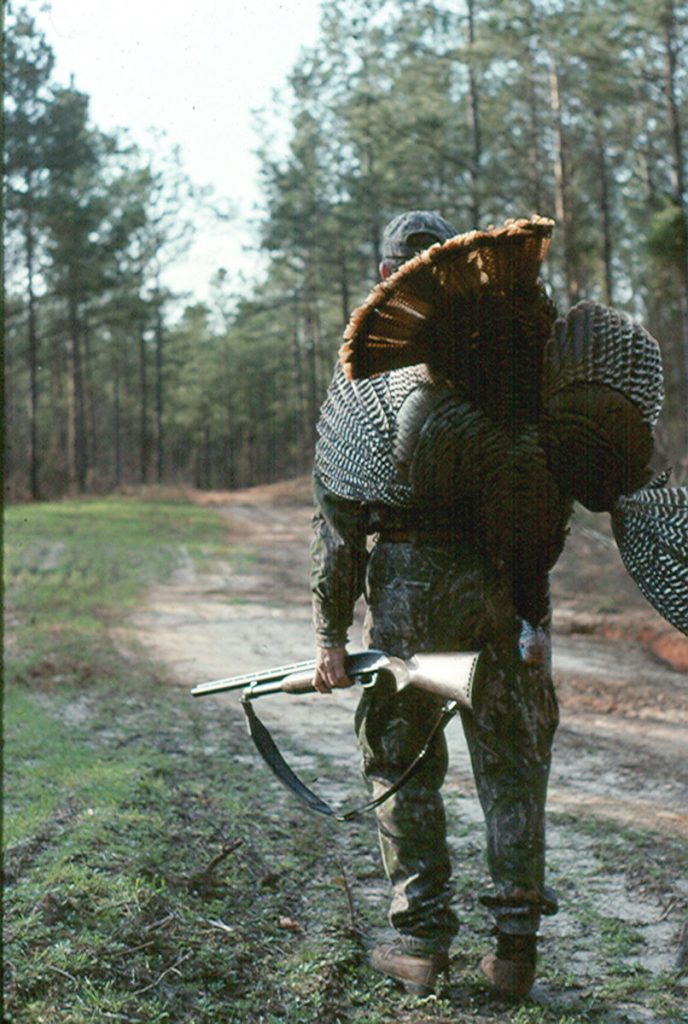
Turkey guide Dr. Bob carries a gobbler along a clay road in the Alabama pine woods.
Ben Moyer
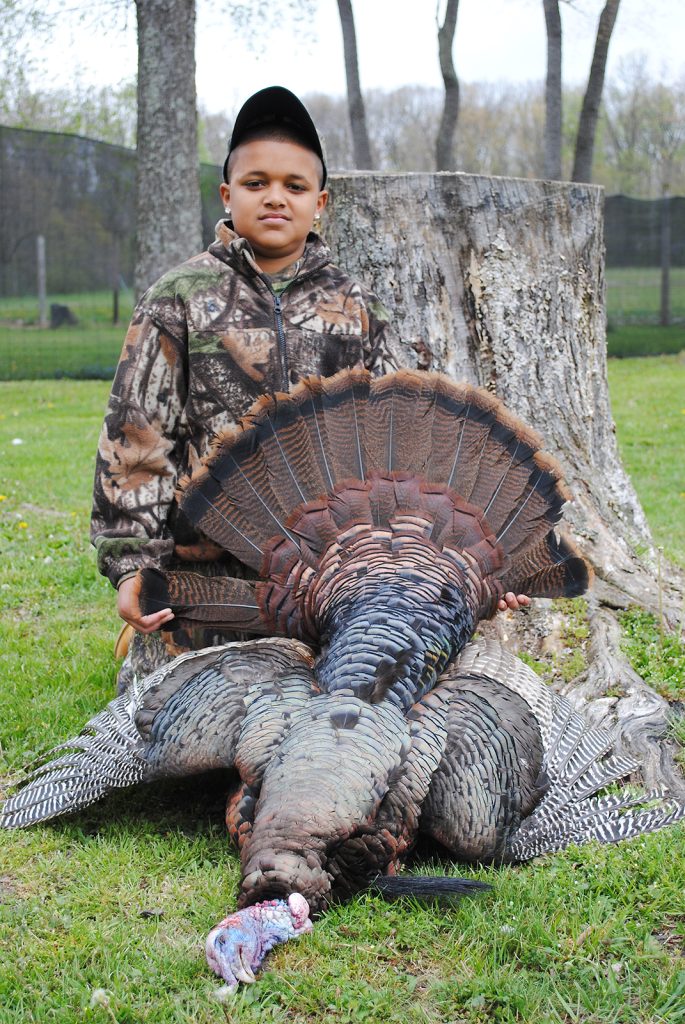
The woods in Greene and parts of Fayette County give up to hunters more spring gobblers per square mile than nearly anywhere else in the state. Jarod Davis of Uniontown got this gobbler in 2015 as part of the Wharton Township Hunting and Fishing Club’s annual youth turkey hunt.
As signs of spring go, the spring turkey hunting season is relatively new on the scene. This year’s season, which began last Saturday, is “only” the 51st in Pennsylvania history. Hunting gobblers in the spring had already been a long-established tradition in the Deep South when the Pennsylvania Game Commission authorized the first spring hunt here–one week in length–in 1968.
Before that, Pennsylvania hunters considered fall the proper time to hunt wild turkeys, but the new spring hunt was a hit from the beginning, and its popularity has never waned. About 175,000 hunters will participate in some part of the season, which ends May 31. But despite the acclaim spring gobbler hunting attracts, that’s still less than a quarter the number of hunters out in the deer season.
In the spring season, hunters try to interject themselves into the wild turkey’s courtship rites by imitating the yelps, clucks, and putts voiced by turkey hens (females) with various types of call devices. Ideally, if a gobbler hears the imitation hen vocalizations, he will gobble back a romantic response and strut in to introduce himself, with the hunter concealed nearby. But it doesn’t always happen that way. Sometimes you never hear a turkey. Sometimes you’ll hear one, but it’s too wary to approach.
Biologists estimate that something like 215,000 wild turkeys inhabit the state’s woodlands. And according to Game Commission statistics, parts of our region offer spring hunters some of the best prospects anywhere. During the past three seasons, hunters in Wildlife Management Area 2A, which includes Greene County, most of Washington County and the Fayette County lowlands, tagged 1.2 gobblers per square mile of habitat, the second greatest harvest density among the state’s 23 units.
By comparison, in the Fayette mountains, part of WMU 2C, hunters killed only about half that many gobblers per square mile (0.64) over the past three springs. Still, the ridges might be a good place to hunt because–also according to Game Commission data–the highland region has one of the lowest densities of hunters in the state, so the competition should be less. The data says that 2.6 hunters per square mile prowl the mountains here, while 3.6 hunters dot the average square mile of woods in the lowlands.
Although such statistics are important in wildlife management, they can grow tedious. But there’s nothing tedious about being out there hunting gobblers in spring. It’s a great time to be in the woods regardless of success. I was out deep in the mountains one day this week, and although the turkeys weren’t gobbling, the greening woods were full of birdsong and a varied carpet of wildflowers covered the slopes. The little trout stream that chattered below was so alluring that I might go back there with a flyrod instead of a gun and call. I also saw an adult bald eagle in a place within Fayette County where I’d never expected to encounter such a creature.
When you do encounter a gobbler, the excitement can be fast-paced. A few years back, my son Aaron was home during the season. He did some scouting high on a ridge and heard a bird gobble in the evening when it flew to its roost. Naturally, he wanted to return there next morning to hunt, but the wind was howling so hard across that ridgetop that I tried to talk him into another spot, in a hollow out of the wind. But he insisted. He’d located that turkey and he wanted to try to call it in.
We climbed up there, set up just below the ridgeline, somewhat out of the wind, and began calling. My heart wasn’t in the hunt because I thought there was no way a turkey could hear our yelps and putts in that gale, but Aaron wouldn’t give up. Suddenly, that turkey he’d heard the night before gobbled just over the crest of the ridge. It would stay silent for a while, then gobble from farther away and we’d have to coax it back. Finally, the gobbler stepped within Aaron’s range. I couldn’t see the bird at that point, but I could see Aaron nestle the gun on his knee and sight down the barrel. It seemed to take a long time for him to shoot but finally the gun boomed. Aaron was so calm and reserved that I thought he’d missed. Eventually he got up, walked a few yards to the crest, picked up his gobbler and grinned.
That remains one of the most satisfying hunts we’ve shared–satisfying for him because he’d gone out and pin-pointed the gobbler’s location then stuck with his plan despite the challenging elements. It was fulfilling for me because after a lot of coaching and “guiding” through Aaron’s youth, I got to watch my son culminate a successful hunt on his own terms.
Ben Moyer is a member of the Pennsylvania Outdoor Writers Association and the Outdoor Writers Association of America.