

Shoaf native Nagy put pro bowling on map
Submitted photo
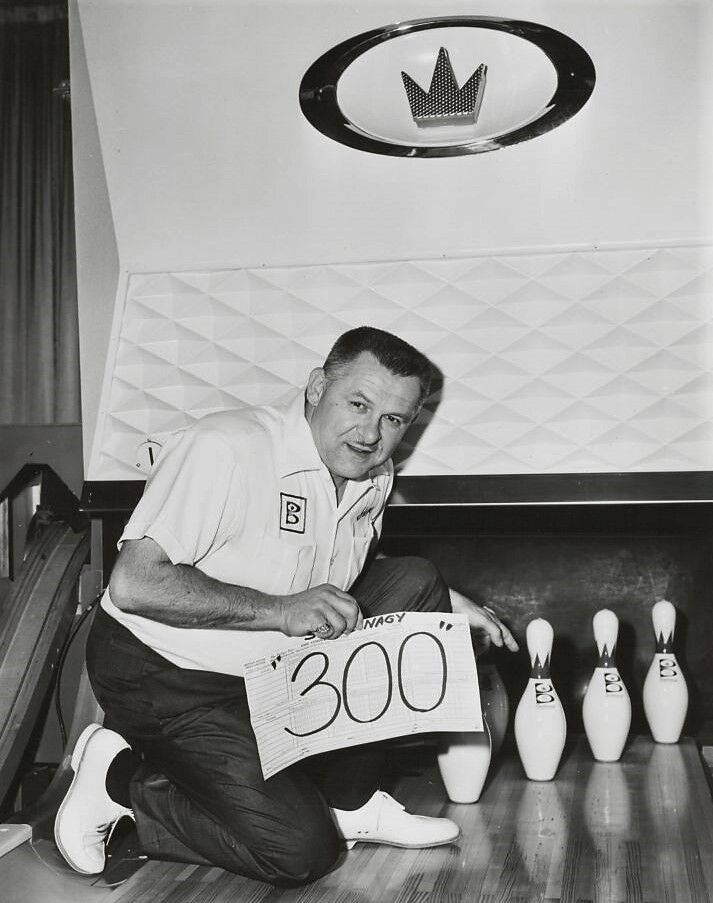
Shoaf native Steve Nagy is shown after bowling his 38th perfect game on the second night of the San Jose Open in 1961.
Submitted photo
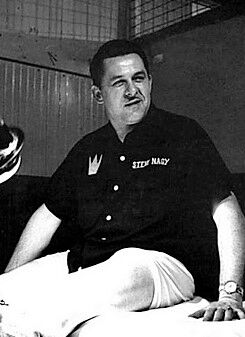
Shoaf native Steve Nagy was inducted into the Professional Bowling Association Hall of Fame in 1977. The PBA鈥檚 annual Steve Nagy 缅北禁地manship Award is named in his honor.
Pro Bowling became a staple on television in the 1950s and one the most recognized stars on the network television series Championship Bowling was big Steve Nagy who was born in Shoaf, Pa. in 1913.
Nagy is link to the heyday of bowling. Remember when there were many bowling alleys in every neighborhood? In the early 1950s in Chicago, there were 202 bowling alleys listed in the Yellow Pages phone directory. Today there are only 32 bowling centers in the immediate Chicago area.
Nagy lived with his family in Georges Township until they moved to Cleveland when he was nine years old. Nagy was one of the three sons of Hungarian immigrant parents. Always interested in athletics, Nagy had no opportunities to play sports professionally until after he became established as a cabinetmaker. Golf would remain a hobby throughout his life, but bowling would become his second career.
He got his start in bowling at Shoaf where his father managed three alleys in the basement of a church. Nagy began bowling seriously at age 26 starting in 1939 on a Booster division team in a league reserved for lower-level players. He quickly dominated his competition, however, and by 1941 he was bowling on the American Bowling Congress (ABC) professional circuit. He was competitive throughout the 1940s but stardom eluded him, and he never placed higher than third in the annual ABC All-Star competition.
Thirteen years after his first appearance in 1939, Nagy set an Open Championships doubles record (1,453) with fellow Hall of Famer Johnny Klares that stood until 1989.
Nagy was twice voted the Bowler of the Year and four times an All-American, he was ranked No. 23 among 20th Century bowlers in the Bowlers Journal poll. His tournament resume includes five ABC championships and the 1954-55 All-Star.
Big and gregarious, Nagy was a showman. Sam Levine, a great friend of Nagy鈥檚, captured some of Nagy鈥檚 lighter moments in an article in The Cleveland Kegler.
Levine wrote:
鈥淲ho will ever forget Nagy, when on a television show, after leaving a pin standing on what looked like a good hit, he pulled the belt from his trousers and gave his bowling ball a good beating.
鈥淭here was another during a head-to-head clash with George Young of Detroit. Young, also a member of the ABC Hall of Fame, was a 鈥減umper.鈥� He would stand at the foul line and pump the ball up and down and up and down numerous times. After Young had completed one of his deliveries, Nagy quipped, with tongue in cheek 鈥� 鈥榊ou know George, I notice that every time you pump the ball 12 times, you get a strike.鈥� After his next trip to the foul line, Young returned and shouted at Nagy, 鈥楧arn you Steve, now you鈥檝e got me counting.'鈥�
Another famous incident involved outstanding female bowling great Marian Ladewig.
鈥淲orking on a string of strikes on lane four, Steve fired another strike and went into his patented act. He jumped over the ball return between lanes four and three, hopped over the ball return between two and one, flew right off the edge of the lanes, kept on going past the aisle which ran along number one, went through the curtain which hung alongside the aisle, slammed through a door behind the curtain and almost wound up on the street outside the Coliseum. The great Marian Ladeweg, who was bowling on the lanes next to Nagy, broke up so much with laughter that she could hardly throw her ball.鈥�
When the network television series Championship Bowling began filming in 1954, the producers offered $1,000 to anyone who could bowl a perfect game during its telecast. In 1955 Nagy came to Chicago鈥檚 Faetz-Niesen Recreation Center, where he had never bowled, to face the reigning champion of the series, Chicago bowler Eddie Kawolics, who was a regular at Faetz. Nagy rolled a few practice games, smiled, and said to announcer Joe Wilson, 鈥淭his place gives you your confidence back.鈥�
Nagy got off to a slow start, losing the first game of the match to Kowalics. In the second game, Nagy rolled nothing but strikes. In the ninth frame, he left a 10-pin, but it fell over just in time. Nagy鈥檚 last roll was a strike, and he became the first player ever to roll a perfect game on national television (A clip of the 10th frame can be seen on YouTube, 鈥淐hampionship Bowling 鈥� Steve Nagy 300鈥�).
Nagy bowled his 38th perfect game on the second night of the San Jose Open in 1961.
He was one of the 33 founding members of the PBA, which he serve as president from 1963-1964. For many years he was part of the promotional staff of Brunswick, a bowling manufacturer, and conducted hundreds of clinics and exhibitions across the United States and Canada.
Nagy is still the only bowler featured on the cover of 缅北禁地 Illustrated. Nagy was elected to American Bowling Congress Hall of Fame, 1963.
In 1964 Nagy had a stroke and was hospitalized for six weeks. In 1965 he suffered another stroke and passed away Nov. 11, 1966 at the age of 53. He was posthumously inducted into the Professional Bowling Association Hall of Fame in 1977.
The PBA鈥檚 annual Steve Nagy 缅北禁地manship Award is named in his honor.
George Von Benko鈥檚 鈥淢emory Lane鈥� column appears weekly in the 缅北禁地. He also hosts a sports talk show on WMBS-AM radio from 10 a.m. to noon on Saturdays.