

Winter Symbol: Blue jay one of Western Pa.鈥檚 most adaptable, successful songbirds.
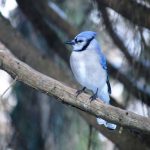
If you were assigned to pick one wild creature that symbolizes winter in our region, you could make a strong argument for the blue jay. This familiar and abundant songbird is equally at home in suburban backyards and remote forest, but thrives best along brushy woodland edges, where forest and farm mix.
Even when seen in June, the blue jay鈥檚 plumage hints of winter. The tail and wings鈥� upper surfaces flash bright blue, like the winter sky can be on our rare clear days. But most of the bird鈥檚 dress is somber, like January overcast. White on the belly blends to ash-gray on the breast and chin, ringed by a collar of black. The crest and back are blue but more subdued than the wings, mimicking evening shadows on snow.
Anyone who enjoys feeding birds in winter knows the blue jay well鈥搕oo well for some. Jays are raucous and aggressive by nature, and sometimes dominate the feeder to the exclusion of smaller birds like chickadees and finches.
Jays are intelligent birds, closely related to crows and ravens. Males and females form mated pairs that are maintained throughout life. Like their larger relatives, jays are 鈥渇ood-generalists.鈥� They eat a wide range of plant materials and insects, but a favorite natural food across their huge North American range is acorns. In early fall, jays consume many acorns as they drop from the oaks but carry off and cache many more. Blue jays can gather up to a half-dozen acorns at once, held in the throat, mouth, and bill. So laden, they fly about and bury the seeds for future use. In a study of six marked blue jays reported by the Cornell University Laboratory of Ornithology, each of the studied birds hid between 3,000 and 5,000 acorns in one autumn season.
Blue jays also cache the smaller seeds of beech trees when available. But jays never find all the seeds they鈥檝e cached; many germinate and grow into trees. In fact, oaks 鈥渄epend鈥� on jays and squirrels to disperse their seeds, which are heavy and cannot be transported by wind in the way of maple seeds. Jays are expert at selecting viable acorns that are not infested with weevils, so have a high probability of successful germination. Some ecologists credit blue jays with spreading hardwood forests across temperate North America, including western Pennsylvania, after the last glaciers retreated northward 10,000 years ago.
Many bird-lovers dislike the blue jay because, being opportunistic food-generalists, jays do sometimes raid the nests of other songbirds, preying on the eggs or nestlings. Another Cornell study, though, indicates nest-raiding by jays is less common than widely believed. Researchers examined the stomach contents of 530 blue jays and found evidence of eggshells or nestlings in only six. Acorns, seeds, and fruit dominated the ingested material.
Like crows and ravens, jays鈥� vocal sounds are amazingly varied. Most common is a harsh, slurred, nasal squawk, not dissimilar from a crow鈥檚 鈥渃aw.鈥� When the birds are relaxed, they also emit an almost musical 鈥測odel.鈥� Blue jays can even mimic the calls of other birds, particularly the high-pitched screams of hawks, and captive jays have learned to imitate human speech.
Blue jays can also communicate with their crest. They raise the crest when alarmed or to convey aggression toward rivals for food or a mate.
Jays are among those songbirds that display no visible difference between the sexes. The only visual distinction between male and female is that males average slightly larger.
The 2004-2009 Pennsylvania Breeding Bird Atlas, the published results of an exhaustive effort to document all nesting bird species, estimated 590,000 blue jays in the state. They were found to be most numerous in the mixed suburban, farm, and woodlot landscapes of southwestern and southeastern counties. Looking beyond the state, blue jays live all across southern Canada and the entire United States east of the Rocky Mountains.
As testament to the blue jay鈥檚 intelligence, I had difficulty getting a photograph to accompany this column. We have a bird feeder filled with sunflower seed hanging just beyond the porch. A mob of seven or eight jays often take over the feeder and surrounding branches. During those binges, there is never a time when a jay is not clinging to the feeder-rail, gobbling seeds.
But when I cracked the door open a mere three inches, just enough to position the camera lens in the gap, then crouched in shadow just inside, not a single jay would alight on the feeder. Eventually, one or two bold ones perched on surrounding branches, but they knew something was amiss and none would alight to eat.
Color, personality, and adaptable success are the blue jay鈥檚 trademarks, plus a knack for brightening winter days.
Ben Moyer is a member of the Outdoor Writers Association of America and the Pennsylvania Outdoor Writers Association.