

WVU coach Brown: major changes needed in college football
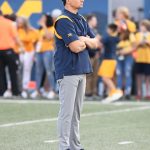
MORGANTOWN, W.Va. — When West Virginia football coach Neal Brown slides into the chair at the desk in his office, which offers a view of the playing field at Milan Puskar Stadium, it sits there among whatever clutter there is before him.
It’s a red folder that contains his team’s current depth chart, a list of high school recruits who they believe will sign this week, a list of what they are seeking to join those recruits with, potential transfer portal players they are going after, and his own scholarship roster.
“December,” he notes, “is a busy time. It’s so fluid.”
He is preparing for a bowl game, out recruiting high school kids and transfer portal potentials, both from other schools and still on his roster, figuring out his own needs and who might fill them.
Is it any wonder that he has joined UCLA coach Chip Kelly and who knows how many others in calling for an overhaul of the college football system? Unlike Kelly, he doesn’t yet have an answer to what that revision should be, but he knows it’s necessary and the more that time passes without it, the worse things keep becoming.
“I’ll put it this way … our game has a lot of issues,” he said Sunday afternoon in his pre-Duke’s Mayo Bowl press conference. “The product is still great. People are going to tune into these bowl games and they will have high ratings. The CFP will still have high ratings. It’s one of the highest spectator sports, if not the highest. But we have some issues and we have to figure it out.”
You can find numbers that argue with Brown’s assessment of the TV ratings. In 2006, the Rose Bowl between Texas and USC set the record with a rating of 21.7 and 35.6 million viewers. This last CFP championship, the 58-point blowout of Georgia over TCU, was the lowest ever with a rating of 8.7 and 17.22 million viewers.
It is so disjointed that in many ways they are starting over.
“Think about it,” Brown said. “We have a professional model but we’re still operating on an academic calendar. The two worlds are so different. We have to figure out some solutions. I don’t have one right now.”
Brown offered up one situation as an example.
“Think about the quarterback leaving Texas (Maalik Murphy). He’s having to make a decision to leave right in the middle of the CFP and I get it. He’s trying to secure a new home,” Brown said.
“Talk about December,” the coach continued. “You have guys who go in the portal and you know your roster numbers. I’m sure, after the bowl game, we’ll have a few more. I don’t know how many. The assumption is we’ll have a few more.
“So, trying to figure out the exact number of high school players to take and the exact number of portal players to take are moving targets at all times. Now, you add a second transfer period into this, you are basically saying everyone is a free agent every time the portal opens.
“Good luck.”
Brown’s immediate attention falls more upon the calendar, the transfer portal and NIL.
“I’ll say this, too,” Brown offered. “I think fans suffer because of it but to the general public it’s not an issue because the product is still good.
“Nobody gives a s-t if the coaches’ lives stink. We are well compensated and all that kind of stuff, but it’s not a good process. We have to figure something out.”
Chip Kelly has seen his UCLA team move into the Big Ten. It is a logistical and scheduling nightmare, a huge step away from what college football is really supposed to be. His plan is to scrap everything we now have and completely revise college football.
“I think football should be separate from other sports,” he has said.
It’s like Brown said on Sunday about the situation WVU is in while a member of what is a national conference. Maybe it works for football, but not other sports.
“To me, football has kind of grown into its own entity. Who are we kidding? We are going to send our soccer team to Arizona for a midweek game. C’mon. There are some real issues,” Brown said.
Kelly’s is a radical plan, but he sets it up by using Notre Dame as an example of how you can have football off alone.
“Well, Notre Dame is independent in football and they’re in a conference in everything else,” he said. “I think we should all be independent in football and you can have a 64-team conference in the Power 5 and you can have a 64-team conference in the Group of 5.”
Here is how he envisions it. Teams would have a seven-game slate against natural opponents — in his case the PAC-12 peers. In WVU’s case, it would be eastern foes like Pitt, Penn State, Maryland, Virginia Tech, Cincinnati, Louisville and Virginia.
Teams could have one rivalry game outside those seven games to keep the rivalry aspect of it — say USC and Notre Dame.
The other games would come from facing say eastern teams one year, southern teams another year and Midwestern teams another year in addition to your seven regional games.
Kelly also envisions a national TV contract, not five of them negotiated by five leagues, something along the lines of the NFL deal.
In this, he sees a chance to sell sponsorships to help create a pathway to “revenue-sharing” for paying the players.
“Not that I’ve really thought about this, not that I’ve spent a lot of time but I think if you went together collectively as a group and said there’s 132 teams and we share the same TV contract, so the Mountain West doesn’t have one and the Sun Belt another, the SEC one, we all go together,” Kelly said. “That’s a lot of games and there’s a lot of people in the TV world that would go through it.
“You can sponsor each one, instead of calling it Group of 5 or Power 5, you can call it Amazon, Nike, whatever. You can do a lot of things.”
The particulars are to be worked out, obviously, but the fact that such a radical plan is being discussed tells you we are in age crying out for transition.
“I think this needs to be done, that money now needs to be shared with the student-athletes and there needs to be revenue-sharing and the players should be paid and you can get rid of (NIL),” Kelly said. “The schools should be paying the players because the players are what the product is and the fact that they don’t get paid is really the biggest travesty.”
Make no doubt that change — big change — is in the air, but it isn’t going to come under the NCAA umbrella.